


AI for retail is moving from experiment to essential, with adoption growing faster than past technology shifts like smartphones and tablets. Retail executives now rank AI as one of the top drivers of growth and efficiency, with 97% planning to increase their AI spend in the next year.
Unlike early AI adoption that focused only on back-office automation, today’s retail AI solutions extend across the value chain: streamlining inventory, powering conversational AI in retail touchpoints, and enabling hyper-personalized customer journeys.
Generative AI in retail is also opening entirely new frontiers. Beyond writing product descriptions, retailers are deploying gen AI use cases in the retail industry for marketing content, customer-facing chat, and digital product twins that cut creative costs by up to 70%.
AI in retail drives real returns today and is quickly becoming the benchmark for long-term competitiveness, and this article shows you exactly how. I discuss its adoption rates, use cases, ethical considerations, sustainability, and future trends in this article.
AI in retail adoption
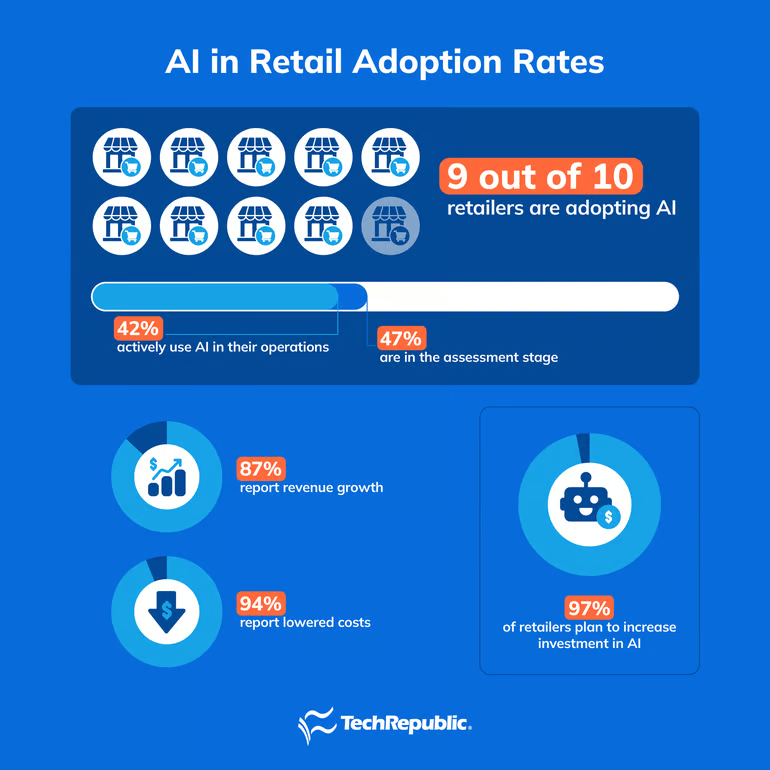
Nine out of 10 retailers are adopting AI, according to the NVIDIA State of AI in Retail and CPG: 2025 Trends Survey Report.
The survey highlights how quickly AI has moved from experimentation to necessity. Forty-two percent of retailers are actively using AI in their operations, while another 47% are in the assessment stage.
Among adopters, 87% say AI has helped increase annual revenue, and a quarter report gains of more than 20%. On the cost side, 94% say AI has reduced operational expenses, with over one in four seeing reductions greater than 20%. Looking forward, 97% of retailers plan to raise AI budgets, half of them by at least 10%.
The data shows that AI is not only improving margins but also driving measurable business growth — retailers that delay AI adoption risk falling behind competitors already benefiting from it.
Related:
Key ways AI delivers growth and efficiency in retail
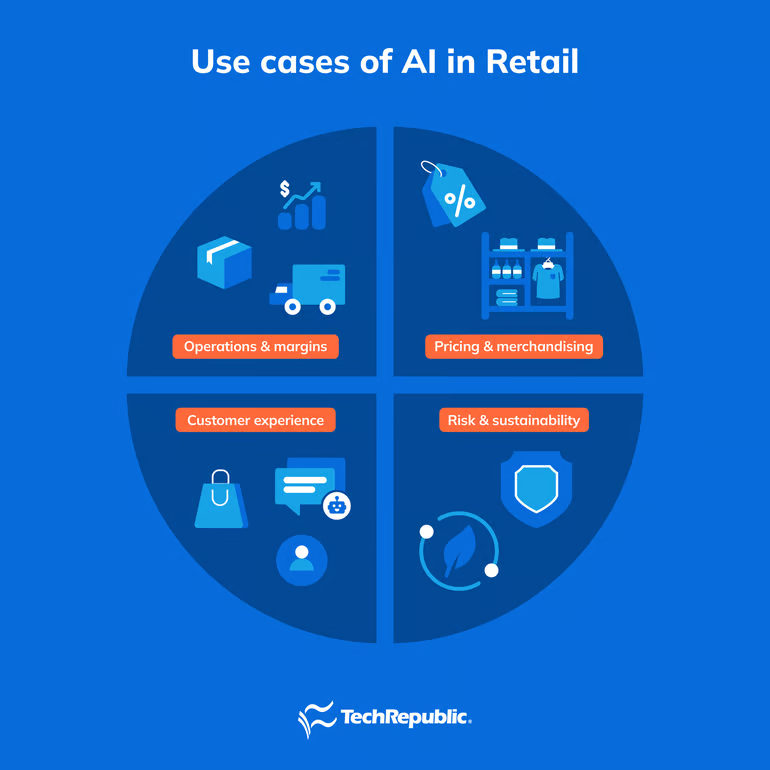
AI helps retailers cut costs, grow revenue, and improve the customer experience by optimizing operations, implementing smarter sales strategies, and reducing risk.
1. Demand forecasting
AI predicts buying patterns to align supply with demand. By analyzing sales history, seasonality, and external factors such as promotions or weather, AI generates accurate demand forecasts that reduce overstocking and prevent stockouts. Predictive analytics has long been a retail staple, but generative AI in retail is now making it even more powerful by anticipating not just what customers want today, but also what they will want next. Studies confirm this shift, as 44% of retailers cite predictive analytics as the second most popular use case in retail, according to the NVIDIA study.
In action:
- Shopify merchant Doe Beauty uses AI-driven forecasting to automate supply planning, saving $30,000 each week and four hours of manual labor.
- Target, on the other hand, has expanded its AI-powered Inventory Ledger to cover 40% of its assortment, generating billions of weekly demand predictions and sharply reducing out-of-stock incidents.
2. Inventory management
AI tracks stock in real time to reduce waste and avoid stockouts. For storefronts, computer vision, sensors, and RFID tags monitor shelves and trigger automatic restocking, reducing errors and preventing shortages or overstock. For online sales channels, AI integrates with order management systems to update counts instantly across channels, avoiding mismatches that frustrate customers.
On the logistics side, predictive systems flag when warehouses and distribution centers need replenishment, improving flow and reducing excess stock.
In action: Migros, Switzerland’s largest supermarket chain, applied AI to manage replenishment across 2,000 stores and 11 distribution centers. Within five months, it achieved 11% fewer inventory days, 1.7% higher stock availability, and 1.3% fewer lost sales.
3. Supply chain management
AI enables retail supply chains to operate faster, more resiliently, and at lower costs. AI-powered platforms analyze demand, lead times, and logistics data to optimize supplier coordination, warehouse operations, and delivery networks. This improves inventory turns, lowers shipping costs, and strengthens resilience during disruptions.
In action:
- Walmart uses AI across its supply chain to forecast demand, optimize routes, and reduce fulfillment delays, enabling faster deliveries and lower costs.
- UPS applies AI to its ORION routing system, saving 100 million miles annually and reducing fuel consumption across its delivery fleet.
Read also: How AI Drives Supply Chain Automation for Retailers Worldwide
4. Product innovation
AI accelerates product design and development while reducing waste. Generative AI tools allow retailers to design new products, test prototypes digitally, and predict which features will resonate with customers. This shortens development cycles, reduces reliance on physical samples, and helps brands align with sustainability goals.
AI-driven product innovation enables brands to shorten design cycles, reduce prototyping costs, and bring consumer-informed products to market more quickly.
In action:
- Levi Strauss & Co. trained employees in machine learning through its in-house bootcamp, leading to AI-driven design breakthroughs. One designer enhanced a neural network to define garment features and merge them with art-inspired references, creating thousands of new Trucker jacket variations in seconds. A companion computer vision tool also automated thread color matching — eliminating hours of manual work.
- Nike applies AI to product development by analyzing performance data from athletes and consumer feedback. Insights are used to inform the design of footwear and apparel, ensuring new products optimize comfort and performance while also reflecting emerging style preferences.
5. Product mix optimization (assortment planning)
AI balances the product mix to maximize sales and profitability. Retailers use AI to analyze customer demographics, local demand signals, and sales data to determine which products to stock and in what quantities. In storefronts, this helps identify underperforming SKUs and shift shelf space toward higher-margin items. In ecommerce, recommendation engines act as assortment planners, highlighting which products to feature, bundle, or discount to increase conversions.
In action:
- Levi’s adopted an AI-powered forecasting and assortment system that integrates sales, promotions, weather, and social data. The system detects regional demand for specific SKUs and redistributes stock accordingly, cutting inventory costs, reducing markdowns, and improving availability of high-demand sizes.
- Macy’s deployed advanced forecasting algorithms as part of its Polaris Strategy, allowing it to avoid the inventory glut faced by competitors. In Q2 2022, Macy’s inventory rose just 7% year-over-year, compared with +36% at Target and +48% at Kohl’s, thanks to AI-driven demand and assortment planning.
These examples show how AI-powered product mix optimization reduces waste, minimizes markdowns, and ensures customers find the right products where and when they need them.
6. Price optimization
AI-driven pricing engines analyze demand, competitor pricing, inventory levels, and even customer behavior in real time. This allows retailers to set the optimal price at any given moment — keeping products competitive without eroding profitability. This dynamic pricing strategy helps retailers capitalize on peak demand, clear slow-moving inventory, and even personalize offers for loyal customers. The results are higher conversion rates, stronger margins, and pricing strategies that adapt as fast as consumer expectations.
In action:
- Amazon is the benchmark for AI-powered dynamic pricing, adjusting millions of product prices multiple times a day based on demand and competitor conditions, a strategy credited with strengthening its ecommerce dominance.
- Walmart is rolling out digital shelf labels (ESLs) to 2,300 stores by 2026, enabling price changes up to six times per hour. This not only automates markdowns and reduces labor costs but also allows for real-time adjustments tied to demand, promotions, or expiration dates.
7. Merchandising
AI-powered merchandising increases sales by optimizing product placement, promotions, and digital displays across storefronts and online channels.
In brick-and-mortar storefronts, AI tools like computer vision and heat mapping track how shoppers move, which items draw attention, and what products get picked up or ignored. Retailers use these insights to adjust layouts, endcaps, and promotions — ensuring the right items are featured at the right time.
Online, AI merchandising engines personalize product displays, recommend complementary items, and dynamically promote inventory based on shopper intent. This alignment helps retailers increase engagement, reduce markdowns, and lift conversion rates.
In action:
- Walmart used AI and computer vision to monitor shelf conditions and guide placement, ensuring promotional products are always stocked and visible during the holiday season.
- Luxury fashion retailer Antonioli leveraged Shopify’s AI-driven merchandising to unify ecommerce and warehouse management, automatically enrich product data, and create dynamic, personalized collections for international customers (Shopify).
AI-driven merchandising ensures retailers maximize every square foot of shelf space and every pixel of screen space — turning shopper behavior data into actionable data to increase sales.
8. Personalization
Forty-two percent of retailers already use generative AI for personalized marketing and advertising, and 64% of digital retailers apply it for hyperpersonalized recommendations, according to the NVIDIA study.
AI personalization fine-tunes how retailers engage customers, ensuring every interaction feels relevant. By analyzing browsing history, purchase behavior, and loyalty program data, AI delivers targeted messages, dynamic offers, and individualized marketing campaigns.
In stores, clienteling apps equip associates with insights into a shopper’s preferences, while online platforms deliver tailored landing pages, emails, and app notifications. The result is stronger loyalty, higher conversion rates, and improved lifetime value.
In action:
- Levi’s uses AI-powered personalization engines like its “Style Finder” to guide customers toward jeans and outfits aligned with their preferences, improving satisfaction and conversion.
- Stitch Fix integrates AI into its subscription service to personalize communication and customer experiences, which drives retention and increases purchase frequency.
- Shopify merchant BÉIS implemented Nosto, an AI personalization app, to time targeted campaigns with shoppers’ peak buying moments, fueling the brand’s double-digit growth.
9. Product recommendations
AI suggests products in real time to increase basket size and conversions. Recommendation engines process customer behavior, cart contents, and browsing data to serve up relevant upsell and cross-sell options. This is usually seen in online stores, but in physical retail, kiosks and mobile apps provide similar recommendations based on purchase history. This increases not only revenue per customer but also the likelihood of discovery across a retailer’s full catalog.
In action:
- Amazon attributes up to 35% of its revenue to AI-powered recommendation systems that influence both upselling and cross-selling.
- Sephora integrates AI-driven recommendations into its app and in-store kiosks, guiding customers to complementary products, such as skincare that pairs with chosen makeup, boosting add-on sales.
10. Frictionless shopping and checkout
AI powers cashierless stores and frictionless transactions. Computer vision and sensor-based AI systems enable customers to walk in, pick up items, and walk out without waiting in line. In ecommerce, AI enhances checkout through automated payment verification, fraud detection, and one-click ordering. This reduces friction, improves satisfaction, and increases transaction volume.
Frictionless checkout reduces cart abandonment, both in-store and online, while streamlining the overall shopping experience.
In action:
- Amazon Go pioneered AI-powered cashierless stores, where cameras and sensors automatically charge customers as they exit, eliminating checkout lines.
- Circle K has partnered with Standard AI to roll out AI-driven autonomous checkout in select convenience stores, reducing wait times and labor costs.
11. Chatbots and conversational AI
AI-powered chatbots provide 24/7 support and reduce wait times. Natural language processing (NLP) allows conversational AI in retail to handle routine customer queries instantly, from order tracking to return policies. This improves service availability, reduces call center costs, and frees up human agents for more complex interactions.
Chatbots extend customer service capacity while maintaining a consistent brand voice across digital touchpoints.
In action:
- Levi’s introduced AI-driven chatbots across its website, mobile app, and social platforms to handle over 60% of customer inquiries, reducing response times from minutes to seconds.
- H&M uses AI chatbots on messaging apps to assist shoppers with product searches, recommendations, and order tracking, enhancing convenience and engagement.
12. Marketing and advertising
AI optimizes campaigns to reach the right audience at the right time. By analyzing customer data, browsing behavior, and real-time trends, AI helps retailers allocate budgets more effectively and personalize ad creative. This reduces wasted spend and improves campaign ROI across channels like search, social, and display.
In action:
- Coca-Cola has used AI to create large-scale personalized marketing experiences. During the FIFA World Cup, the company generated more than 120,000 customized videos that incorporated consumers’ names and photos into branded content shared across digital platforms. The campaign boosted interaction and visibility during one of the world’s most-watched events. They also introduced the “Create Real Magic” platform, where users could generate personalized greeting cards by reimagining iconic brand imagery with AI tools.
AI-powered advertising ensures brands maximize return on marketing investment while delivering more relevant messages to shoppers.
13. Content creation (images, text, video, music)
AI generates creative assets that scale faster than traditional production. Generative AI tools help retailers create product descriptions, promotional images, videos, and even music for campaigns. This reduces production costs, shortens timelines, and enables highly tailored creative at scale.
AI-driven content creation lets retailers test, scale, and personalize creative output with speed that traditional workflows can’t match.
In action:
- Nestlé launched an AI-powered content service that creates “digital twins” of products like Purina, Nescafé Dolce Gusto, and Nespresso. Built on NVIDIA Omniverse, the system enables the company to generate high-quality ecommerce and marketing assets at scale, reducing content production time and costs by more than 70%, while supporting 250 marketers and 45 content studios worldwide in delivering localized campaigns.
14. Visual search and curation
AI enables shoppers to find products instantly with images instead of text. Computer vision tools allow customers to upload photos or screenshots and receive instant matches from a retailer’s catalog. In merchandising, AI also curates product collections based on shopper preferences or visual themes, improving discovery and engagement.
Visual search shortens the path to purchase, while AI-powered curation increases basket size by surfacing relevant products.
In action:
- ASOS uses AI-powered visual search in its app, letting customers upload outfit photos to find similar products instantly.
- Pinterest’s Lens tool powers image-based search, driving significant ecommerce referrals through visually matched shopping suggestions.
15. Sentiment analysis
AI-powered sentiment analysis helps retailers track customer opinions in real time, manage brand reputation, and boost loyalty. Natural language processing (NLP) tools analyze customer reviews, social media posts, and survey feedback to identify satisfaction trends and flag potential issues. Retailers use these insights to adjust service, marketing, and product decisions in real time.
AI-powered sentiment analysis gives retailers actionable insights to refine campaigns, strengthen relationships, and safeguard their brand reputation.
In action:
The following examples are case studies about AI-powered sentiment analysis:
- Domino’s Pizza used sentiment analysis to monitor a viral food safety crisis. By analyzing social chatter and responding to more than 10,000 customer posts in 24 hours, the brand restored trust and improved positive sentiment by 20% in one week.
- Nike applied sentiment analysis to monitor brand perception among younger demographics, leading to a 15% increase in positive sentiment and a 25% jump in engagement within six months.
- Coca-Cola leveraged AI to track competitors like Pepsi and Dr Pepper, increasing its own social engagement by 20% and improving sentiment by 10% in three months.
- Starbucks used sentiment analysis to uncover product and service feedback, achieving a 15% increase in positive sentiment and a 25% boost in engagement and loyalty over six months.
16. Fraud detection, loss prevention, and security
AI protects profits by detecting fraud, theft, and suspicious activity in real time. Computer vision, transaction monitoring, and anomaly detection systems help retailers reduce shrink, prevent fraudulent transactions, and secure both physical and digital storefronts. These tools work across POS systems, ecommerce checkouts, and in-store surveillance, identifying risks faster than human teams alone.
In action:
- Walmart applies computer vision and AI monitoring to its checkout systems to detect theft and reduce shrink, a key driver behind its improved loss prevention efforts.
- Amazon integrates AI-driven fraud detection across its marketplace, analyzing billions of transactions daily to block fake accounts, fraudulent reviews, and suspicious purchases.
Related:
- IDC perspective: AI Use Cases in Retail: Automating the Automatable Versus Doing What Humans Can’t
- AI in E-commerce: The Ultimate Guide to Growth & Automation
Ethical AI and customer privacy
While 64% of consumers prefer personalized experiences, nearly 70% are concerned about how their data is used — highlighting a critical tension between personalization and trust.
AI in retail must address this tension by balancing data-driven personalization with fairness, data privacy, and transparent practices. Consumers value tailored experiences, but only when brands protect their information and act ethically. Retailers must ensure AI systems treat all users fairly, operate transparently, and maintain consumer trust as they scale.
Bias in recommendations
AI systems trained on skewed or limited datasets can produce unfair or unbalanced outputs, favoring certain products, demographics, or price ranges. Retailers must audit for bias, ensure diverse training data, and continuously test algorithms to prevent reinforcing historical inequities.
Transparency and regulation
Consumers and regulators increasingly demand clarity around how AI systems work. Frameworks like the EU’s AI Act and evolving privacy laws (e.g., GDPR, CCPA) require retailers to clearly disclose data collection practices, document decision logic, and uphold consumer rights. Proactive transparency safeguards brand reputation and reinforces consumer trust.
Building customer trust while scaling AI
Empowering consumers with control, through consent mechanisms, opt-outs, and anonymized data usage, strengthens loyalty. Techniques such as on-device processing and data anonymization enable personalization while keeping sensitive data secure. Retailers that prioritize transparent and respectful AI are more likely to retain long-term customer confidence.
In action:
- Apple delivers on-device personalization. Recommendations are processed locally rather than in the cloud, limiting external data exposure and increasing user privacy (Apple Privacy).
- Carrefour in Europe emphasizes clear consent processes and GDPR-aligned loyalty programs, demonstrating that regulatory compliance and AI scalability can coexist.
AI for sustainability beyond supply chains
Retailers are extending AI adoption to cut emissions, reduce waste, and design greener operations that customers increasingly demand.
Sustainability is no longer just about logistics. It now touches packaging, store operations, and the customer lifecycle. AI gives retailers the ability to measure environmental impact in real time and adjust processes to lower their footprint while maintaining efficiency and profitability.
Smarter packaging design
AI models simulate packaging choices to minimize material use without sacrificing durability. Retailers and CPG brands use algorithms to optimize box sizes, reduce filler material, and design packaging that is easier to recycle. This not only lowers carbon emissions from transport but also meets growing consumer expectations for sustainable packaging.
Energy efficiency in stores and warehouses
AI-powered systems analyze energy usage across lighting, refrigeration, and HVAC systems, automatically adjusting to lower consumption during off-peak hours. Large retailers deploy predictive algorithms to anticipate demand spikes and optimize energy-intensive processes such as cooling and heating, helping cut operating costs while shrinking emissions.
Reducing returns-related waste
Returns are a major source of retail waste, with billions of pounds of goods ending up in landfills annually. AI helps by improving product recommendations, sizing accuracy, and quality control — reducing the number of items that need to be sent back in the first place. For returned items, AI-driven logistics platforms determine the fastest, most sustainable resale or recycling path.
The future of AI in the retail industry
AI is fundamentally changing how businesses operate and how customers shop, with adoption outpacing smartphones and tablets. As a core technology for retail’s next era, AI is no longer just about efficiency — it’s becoming a strategic engine for personalization, automation, sustainability, and competitive advantage.
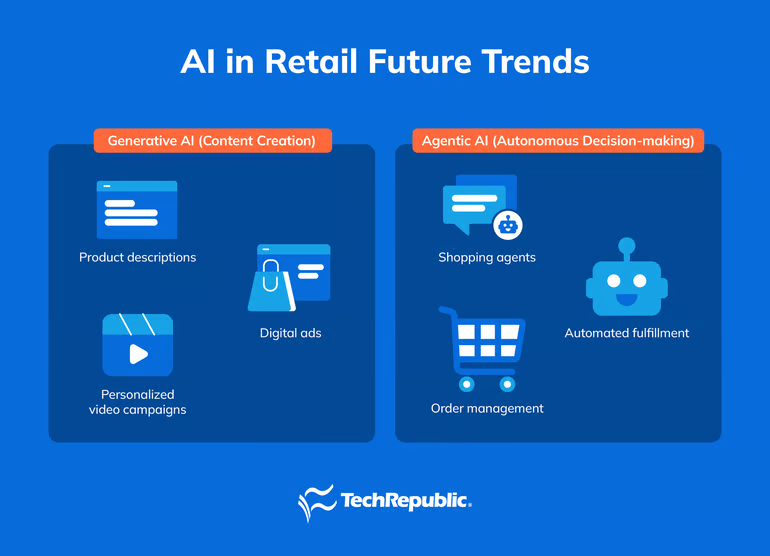
This year, AI in retail is all about agentic AI. Agentic AI moves beyond automation to autonomous decision-making. These AI “agents” manage tasks like price adjustments, product comparisons, or inventory restocking on behalf of customers and employees.
In action:
- Walmart is piloting agentic AI assistants to automate customer inquiries and ecommerce workflows.
- Amazon continues to expand Alexa’s role as a personal shopping agent, capable of suggesting, comparing, and purchasing items across categories.
Related: Special report: Data, AI, IoT: The future of retail (free PDF)
AI in retail is a competitive necessity
AI and retail are becoming inseparable. Companies that delay adoption risk falling behind on costs, innovation, and customer loyalty. The retailers that win long-term will be those that embrace AI strategically, deploying solutions that create customer value, support sustainability goals, and maintain ethical standards. As AI technology continues to advance, it will unlock new ways to optimize operations, strengthen loyalty, and fuel sustainable growth.