
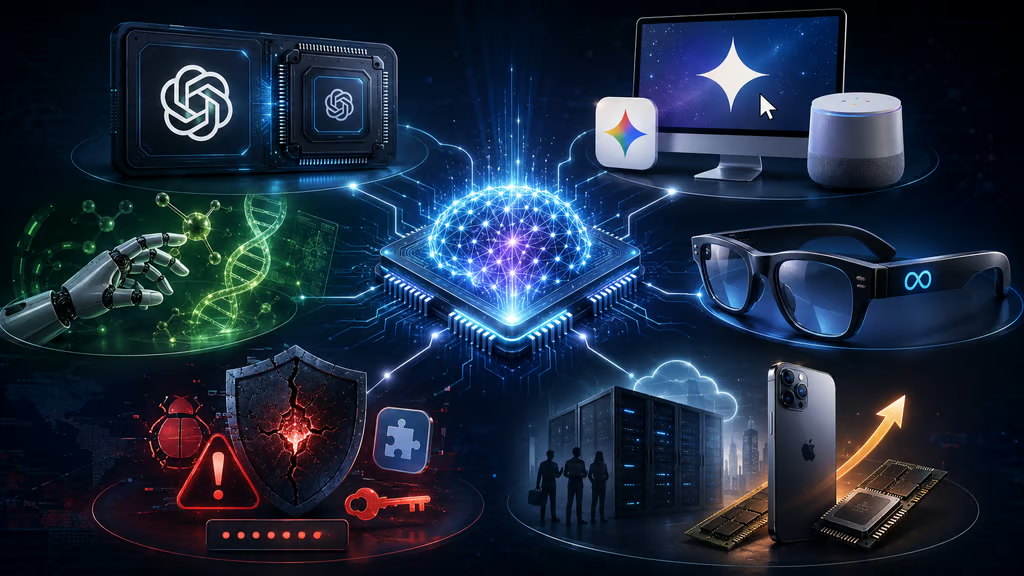


AI was everywhere this week, from smarter chatbots and desktop-controlling models to Nvidia tools built for drug discovery and robot safety. But the week was not all shiny demos and future-of-work optimism. The same tech boom also brought browser hijacks, ransomware leaks, supply-chain scares, and enough password exposure to make “use a passkey” sound less like advice and more like a survival strategy.
Meanwhile, Apple, Amazon, Meta, Google, Microsoft, Oracle, and others showed how AI is reshaping hardware, commerce, pricing, security, and corporate strategy all at once. Convenient? Sometimes. Expensive? Increasingly. Weirdly dystopian? Let’s call it “eature-rich.”
Top news
AI platforms and tools take center stage
OpenAI released a major update to GPT-5.5 Instant, enhancing its ability to follow user instructions, integrate text and images, and deliver more accurate responses. The update coincides with the company’s announcement of the Jalapeño inference chip, designed for faster processing. Meanwhile, Google expanded its Gemini 3.5 Flash model with native desktop control capabilities, signaling a new phase of multimodal AI integration.
Nvidia introduced the BioNeMo Agent Toolkit to empower AI agents in genomics, chemistry, and drug discovery. The toolkit integrates multiple Nvidia technologies and is already being adopted by major research institutions to accelerate R&D breakthroughs.
Hardware and consumer tech updates
Microsoft extended its Windows 10 Extended Security Updates program until October 12, 2027, giving users another year of free or low-cost patches. The move is intended to ease the transition to Windows 11 amid hardware upgrade hesitations.
Google launched the $99 Gemini-powered Home Speaker, its first new model in six years. The device replaces the Nest Mini and Nest Audio, offering AI-driven features through a Google Home Premium subscription and supporting Wi-Fi 6, Bluetooth 5.4, Matter, and Thread 1.3.
Meta unveiled its first in-house smart glasses, starting at $299. The glasses feature 12 MP cameras, open-ear speakers, and AI-powered functions like live translation and object recognition, aiming to make smart eyewear mainstream despite privacy concerns.
AI meets commerce and media
Meta is also testing an experimental app called Arena, which allows users to wager virtual currency on future events. Powered by Meta’s Llama AI, the app automatically generates questions and settles outcomes, blending social prediction markets with generative AI.
Getty Images signed a multiyear deal with OpenAI to integrate its licensed photos into ChatGPT search results. The agreement marks a major shift from Getty’s earlier legal disputes with AI firms and comes amid a pending $3.7 billion acquisition of Shutterstock.
Retail and pricing trends
Amazon kicked off its four-day Prime Day sale a month early, responding to inflation and shifting consumer priorities toward essentials. Analysts expect over $21 billion in sales, though cybersecurity experts warn of increased phishing and fake domain scams.
Apple warned that rising DRAM and NAND prices, driven by AI data center demand, will push iPhone prices higher. Analysts predict the next iPhone Pro could cost up to $1,399, with Apple considering supplier funding to stabilize component output. Shortly after that, Apple raised prices on Macs, iPads, and other devices by up to 67% due to soaring memory costs driven by AI data center demand. The hikes led to a 6.1% drop in Apple’s stock and are expected to ripple across the PC industry.
Privacy and safety developments
Nvidia also launched Halos for Robotics, a full-stack safety system designed to help humanoid and industrial robots operate safely around humans. The system adapts autonomous vehicle safety technology for factory and warehouse environments.
Apple will unify its Sign in with Apple and Hide My Email services under the private.icloud.com domain later this summer. The change simplifies management but may make Apple aliases easier to identify and block, prompting developers to adjust validation systems.
Insider intel
IBM partnered with OpenAI through the Daybreak Cyber Partner Program to launch a managed security service that uses OpenAI models to detect and verify exploitable software flaws. The initiative aims to strengthen open-source supply chains and counter AI-driven cyber threats via Project Lightwell.
Security alerts
Malware and exploits
Researchers found that the Adblock for YouTube Chrome extension, with over 10 million installs, contained hidden code capable of injecting JavaScript and hijacking browser sessions. Users are urged to uninstall it immediately.
Gaslight, a new macOS backdoor linked to North Korea, evades AI-based analysis by using fake crash messages. It steals browser data and credentials via Telegram, though Apple’s XProtect now blocks it.
Researchers also revealed an unpatchable SecureROM vulnerability dubbed “usbliter8,” affecting Apple A12 and A13 devices. The flaw allows attackers with physical access to hijack devices before iOS loads, though the Secure Enclave remains secure.
AI and cyberdefense
Anthropic’s Mythos AI identified vulnerabilities in classified US government systems during controlled testing. The discovery underscores the growing role of AI in both offensive and defensive cybersecurity operations.
Supply chain and data breaches
Tata Electronics confirmed a ransomware attack that leaked 630 GB of data, including Apple and Tesla manufacturing files. The breach exposed over 200,000 files containing trade secrets and personal data.
LastPass was affected by a supply-chain breach at Klue, exposing customer contact and support data. Although encrypted vaults were not compromised, the incident highlights the risks of shared credentials across SaaS ecosystems.
ClawHub removed 23 impersonating plugins that used deceptive names like @openclaw and @clawhub. While no malicious code was found, the plugins had broad system access, prompting new namespace dispute policies to prevent future supply-chain risks.
Ransomware and credential threats
Prinz Eugen, a new Go-based ransomware, targets recently modified files and deletes originals after encryption. It spreads via stolen RDP credentials and legitimate IT tools, leaving no ransom note behind.
FortiBleed, a Russian-linked campaign, compromised over 70,000 Fortinet firewalls and VPN gateways across 194 countries by exploiting weak password hashes. Administrators are urged to reset credentials, enable MFA, and patch FortiOS immediately.
Have I Been Pwned added 124 million unique passwords and 56 million email addresses from infostealer-infected devices, urging users to check exposure and adopt passkeys or two-factor authentication.
Industry shakeups
Corporate restructuring and investment
Oracle announced 21,000 job cuts — 13% of its workforce — as part of a $70 billion AI and cloud infrastructure restructuring. The company faces mounting debt and negative cash flow while expanding data centers for clients like OpenAI and Meta.
Berkshire Hathaway invested $10 billion in Alphabet to bolster its AI infrastructure expansion. The move, led by CEO Greg Abel, signals a strategic pivot toward advanced technology investments despite internal challenges at Google.
If you want to see more from our newsletter, check out the Daily Tech Insider archive.