


Starting an e-commerce business is easy, but creating a highly profitable and lasting e-commerce business is another. Learn how to start an e-commerce business in this guide.
Key takeaways:
|
E-commerce is the driving force of global retail. By 2027, online shopping is expected to account for nearly a quarter of all global retail sales, up from 19% in 20231, and global e-commerce sales are forecast to surpass $8 trillion2, a testament to its explosive growth.
With 2.77 billion online shoppers worldwide in 20253 — a whopping third of the global population — digital commerce has become the preferred way to shop. In the US alone, online shoppers have increased by 8.1% year-over-year to 270.11 million4 and are projected to keep rising.
As inflation, supply chain shifts, and evolving consumer expectations reshape the market, businesses of all sizes — SMBs, direct-to-consumer brands, digital-first startups, and B2B businesses — should be wise to seize these new opportunities.
Success in this rapidly expanding space demands strategic business models, efficient fulfillment, and optimized digital marketing. In this guide, I provide expert insights into launching and scaling an e-commerce business in 2025.
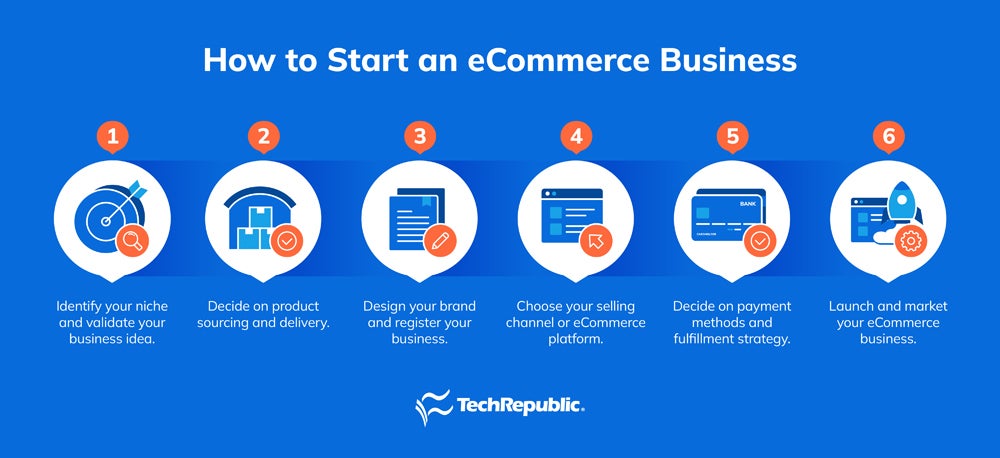
- Step 1: Identify your niche and validate your business idea.
- Step 2: Decide on product sourcing and delivery.
- Step 3: Design your brand and register your business.
- Step 4: Choose your selling channel or e-commerce platform.
- Step 5: Decide on payment methods and fulfillment strategy.
- Step 6: Launch and market your e-commerce business.
- Frequently Asked Questions (FAQs)
Step 1: Identify your niche and validate your business idea.
A successful e-commerce business starts with a great product idea, and the foundation of this is zeroing in on a target audience and selecting a niche. While it might seem counterintuitive to niche down, a well-defined niche actually helps refine your product selection and brand positioning. In the same way, narrowing down your audience makes it easier to offer products that resonate, rather than selling a broad range of generic goods. A clear understanding of your ideal customer ensures effective marketing and higher sales.
To identify your niche product and validate its sellability:
- Find product opportunities: Start by researching trending products using tools like Google Trends, Amazon Best Sellers, and social media platforms like Instagram and TikTok. Look for gaps in the market where demand is high but supply is limited. Browse niche forums and online communities to identify common pain points that potential products can address. Additionally, considering personal interests and expertise can provide a unique advantage when selecting a product category.
- Evaluate your idea: Once you have a product idea, validate its potential by conducting thorough market research. Create surveys and polls to gather feedback from potential customers. Use tools like Google Keyword Planner to analyze search volume and demand. Calculate the cost of production, marketing, and shipping to determine profit margins. Testing the idea with a small batch or pre-order campaign is also helpful before committing to large-scale production.
- Understand and study competition: Assess the competitive landscape by analyzing existing businesses offering similar products. Identify their strengths, weaknesses, pricing strategies, and customer reviews. Use competitive analysis tools such as SEMrush, Ahrefs, and SimilarWeb to gain insights into their online performance and marketing strategies. Differentiate your brand by offering unique value propositions such as superior customer service, eco-friendly packaging, or exclusive product bundles.
Decide on an e-commerce business model.
Along with a product idea, choosing the right e-commerce business model is also crucial as it defines how you manufacture, deliver, and sell your products or services. Whether you have a business idea first or prefer to choose a model and then find a business idea that fits, the key is defining a structure that supports long-term growth.
There are several popular models to consider:
| E-commerce business model | Revenue streams | Operational dynamics |
|---|---|---|
| Business-to-Customer (B2C) The most common model, where businesses sell products directly to consumers (e.g., Amazon, Walmart) | Product sales, upselling, cross-selling, membership subscriptions | Requires effective marketing, customer acquisition strategies, and optimized logistics for fast delivery |
| Business-to-Business (B2B) Companies sell goods or services to other businesses, often in bulk or recurring transactions (e.g., Alibaba, wholesale suppliers) | Bulk orders, long-term contracts, wholesale pricing structures | Focuses on repeat orders, customer relationship management, and account-based sales approaches |
| Customer-to-Customer (C2C) Online marketplaces where consumers sell to other consumers (e.g., eBay, Etsy) | Transaction fees, listing fees, premium memberships | Marketplace moderation, user verification, and dispute resolution systems are key |
| Customer-to-Business (C2B) Individuals provide goods or services to businesses (e.g., freelancers on Upwork, influencers working with brands) | Service commissions, freelance project fees, influencer marketing collaborations | Requires a platform that connects individuals with businesses and ensures smooth transactions |
To choose the right business model, analyze how similar businesses operate and identify opportunities for improvement. Understand customer needs — whether they prioritize affordability, fast shipping, or personalized products. And experiment with business models, marketing tactics, and fulfillment methods to optimize profitability and efficiency over time.
Write a business plan.
Writing a business plan helps clarify how your business will generate revenue and scale. Many business plans are available for startups, B2Bs, and technology-based or industry-disrupting businesses. Overall, regardless of the type of business plan you create, it needs to have the following sections specific to e-commerce businesses:
- Problem statement: Identify one to three major problems your business aims to solve. Highlight existing businesses that currently address these issues.
- Solution: Describe the key features of your product or service and explain how they directly solve the problems outlined in the previous section.
- Key metrics: List the performance indicators measuring business growth and success. Common KPIs include customer acquisition cost, lifetime value, retention rates, and sales per customer.
- Unique value proposition (UVP): Clearly define what sets your business apart from competitors and why customers should choose your product or service.
- Unfair advantage: Outline the aspects of your business that competitors cannot easily replicate — proprietary technology, exclusive partnerships, or unique expertise.
- Channels: Identify the pathways to reach your target customers, such as direct sales, social media, partnerships, government contracts, or e-commerce platforms.
- Customer segments: Define the key customer groups that will benefit from your business. Include a brief profile of your likely early adopters.
- Cost structure: List the major fixed and variable expenses associated with launching and operating your business, such as permits, licenses, rent, marketing, and salaries.
- Revenue streams: Outline how your business will generate revenue, whether through subscriptions, direct sales, consulting fees, licensing, e-commerce sales, or other methods.
Step 2: Decide on product sourcing and delivery.
Once you have identified a niche product and decided on a business model, the next step is to decide where to source your products and how to deliver them. This will involve determining whether you will manufacture, wholesale, or dropship your products, researching suppliers, negotiating costs, and ensuring product quality meets customer expectations.
Product delivery and sourcing methods.
You have several options for sourcing products:
- Resell existing products: Procure products from suppliers and resell them for a profit. Use online directories to find reliable vendors and negotiate supply agreements.
- Create or build products: Maintain control over design and quality by making products yourself. This approach works well for handmade, artisanal, or premium-priced goods.
- Use dropshipping or print-on-demand: Reduce inventory risks by having a third-party supplier handle storage and fulfillment. Print-on-demand is ideal for custom designs like T-shirts or books.
- Work with a manufacturer: If creating a unique brand, consider partnering with a manufacturer. Request samples, evaluate production capacity, and have backup suppliers to prevent stock issues.
Here are some delivery and sourcing models an e-commerce business falls under:
| Product delivery and sourcing model | Revenue streams | Operational dynamics |
|---|---|---|
| Direct-to-Consumer (D2C) Sell your own products directly to customers without intermediaries | Direct sales, exclusive product launches, limited edition releases | Focuses on branding, customer experience, and strong digital marketing strategies |
| Dropshipping Partner with suppliers who handle inventory and shipping while you manage the storefront | Markup pricing on supplier products, affiliate commissions | Low inventory risk, supplier dependency, and high competition require strong niche targeting |
| Wholesaling Purchase products in bulk at a discount and sell them at a markup | Bulk sales, volume-based pricing, repeat orders | Requires efficient inventory management and long-term supplier relationships |
| White Label Rebrand generic products as your own for resale | Branded product sales, private brand partnerships | Involves working with manufacturers to create generic products customized with unique branding |
| Private Label Hire a manufacturer to create exclusive products for your brand | Exclusive product sales, brand licensing | Requires higher initial investment but offers greater brand differentiation and market control |
| Subscription Offer recurring deliveries of products like pet food or beauty boxes | Recurring payments, tiered membership pricing | Focuses on customer retention, value-added services, and automated fulfillment |
Choosing the right suppliers for products.
Finding the right suppliers is essential for ensuring product quality, cost-effectiveness, and timely deliveries. B2B businesses should plan for an extended vetting process to secure reliable partners.
- Research competitors: Purchase competitor products or analyze product labels to find supplier information.
- Use Alibaba and supplier directories: Platforms like Alibaba allow you to suppliers to be filtered based on price, minimum orders, and ratings. Dedicated directory services can also help you find US-based suppliers.
- Attend trade shows and wholesale marketplaces: Events provide hands-on product evaluations and networking opportunities with manufacturers.
- Consider private label manufacturing: Custom branding on manufactured products strengthens brand identity and reduces price competition.
Selecting the right suppliers and sourcing methods is crucial to ensuring product quality, profitability, and business sustainability. With your sourcing and delivery methods established, the next step is building your brand and registering your business for compliance.
Step 3: Design your brand and register your business.
Once you have ironed out your product validation and sourcing process, it’s time to make things formal — build a brand identity and register your e-commerce business.
Design your brand.
Branding is the process of creating a unique identity for a business that differentiates it from competitors and builds customer trust. It includes visual elements such as logos, color schemes, typography, as well as messaging, brand voice, and overall customer experience.
To build a successful e-commerce brand, a business must develop a cohesive identity that reflects its values, resonates with their audience, and creates a memorable experience. Some essential branding elements every e-commerce business should focus on are the following:
- Brand name and logo: Choose a simple, versatile, and visually appealing logo that aligns with your brand identity. Ensure the name is easy to spell, pronounce, and available for domain registration.
- Brand mission and values: Your mission statement defines your business’s purpose, while brand values communicate what your business stands for.
- Target audience and buyer personas: Your target audience consists of the customers most likely to buy your products, while buyer personas represent detailed profiles of these ideal customers. Research customer demographics, preferences, and behaviors to create personas that help tailor your messaging, products, and marketing strategies effectively.
- Brand voice and messaging: Your brand voice defines the personality and tone of your communication, ensuring consistency across all customer interactions. Whether professional, friendly, authoritative, or playful, maintain a consistent tone that resonates with your target audience and reinforces your brand identity.
- Visual identity (colors, typography, and design): A cohesive visual identity, including color schemes, fonts, and design elements, enhances brand recognition and professionalism. Choose colors that evoke emotions aligned with your brand values, select readable fonts, and maintain consistency across all platforms and materials.
- Website and user experience (UX): Your website is the core of your e-commerce business, and a seamless user experience ensures visitors can navigate, browse, and purchase easily. Prioritize mobile responsiveness, fast load times, and a frictionless checkout process.
- Social media presence: A strong presence helps businesses engage with customers, build relationships, and expand brand reach.
- Product packaging and unboxing experience: Branded packaging enhances the customer experience and reinforces brand identity, making your product feel premium and memorable. Use custom packaging, thank-you notes, or eco-friendly materials to create a unique unboxing experience that encourages social sharing and repeat purchases.
- Brand story and emotional connection: A compelling story humanizes your business, connecting emotionally with customers and making your brand more memorable. Share your journey, inspiration, and values authentically through content marketing, social media, and your website’s “About Us” page.
As you can see, your brand will touch every aspect of your online business — from product packaging, to website copy, and even social tone. Reflect on these aspects, as it will set the tone of your marketing, too.
While developing your brand, take care of legal requirements, such as obtaining the necessary licenses and protecting your intellectual property. Consider getting these legal protections:
- Resale license: If you’re selling physical products, you’ll likely need a resale license (also called a reseller’s permit or sales tax ID) from your state’s tax department.
- Trademarks and patents: If you’re manufacturing or designing unique products, consider filing for a patent with the United States Patent and Trademark Office (USPTO). Trademarking your business name helps prevent others from selling under your brand identity.
Register your business.
Before you start selling, you must legally register your business. This involves selecting a business structure, obtaining an Employer Identification Number (EIN), and securing necessary permits and licenses based on your business model.
- Choose a business name and verify its availability: Check your local Secretary of State’s website and the U.S. Patent and Trademark Office to confirm that your desired business name is available.
- Select a legal structure: Your business entity type determines your legal and financial responsibilities. Common options include sole proprietorship, general partnership, limited liability company (LLC), or corporation. Consulting a legal professional can help you choose the best option for your business needs.
- Apply for an EIN: This tax identification number, issued by the IRS, allows you to separate your business and personal finances. You can apply for free on the IRS website.
- Obtain required permits and licenses: Check your state and local regulations to determine which licenses you need. While many e-commerce businesses operate from home and require minimal permits, you may need a resale license, business operation permit, or home occupation permit, depending on your location and industry.
Now is also the time to open a business bank account separate from your personal or other business accounts. Read our recommended banks for e-commerce businesses.
Registering your business properly establishes a solid foundation for financial management, legal compliance, and brand protection. Once your business is officially established, the next step is setting up your online store and sales channels.
Related: All You Need to Know about Banking Technology
Step 4: Choose your selling channel or e-commerce platform.
It’s time to start selling. Selling online is no longer confined to a single channel, such as your website. It’s all about meeting the customers where they are, and it will be a strategic decision to establish multiple online selling channels. However, it doesn’t stop there — your selling channels should deliver a seamless buying experience for your customers and allow you to automatically sync inventory from the backend.
Choosing the right sales channel or e-commerce platform is crucial to the success of your online business. Your choice will determine how you reach customers, manage sales, and scale operations. Below are the most common e-commerce selling channels:
| e-commerce channel | Best for | Pros | Cons |
|---|---|---|---|
| Standalone e-commerce store Examples: Shopify, WooCommerce, BigCommerce, Magento | Businesses looking to establish a strong brand identity and have long-term growth goals | Complete control over branding, pricing, and marketing; lower transaction fees; customer data ownership | Requires initial setup, hosting costs, and ongoing website maintenance |
| Online marketplaces Examples: Amazon, eBay, Etsy, Walmart Marketplace | Businesses that want immediate access to a large audience and are comfortable with platform restrictions | Access to millions of potential customers, built-in trust and security, no need for independent website management | High competition, marketplace fees, limited control over branding and customer data |
| Social commerce Examples: Instagram Shops, Facebook Marketplace, TikTok Shopping, Pinterest Shopping | Brands with strong visual content and high social media engagement | Direct access to engaged audiences, seamless user experience, potential for viral marketing | Limited e-commerce features, dependency on social media algorithms, platform fees |
| Wholesale and B2B platforms Examples: Alibaba, Faire, IndiaMART | Manufacturers, wholesalers, and businesses targeting bulk buyers | Bulk sales potential, stable revenue from business customers, lower competition than B2C markets | Higher minimum order requirements, complex logistics, longer sales cycles |
I am all for sales channel diversification, especially with recent consumer trends. However, I cannot stress the importance of having your own online store through an e-commerce platform, especially if you have serious plans to grow your business in the long run. To choose an e-commerce platform for your business, consider these factors:
- Ease of use: Evaluate how user-friendly the platform is for both your team and potential customers. For example, Magento has a more complex backend with a steep learning curve, while WooCommerce offers an intuitive WordPress plugin that simplifies content management and front-end design.
- Scalability: Ensure the platform can grow with your business as demand increases.
- Customization: Look for platforms that allow brand customization, integrations, and unique storefront designs.
- Payment processing: Choose platforms with secure and flexible payment options for customers.
- Features and integrations: Assess built-in features and third-party integrations offered by each platform. If your business operates multiple stores or manages international stock, BigCommerce’s advanced inventory management tools might be a better fit. Conversely, Shopify and WooCommerce provide built-in marketing tools that enhance customer engagement.
- Marketing and SEO tools: Consider platforms with built-in SEO, email marketing, and analytics capabilities.
- Security and compliance: Evaluate the platform’s security features and compatibility with third-party security integrations. Shopify and BigCommerce offer robust security plugins, while WooCommerce, being open-source, requires additional security measures to protect against cyber threats.
- Customer support and community: Consider the level of customer support provided by the platform, as well as access to expert communities. Shopify, for example, has a dedicated support team and a community of professionals available to assist with troubleshooting and store optimization.
Step 5: Decide on payment methods and fulfillment strategy.
After deciding on your sales channel, the next step is to decide which payment methods you will accept and the strategy you will employ to fulfill orders.
Choosing the right payment processing and fulfillment strategy is essential for ensuring a seamless customer experience and optimizing business operations. The right combination will impact customer satisfaction, transaction security, and logistics efficiency.
Decide on a payment gateway.
A payment gateway is a customer-facing platform that collects payment information during checkout. It is responsible for data encryption to protect the payment information, then sends it to the payment processor to initiate funds transfer.
The right gateway should align with your business’s security needs, cost structure, and platform compatibility. Consider the following factors:
- Security and compliance: The payment gateway you go with should be PCI-DSS compliant and provide robust fraud detection tools. A reliable provider assumes responsibility for transaction security, reducing liability for your business.
- User experience and integration: A smooth checkout experience directly impacts conversion rates. Evaluate ease of use by testing demo environments, reading user reviews, and ensuring seamless integration with your existing e-commerce system.
- Cost: Compare transaction fees, monthly service charges, and cross-border payment costs to find a provider that balances affordability and reliability for your sales volume.
- Localization and multi-currency support: If serving international clients, opt for a payment gateway that enables multi-currency transactions and localized checkout experiences to support global buyers.
- Platform compatibility: Ensure the gateway integrates smoothly with your chosen e-commerce platform (Shopify, WooCommerce, Magento, BigCommerce, or custom-built stores) to prevent technical issues and payment failures.
Related: Best Payment Gateways: Top Secure Solutions Reviewed
Choose the right payment methods.
Customers expect multiple payment options when making purchases. The best e-commerce payment solutions should be secure, flexible, and globally accessible for both B2B and B2C transactions. Offer a mix of traditional and modern payment methods to accommodate different customer preferences and reduce abandoned carts.
Some common payment methods include:
- Credit/debit cards: The most widely used option, supported by payment processors like Stripe, PayPal, and Square.
- Digital wallets: Services like Apple Pay, Google Pay, and PayPal provide a faster checkout experience and increase conversions.
- Buy Now, Pay Later (BNPL): Popular for B2C and some B2B purchases, platforms like Afterpay, Klarna, and Affirm allow customers to split payments into installments.
- Bank transfers and ACH Payments: Essential for B2B businesses handling large transactions, offering lower fees than credit cards.
- Cryptocurrency payments: Accepting Bitcoin and other cryptocurrencies through platforms like Coinbase Commerce can appeal to tech-savvy buyers.
Unlike B2C e-commerce, where one-time purchases dominate, B2B businesses often handle large-volume orders, recurring transactions, and multi-stage procurement processes. As such, e-commerce businesses should provide structured invoicing models to support longer sales cycles and higher-value transactions.
Commonly employed B2B payment methods include:
- ACH transfers and bank wire payments: ACH and wire payments allow businesses to process high-value transactions with lower fees than credit card payments.
- Digital invoicing and Net Terms (30, 60, 90 Days): Many B2B clients prefer flexible payment terms, so offering net 30, net 60, or net 90 can help secure larger contracts.
- Credit card and corporate expense accounts: Accepting major corporate cards (Visa, Mastercard, AmEx) ensures faster transactions and simplifies financial reconciliation. Offer a secure online payment gateway with multi-user authorization for enterprise clients.
- Cryptocurrency and blockchain payments: Some tech-forward B2B companies accept Bitcoin and stablecoins for global transactions, bypassing currency exchange fees.
Related:
- What Is PCI Compliance? A Simple Guide for Businesses
- Digital Payments: Everything You Need To Know
- How to Accept Crypto Payments: A Step-by-Step Guide
Select a fulfillment strategy.
Whether you are running a B2C e-commerce store or managing high-volume B2B transactions, your fulfillment method should align with your business model, product type, and scalability goals. However, unlike B2C, where speed and convenience dominate, B2B fulfillment requires bulk processing, customized logistics, and often longer sales cycles. The right fulfillment method should optimize inventory management, reduce shipping costs, and streamline order accuracy across all sales channels.
Below you will find e-commerce fulfillment methods you can use. Most e-commerce businesses usually use a hybrid approach.
| Fulfillment method | Best for | Pros | Cons |
|---|---|---|---|
| Self-fulfillment (In-House storage and shipping) In this strategy, businesses store, package, and ship orders themselves without outsourcing to third parties | B2C: Small e-commerce businesses selling handmade, customized, or low-volume products B2B: Companies requiring direct quality control over hardware, IT equipment, or specialized components |
|
|
| Third-Party Logistics (3PL) Businesses outsource inventory storage, order fulfillment, and shipping to a third-party logistics provider | B2C: Growing e-commerce brands needing faster shipping and bulk inventory management B2B: Companies shipping large orders of IT equipment, office hardware, or enterprise electronics |
|
|
| Just-in-Time (JIT) fulfillment Products are manufactured or delivered only when an order is placed, reducing storage costs | B2C: Digital products like eBooks, print-on-demand merchandise, and limited-run fashion B2B: SaaS companies, cybersecurity firms, and cloud-based enterprise software providers requiring automated software licensing |
|
|
| Dropshipping Businesses sell products without holding inventory, relying on suppliers to store, package, and ship orders directly to customers | B2C: Small e-commerce brands selling trending or seasonal products B2B: Companies offering on-demand tech accessories, white-labeled smart devices, or bulk industrial components |
|
|
| Hybrid fulfillment Businesses use a combination of self-fulfillment, 3PL, dropshipping, or digital fulfillment to optimize logistics for different product categories | B2C: Brands balancing custom in-house products with outsourced mass production B2B: Companies selling a mix of digital services, hardware, and subscription-based software |
|
|
The best fulfillment strategy depends on your business model, order volume, and customer expectations. B2C brands typically focus on speed and convenience, while B2B companies require bulk order processing, flexible payment terms, and long-term supplier relationships.
By combining the right fulfillment strategy with automated logistics solutions, you can optimize operations, reduce costs, and deliver seamless experiences for your customers — whether they be individual customers or enterprise buyers.
Step 6: Launch and market your e-commerce business.
You have all the systems in place — a killer product, solid branding, legal compliance, and carefully chosen backend tools (e-commerce platform, payment methods, and fulfillment strategy). It’s time to launch and promote your business.
Prepare for a successful launch.
A successful launch requires strategic planning, brand positioning, and targeted marketing efforts to attract and retain customers. Before your official launch day, ensure that you have carried out these steps:
- Test your website and checkout process: Ensure your online store is fully optimized for speed, security, and mobile responsiveness. Conduct test transactions to verify that payment processing, shipping, and order tracking work smoothly.
- Set up analytics and tracking: Use tools like Google Analytics, Facebook Pixel, and heatmaps to monitor traffic, conversion rates, and customer behavior from day one.
- Develop a pre-launch strategy: Build hype by using email marketing, social media teasers, and influencer partnerships. A soft launch or beta testing phase can help identify potential improvements.
- Optimize your SEO and product listings: Implement SEO best practices to improve search visibility. This includes keyword-rich product descriptions, meta tags, alt text for images, and structured product pages.
Employ well-thought-of marketing strategies.
There are plenty of marketing tools at your disposal; you just have to be strategic about which ones to use for your e-commerce business. Marketing efforts should be tailored to your industry, audience, and business model.
Here are some marketing approaches you can consider:
- SEO and content marketing
Content marketing and search engine optimization (SEO) help businesses increase organic traffic, establish credibility, and improve search rankings. By creating valuable content, businesses can engage potential customers and nurture long-term relationships.
Action steps:
- Publish blog posts, whitepapers, and case studies relevant to your niche.
- Optimize product descriptions and landing pages with high-intent keywords.
- Use YouTube tutorials or webinars to demonstrate your product’s value.
- Paid advertising (PPC & social media ads)
Paid advertising generates immediate visibility and targeted traffic by placing ads on search engines, social media, and other platforms. This method is highly effective for acquiring customers quickly and scaling business growth.
Action steps:
- Run Google Ads (Search, Display, and Shopping) campaigns for high-intent buyers.
- Utilize LinkedIn Ads for B2B lead generation.
- Launch Facebook, Instagram, and TikTok ads to increase brand awareness and engagement.
- Email marketing
Email marketing is a powerful tool for nurturing leads, increasing conversions, and maintaining long-term customer relationships. Automated email sequences help businesses engage customers at various stages of the buying journey.
Action steps:
- Build an email list through lead magnets (eBooks, discounts, exclusive content).
- Use automated email sequences for abandoned cart recovery, onboarding, and personalized offers.
- Send targeted newsletters with industry insights, promotions, and product updates.
- Social media and influencer marketing
Social media platforms provide businesses with an opportunity to build brand trust, foster engagement, and reach new audiences through organic and paid strategies. Partnering with influencers helps expand reach and credibility.
Action steps:
- Partner with industry influencers to showcase your product.
- Use LinkedIn and Twitter for B2B networking and brand authority.
- Engage in relevant Facebook and Reddit groups to answer industry-related questions.
Frequently Asked Questions (FAQs)
How do I start my first e-commerce business?
Start by choosing a niche, researching the market, and selecting a business model. Register your business, set up an e-commerce platform, and integrate payment and fulfillment solutions. Launch with a marketing strategy to drive traffic and optimize for conversions.
How much money do I need to start an e-commerce business?
Startup costs vary based on business model, platform, and inventory. A dropshipping or print-on-demand store can start with $500–$1,500, while businesses carrying inventory may need $5,000+. Expenses include website hosting, product sourcing, marketing, and transaction fees.
Do I need an LLC for an e-commerce business?
An LLC is not required but provides liability protection, credibility, and tax benefits. Sole proprietorships are easier to set up but expose personal assets to business risks. Many entrepreneurs start as sole proprietors and transition to an LLC as they scale.
What is the easiest e-commerce business to start?
Dropshipping, print-on-demand, and digital products require minimal upfront investment and no inventory management. Affiliate marketing is another low-risk model where you earn commissions promoting products. These models allow you to start quickly with little financial risk.
Is it free to start e-commerce?
Some platforms like Facebook Marketplace and Etsy allow selling with no upfront costs, but scaling a business requires investment. Free website builders exist, but domain registration, payment processing, and marketing often incur fees. While possible to start for free, paid tools improve growth potential.
How profitable is e-commerce?
Profitability depends on product margins, marketing costs, and fulfillment expenses. Dropshipping typically has 10-30% profit margins, while private-label products can yield 30-50%. Scaling efficiently and improving customer retention boosts long-term profitability.