



Android could soon feel noticeably faster after Google rebuilt part of the operating system’s core using real-world usage data.
The change relies on Automatic Feedback-Directed Optimization (AutoFDO), a technique that analyzes how software actually runs on devices and reorganizes code to prioritize the tasks users trigger most often. Instead of relying on theoretical compiler assumptions, Android’s core can now be optimized around real app behavior.
To power the update, Google engineers gathered performance data from tests using the 100 most-used Android apps on Pixel devices. That data helped identify the most frequently executed parts of Android’s core software, allowing engineers to rebuild sections of the system so those “hot” code paths run faster and more efficiently.
What Google actually did with Android
Google didn’t add a new feature to Android, and users aren’t expected to do anything new. But phones will be faster, and users will notice the difference in performance. What happened then?
Instead of bringing a new feature, especially one that aligns with the AI spree, it simply modified Android code a bit.
The new approach targets Android’s core: the kernel. Because the kernel accounts for around 40% of CPU time, according to Android Developers, optimizing its task handling delivers a noticeable, device-wide speed increase.
To gather the necessary optimization data, Google stopped relying on inaccurate static data and focused on the Android compiler. The team ran usage tests using the 100 most-used apps, identifying the core software segments used most often. They rebuilt the kernel using this data. Now, these frequently used tasks, known as “hot-code,” run more efficiently, enabling faster app launches, smoother multitasking, and better battery life.
The initial work occurred in a lab. For continuous, real-time optimization, AutoFDO takes over. AutoFDO collects data and dynamically reorganizes the code on the user’s device, prioritizing CPU resources based on frequent user actions
Where Android Gets Faster
By optimizing the Android kernel code for speed prioritization, Google was able to improve the following:
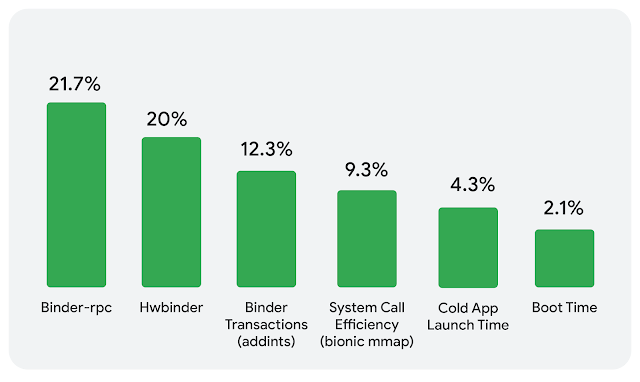
- A 21.7% increase in Binder-rpc: Android software now sends Remote Procedural Calls (RPCs) to system services 21.7% faster. For users, this means requests like accessing media in WhatsApp will receive a substantial speed boost, resulting in an overall snappier device feel.
- A 20% increase in Hwbinder: Hwbinder is similar to Binder-rpc, except that it handles only system calls to hardware components. Think of it as your app requesting information from a component, such as the camera or fingerprint sensor. That percentage increase simply means fewer delays.
- A 12.3% increase in Binder Transactions’ speed(addints): With a 12.3% overall increase in Binder Transactions, messages between services within the Android kernel get a speed bump in delivery and response time.
- A 9.3% increase in System Call Efficiency (bionic mmap): System calls, memory-related operations, and other low-level system requests now run 9.3% faster.
- A 4.3% decrease in cold app launch time: Users will see a 4.3% reduction in startup time during a cold launch, which occurs when an app (like Chrome after a phone restart) is opened without being preloaded into memory.
- A 2.1% reduction in boot time: The time it takes for an Android phone to move from power-off to usable state gets reduced by 2.1%.
When will Android devices see the upgrade?
According to TechRader, this update is being tested on Android versions 15, 16, and 17 beta. It suggests that only devices running these versions will receive the optimization when their manufacturers ship kernel updates that include the changes.
As the optimization rolls out, older phones may become eligible, since they seem to need it more. The exact date the rollout will start isn’t known yet, but based on how Google ships updates, Pixel phones will likely get it first.
For more on where the platform is headed next, check out our breakdown of the biggest Android trends shaping smartphones in 2026.