


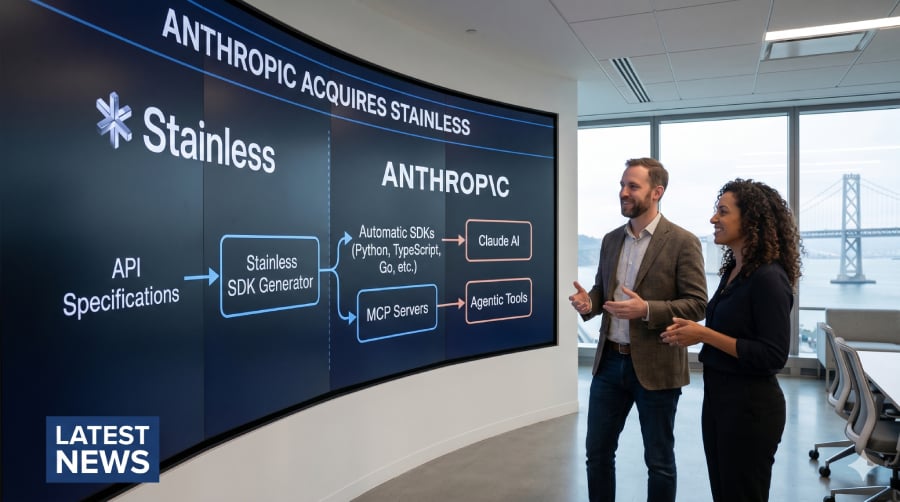
Anthropic just bought a company most users have never heard of, but many AI developers have already relied on.
The company announced Monday that it has acquired Stainless, a New York-based startup that turns API specifications into SDKs, command-line tools, and MCP servers. The deal gives Anthropic deeper control over developer infrastructure at a time when AI companies are competing not only on model quality, but on how easily developers can build with their tools.
Stainless was founded in 2022 by former Stripe engineer Alex Rattray and quickly became a quiet but widely used part of the AI ecosystem. Its software automatically generates and maintains SDKs for languages such as Python, TypeScript, Go, Java, and Kotlin.
The company did not disclose financial terms. However, earlier reporting cited by TechCrunch suggested the deal could be worth more than $300 million.
What Stainless actually does and why it matters
Stainless sits in a layer most users never see, but developers depend on heavily. It takes API specifications and turns them into ready-to-use SDKs, then keeps them updated as APIs change. That removes the manual work of maintaining integrations across multiple programming languages.
According to Anthropic, Stainless has powered the generation of every official Anthropic SDK since the early days of its API. That same tooling has also been used across the industry by companies like OpenAI, Google, Cloudflare, Runway, and Replicate, TechCrunch reported.
Cutting off the competition
The acquisition immediately shifts the competitive landscape by removing this toolchain from the broader market. Anthropic confirmed it will wind down all hosted Stainless products, including its automated SDK generator.
An Anthropic spokesperson stated that existing Stainless customers will still own the SDKs they have generated to date and retain full rights to modify and extend them.
However, because the core engine will no longer be available to outsiders, competitors now face a distinct dependency problem. Rival model providers must choose between manually maintaining their existing frameworks or rushing to build or buy alternative solutions.
This wind-down could open significant market opportunities for alternative automated library-creation tools like Liblab.
More must-read AI coverage
- SS&C Intralinks DealCentre AI vs. Datasite: Which platform is built for the future of dealmaking?
- SS&C Intralinks FundCentre AI vs. Juniper Square: Which platform better supports modern private markets fund managers?
- Why Data, Not Models, Determines AI Success
- The Rise of the AI-Native Factory: How Physical AI Is Transforming Manufacturing
The shift to agentic AI
The acquisition highlights an industry transition in which AI labs are increasingly competing on developer tooling and orchestration layers rather than on pure model performance.
“Agents are only as useful as what they can connect to,” said Katelyn Lesse, Head of Platform Engineering at Anthropic, in a statement. “We’re excited to bring the Stainless team into Anthropic to advance Claude’s ability to connect to data and tools.”
Alex Rattray, Founder and CEO of Stainless, noted that Anthropic was one of the first teams to back his vision.
“I started Stainless because SDKs deserve as much care as the APIs they wrap,” Rattray said. “Anthropic was one of the first teams to bet on this with us. We have been watching what developers have built on Claude over the last few years, which made bringing our teams together an easy decision.”
This transaction marks Anthropic’s fourth acquisition in roughly six months, following its previous purchases of Bun (a JavaScript runtime), Vercept, and Coefficient Bio. Industry analysts point out that the strategy mirrors efforts by rivals, such as OpenAI’s reported acquisition of the Python developer tool startup Astral.
Related reading: For more on the AI deployment race, read our coverage of how OpenAI and Anthropic are pushing enterprise AI from pilots into production.