


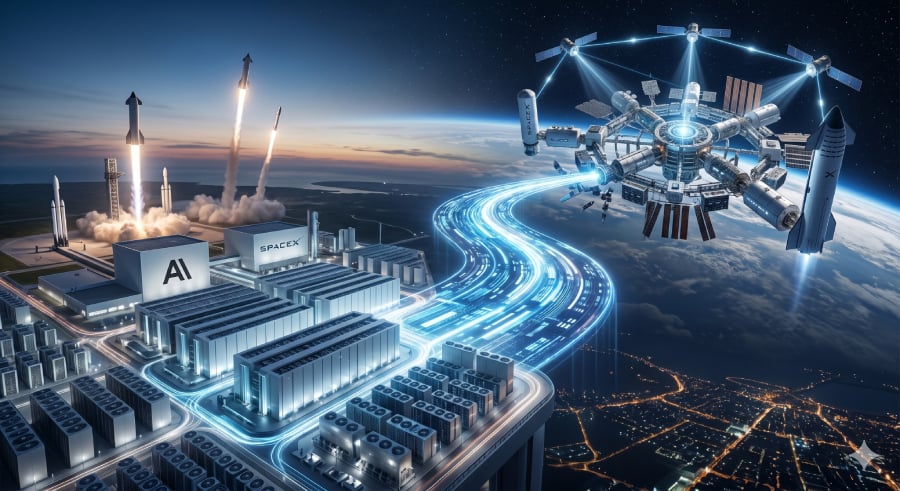
AI used to live in the cloud. Now it is eyeing the sky.
Anthropic has signed a compute agreement with SpaceX to access Colossus 1, a massive AI supercomputer with more than 220,000 Nvidia’s GPUs, including H100, H200, and GB200 accelerators, according to a recent announcement. The additional capacity is expected to support Claude Pro and Claude Max subscribers.
The deal also carries a stranger, more futuristic signal: Anthropic has expressed interest in partnering with SpaceX to develop multiple gigawatts of orbital AI compute capacity. In other words, one of the leading AI labs is not just renting more data center capacity. It is flirting with the idea that some future AI infrastructure may leave Earth entirely.
Financial terms were not disclosed at the time of publication.
Anthropic gets access to Colossus 1
Colossus 1 is described by xAI as one of the world’s largest and fastest-deployed AI supercomputers, built for AI training, fine-tuning, inference, scientific simulations, multimodal systems, and other high-performance workloads.
A Wall Street Journal report said Anthropic will use all of the computing capacity at SpaceX’s Colossus 1 data center, adding more than 300 megawatts of compute capacity by the end of the month.
For Claude users, the near-term impact is more practical than cosmic.
Anthropic said the added compute will help improve capacity for Claude Pro and Claude Max subscribers, while Investing.com reported that Anthropic is also doubling Claude Code’s five-hour rate limits for Pro, Max, Team, and Enterprise plans, removing peak-hour limit reductions for Claude Code on Pro and Max accounts, and raising API rate limits for Claude Opus models.
Why AI companies are buying compute everywhere
The SpaceX deal is the latest sign that frontier AI companies are turning infrastructure into a competitive weapon. Better models require more chips, more power, more cooling, and more reliable access to capacity at a time when cloud providers, chipmakers, and AI labs are all chasing the same scarce resources.
Anthropic has already been lining up major compute partnerships. In April, the company announced an expanded agreement with Google and Broadcom for multiple gigawatts of next-generation TPU capacity beginning in 2027. Anthropic said that the deal would support future Claude models and help serve growing customer demand.
The company also recently expanded its Amazon partnership for up to 5 gigawatts of capacity, including new Trainium2 capacity coming online in the first half of 2026 and nearly 1 gigawatt of Trainium2 and Trainium3 capacity by the end of the year. Anthropic said more than 100,000 customers run Claude on Amazon Bedrock.
That makes the SpaceX deal part of a broader compute land grab, not a one-off moonshot. Anthropic is stitching together capacity from multiple providers because the AI market’s appetite for compute has become a many-headed furnace.
More must-read AI coverage
- SS&C Intralinks DealCentre AI vs. Datasite: Which platform is built for the future of dealmaking?
- SS&C Intralinks FundCentre AI vs. Juniper Square: Which platform better supports modern private markets fund managers?
- Why Data, Not Models, Determines AI Success
- The Rise of the AI-Native Factory: How Physical AI Is Transforming Manufacturing
The orbital data center idea is still unproven
The orbital compute portion of the announcement is the most eye-catching and the most uncertain.
xAI argued that future AI systems may demand more power, land, and cooling than terrestrial infrastructure can provide on the necessary timelines. It also claimed SpaceX has the launch cadence, economics, and constellation operations experience to turn space-based compute into a near-term engineering program, assuming major engineering challenges can be solved.
That caveat is doing heavy lifting.
Space-based data centers would face serious technical hurdles, including launch costs, radiation exposure, heat management, maintenance limitations, latency, hardware reliability, orbital debris risk, and the challenge of upgrading or repairing systems once deployed.
A recent TechRadar report noted that SpaceX itself warned in a filing that space data centers involve “significant technical complexity and unproven technologies” and may not become commercially viable.
For now, the earthly part of the deal matters more. Anthropic gets more capacity for Claude. SpaceX gets another major customer for Colossus 1. The broader AI industry gets another reminder that model competition is increasingly a competition for infrastructure.
What comes next?
The most immediate thing to watch is whether Claude users actually feel the capacity improvement through higher limits, fewer slowdowns, and better availability during heavy usage periods.
The bigger question is whether orbital AI compute becomes a serious infrastructure path or remains a spectacularly expensive thought balloon. Either way, the direction is clear: the AI race is no longer just about who builds the smartest model. It is about who can build, buy, power, and cool the machine behind it.
The SpaceXAI deal also builds on Anthropic’s recent infrastructure push, including Google’s planned investment of up to $40 billion in cash and compute capacity as demand for Claude continues to surge.