


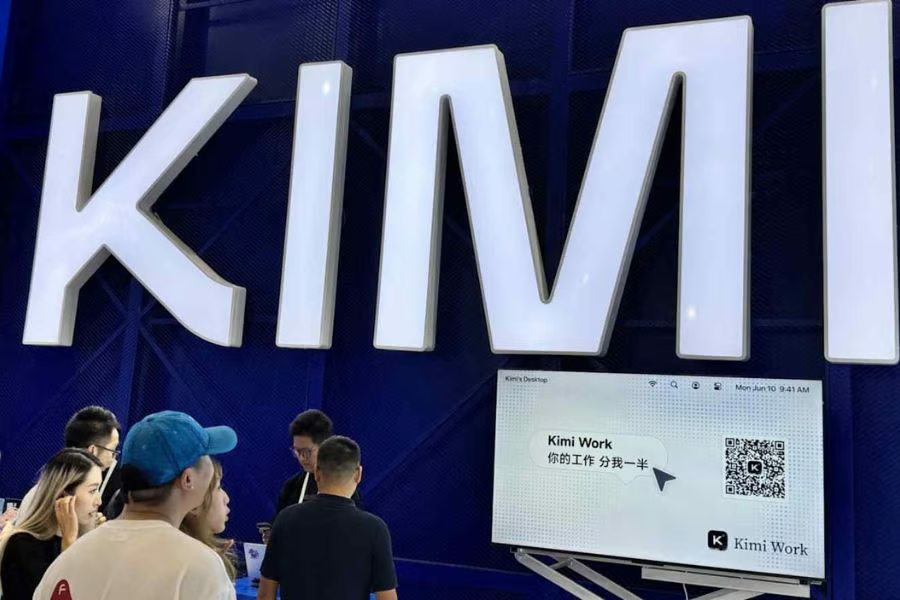
Chinese AI startup Moonshot AI has released Kimi K3, a massive open-weight AI model designed for advanced coding, reasoning, and knowledge work.
The model features 2.8 trillion parameters, a 1 million-token context window, and native vision capabilities. Moonshot describes it as the “world’s first open 3T-class model” built for long-running tasks such as software development, research, and complex problem-solving.
The company said Kimi K3 still trails the strongest proprietary systems overall but achieved frontier-level results across its evaluation suite, outperforming several tested models. Kimi K3 is currently available through Kimi’s chatbot, desktop app, coding assistant and API services, while Moonshot plans to release the full model weights on July 27.
Kimi K3 leads frontend coding benchmark
One of the biggest claims surrounding Kimi K3 is its performance in frontend development. Kimi K3 ranked first in Arena.AI’s Frontend Code Arena benchmark, which tests AI models on building real-world user interfaces across areas including product design, data visualization and creative applications.
The model reportedly surpassed Anthropic’s Claude Fable 5 across five categories — Brand and Marketing, Reference-based Design, Data and Analytics, Consumer Product, and Simulations and Content Creation Tools — while trailing only in Gaming.
The benchmark is significant because frontend coding requires more than generating code. Models must understand layouts, visual elements, user experience decisions and functional requirements.
Open-source challenge to US AI leaders
Kimi K3’s release comes as Chinese AI companies attempt to close the gap with leading US developers. Moonshot said Kimi K3 performed competitively with Anthropic’s Fable 5 and substantially outperformed several other models, including GPT 5.6 Sol, GPT 5.5 and Claude Opus 4.8, in specific evaluations.
Independent testing has also shown strong results. Artificial Analysis ranked Kimi K3 near top-tier models on its Intelligence Index, although it remained behind Fable 5 and GPT-5.6 Sol in overall capability.
The model’s open-weight approach could become its biggest advantage. Unlike proprietary systems that restrict access to internal technology, open-weight models allow developers and companies to customize and deploy models themselves.
A new pressure point for AI businesses
Kimi K3 could reshape how companies think about AI costs and vendor choices.
Moonshot is charging $3 per million input tokens and $15 per million output tokens for API access. While that is higher than some Chinese competitors, analysts note that the model’s performance may make it competitive against more expensive US alternatives.
Kimi K3 arrives during a period of rapid progress among Chinese AI developers. Earlier breakthroughs from companies such as DeepSeek challenged assumptions about China’s ability to compete with US AI labs.
More must-read AI coverage
- SS&C Intralinks DealCentre AI vs. Datasite: Which platform is built for the future of dealmaking?
- SS&C Intralinks FundCentre AI vs. Juniper Square: Which platform better supports modern private markets fund managers?
- Why Data, Not Models, Determines AI Success
- The Rise of the AI-Native Factory: How Physical AI Is Transforming Manufacturing
What this signals for developers and businesses
Kimi K3’s benchmark win matters because frontend development is one of the most common commercial AI workloads. A model that performs well in real-world interface creation could become attractive for software teams looking to automate more of the development process.
Moonshot’s decision to release the model weights also gives enterprises and developers an alternative to closed commercial systems, allowing organizations to customize deployments instead of relying entirely on API-based services.
That said, benchmark leadership does not guarantee better results in every production environment.
Real-world performance still depends on workload, infrastructure, operating costs, reliability, and the resources needed to run a model of this size. Organizations will likely continue evaluating Kimi K3 alongside established proprietary models before making deployment decisions.
Also read: Grok Build privacy concerns pushed SpaceXAI to open-source its terminal coding agent under Apache 2.0, giving developers more visibility into how the tool handles code.