


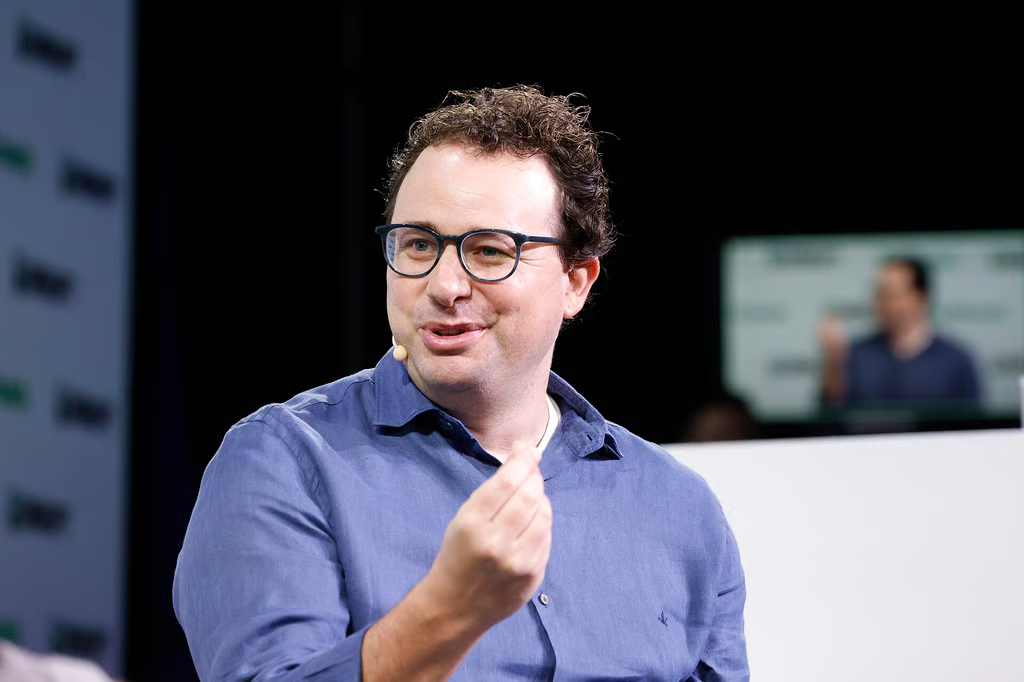
Anthropic chief executive Dario Amodei has a reality check for anyone expecting open-weight AI to democratize Silicon Valley: it won’t.
In an exchange on X with investor Gavin Baker, Amodei rejected the premise that policymakers face an ultimatum between concentrated regulatory control and wide open distribution.
Baker contended on a podcast and social media that Amodei has “lost the argument” on AI governance, claiming his warnings have fueled local backlashes against data centers while urging him to be a “more positive advocate for his own industry.”
Amodei responded that framing the debate as “either concentrate it in the hands of a chosen few companies and politicians via regulation or distribute it widely” represents a “false choice.” He argued that institutions can establish equitable frameworks, comparing formal rules to a legal system that protects individuals from mob justice.
According to Amodei, AI is “structurally a technology that tends to concentrate power” because of the computational demands dictated by scaling laws. Freely distributing model weights, he warned, simply shifts that dominance to whichever entities control the underlying chips and infrastructure.
Slowing down frontier labs
Amodei defended Anthropic’s policy track record, emphasizing that the startup actively designs proposals to “disadvantage (slow down) frontier AI companies while advantaging smaller competitors.”
He highlighted Anthropic’s backing of measures like California’s SB 53, which set compliance thresholds that exempt smaller enterprises below specific revenue or training cost cutoffs.
Amodei also backed tiered evaluation frameworks proposed to the White House and the Center for AI Safety (CAISI), alongside the concept of an independent, self-regulatory body similar to FINRA, originally suggested by Google DeepMind CEO Demis Hassabis.
Rethinking the public trust deficit
Addressing broader pushback against the sector, Amodei denied that his safety warnings have soured public sentiment. Instead, he framed the skepticism as a decades-old institutional trust deficit.
“I think by far the most accurate criticism of AI companies including Anthropic is that we haven’t yet delivered on our big promises to benefit the world,” Amodei wrote, adding that promising to cure cancer has become “more a cliché than it is inspiring.”
To overcome public cynicism, Amodei noted that Anthropic is accelerating internal research in biology and medicine, aiming to deliver tangible clinical advancements rather than relying on promotional spin.
The compute bottleneck reality
The debate between open-weight advocates and safety-focused frontier labs exposes a fundamental commercial reality: software accessibility does not equal infrastructure parity.
Open-weight models can give developers more control over software by allowing them to inspect, modify, and run models independently. But training and operating the most capable systems still requires substantial compute, advanced chips, and access to large-scale infrastructure.
Amodei argues that this infrastructure bottleneck limits how much decentralization open weights alone can achieve. For startups and enterprise users, that means greater software openness may still leave them dependent on a relatively small number of cloud and hardware providers.
The larger policy question is whether decentralizing access to models is enough when the physical infrastructure required to build and run frontier AI remains concentrated elsewhere.
More News: The rise of open-weight models is challenging OpenAI and Anthropic’s closed-model strategies as both companies command soaring valuations.