
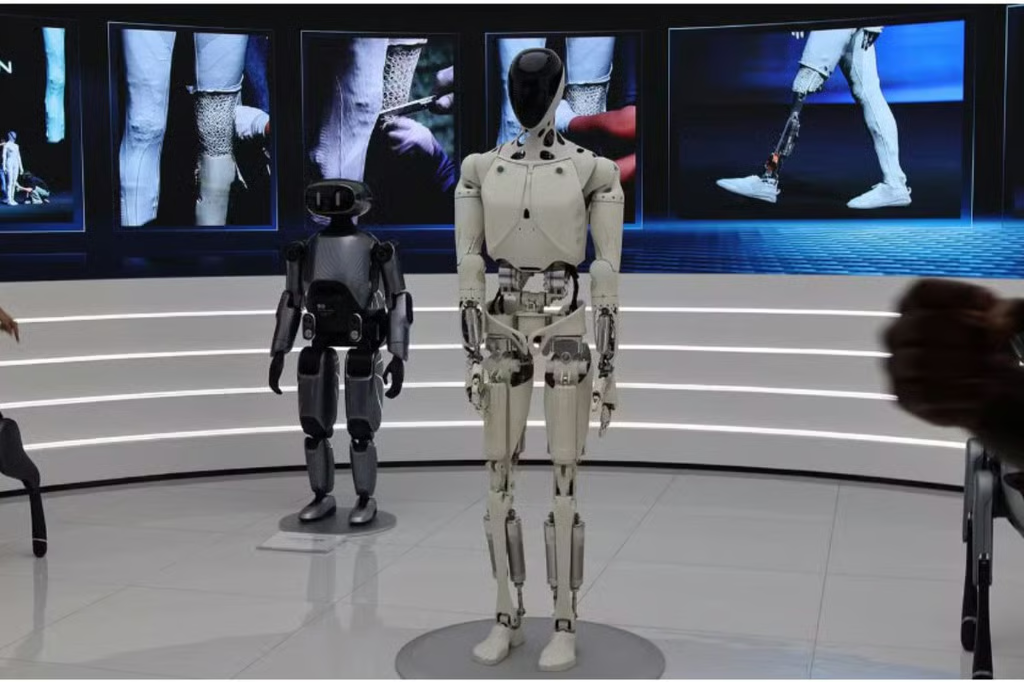


The carmakers that spent years chasing Tesla on electric vehicles are now coming for its robots.
Leading Chinese EV makers, including BYD and XPENG, are accelerating plans to mass-produce humanoid robots. The companies are betting heavily that recent breakthroughs in artificial intelligence will open up a massive new market that stretches far beyond traditional transportation.
This aggressive push is expected to solidify China’s standing as a global manufacturing powerhouse for next-generation mobility. It also marks the latest flashpoint in the broader geopolitical competition between Beijing and Washington, with both nations viewing robotics and physical AI as crucial strategic sectors.
The scale of investment from these automotive giants suggests they see robots as a natural extension of their existing technology. BYD executive vice-president Stella Li expressed high confidence in the domestic ecosystem in a recent video posted to the company’s official WeChat account.
“I believe China will become the first market to see full commercialisation of humanoid robots,” Li said, according to SCMP. “BYD has made a huge investment in AI, and it will take some time before we reap the rewards.”
Though Li did not provide a specific roadmap for mass production, she revealed that BYD intends to utilize its established global dealer network to distribute the robots.
Meanwhile, XPENG is moving on a more explicit timeline. Last November, XPENG CEO He Xiaopeng stated that the company aimed to sell one million robots annually by 2030, with a focus on cutting production costs enough to make them accessible for everyday household use. He later specified that mass production is projected to kick off by the end of 2026.
Other major players are jumping into the fray as well. Li Auto, Xiaomi, and state-owned Chery Automobile, which is partnering with AI firm Aimoga to develop a natural-language robot called Mornine, have all outlined distinct robotics initiatives. According to industry roadmaps, these machines are being designed for a wide variety of tasks, spanning factory labor, logistics, hospitality, and elderly care.
More must-read AI coverage
- SS&C Intralinks DealCentre AI vs. Datasite: Which platform is built for the future of dealmaking?
- SS&C Intralinks FundCentre AI vs. Juniper Square: Which platform better supports modern private markets fund managers?
- Why Data, Not Models, Determines AI Success
- The Rise of the AI-Native Factory: How Physical AI Is Transforming Manufacturing
Squaring off with Tesla
This rapid mobilization puts Chinese tech firms on a direct collision course with Tesla’s own physical AI ambitions.
Tesla CEO Elon Musk has been actively promoting the company’s Optimus humanoid robot project, and Allan Wang Hao, Tesla’s China president, indicated in April that the Shanghai Gigafactory could eventually be used to manufacture the robots.
While Tesla has yet to commercialize Optimus, the competition is fierce. Interestingly, the rivalry is seasoned with mutual respect; Musk recently publicly praised XPENG’s next-generation humanoid robot, Iron, while predicting that Chinese firms and Tesla would ultimately dominate the global robotics landscape.
Also read: XPENG’s first mass-produced robotaxi moves the Chinese EV maker further into autonomous mobility and physical AI.