


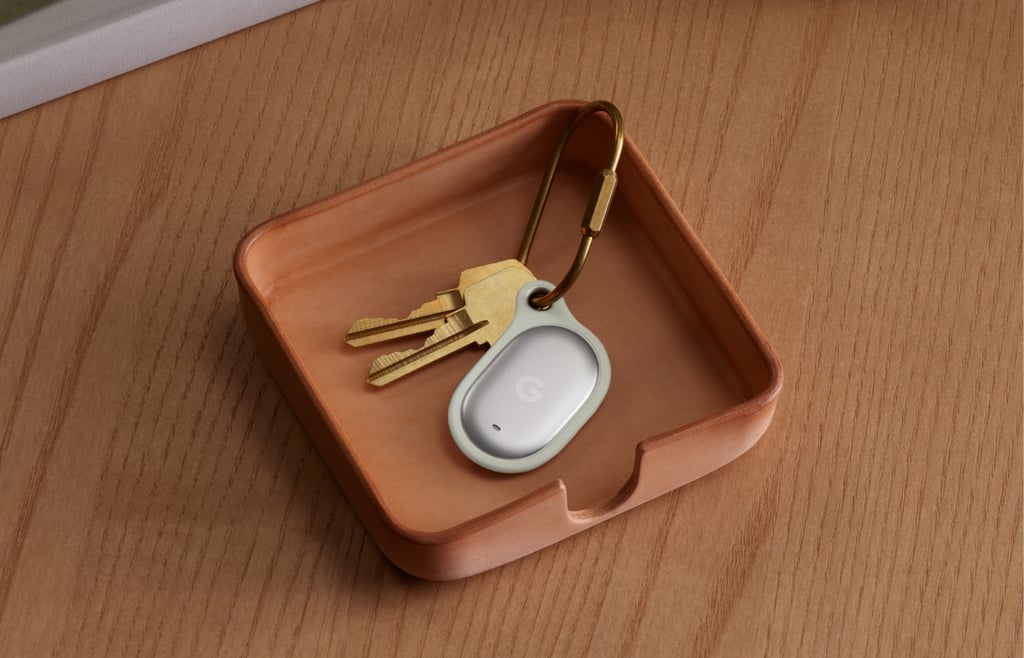
Apple has dominated the item-tracking conversation for years. Now Google wants Android users to have an AirTag of their own.
Google’s answer is a $29.99 Bluetooth tracker called Pixel Tag, built to work with its Find Hub network and help Android users locate missing belongings. Rather than relying on GPS or a standalone cellular connection, the device uses nearby participating Android phones to relay location reports to its owner.
It also brings more than basic Bluetooth tracking to the table, with Ultra-Wideband (UWB), Bluetooth Channel Sounding, and a built-in speaker for finding items nearby.
The launch gives Google a first-party product to tie its tracking software and Android hardware together, putting Apple’s AirTag ecosystem under more direct competition.
How does Google’s Pixel Tag actually work?
The Pixel Tag relies on Bluetooth signals, other Android devices, and Google’s Find Hub network to determine its location.
When your belongings go missing, the Pixel Tag can rely on Google’s crowdsourced network to help report its location. Other Android devices on the network can identify the lost item and share its location with its owner, who can then view it on a map inside the Find Hub app.
But finding an item on a map and getting precise directions to it are two different things. That’s where UWB and Bluetooth Channel Sounding come in.
The Independent explains that UWB provides precise, meter-by-meter directions to a lost item when you’re nearby. Bluetooth Channel Sounding, meanwhile, uses Bluetooth 6.0 to provide more accurate distance measurements than existing Bluetooth trackers.
TechCrunch describes the experience as a combination of visual distance information and directional guidance. So, rather than simply showing you where your keys were last detected, the compatible technology can help you work out how far away they are and which direction to look.
Together, these features help users move beyond viewing an item’s last reported location on a map. Depending on their phone’s capabilities, they can receive more precise information to help locate belongings nearby.
Slim, lightweight, and long-lasting
Google has gone with an elongated, oval-shaped design. At just 5.4mm thick and 11.8g with its battery, the Pixel Tag is slim enough to slip into a wallet or attach to everyday belongings without adding much bulk. Its body combines polycarbonate and metal.
There are a few practical touches, too. A physical button on the tag lets you ring your connected phone if you’ve misplaced it. The tag also has a replaceable CR2032 coin-cell battery, which Google says should last for more than a year under typical use. So, no charging cables or replacing the entire tracker when the battery runs out.
It also carries an IP67 rating for dust and water resistance. That’s reassuring for a device likely to spend its life in bags, pockets, and other places that aren’t always very dry. Just don’t mistake the rating for a promise that it’s waterproof.
Speaking of warranties, coverage depends on where you buy it. Google’s support lists a warranty period of one to three years depending on region and store.
One small catch: Google doesn’t claim the tag is drop-proof, and its water and dust resistance isn’t permanent. Treat it like a durable everyday accessory, not something to put through a washing machine.
Who gets to use it?
The Pixel Tag supports Android 9 and later, but some features need newer hardware. UWB-based Precision Finding requires a compatible UWB phone, while Bluetooth Channel Sounding needs Android 16 and Bluetooth 6.0.
It’s also not available in every country yet. In the US, it costs $29.99 for one or $99.99 for four. So, basic tracking works across more Android phones, but the full experience depends on your device and region.
Pixel Tag vs. Apple AirTag: How do they compare?
Google isn’t trying to reinvent the item tracker. It’s taking on Apple’s AirTag with a similar product built around Android’s Find Hub network. Both trackers help locate missing belongings, but their phone compatibility, precision-finding technology, and a few practical features set them apart.
| Feature | Google Pixel Tag | Apple AirTag (2nd gen) |
|---|---|---|
| Price | $29.99; $99.99 for four | $29; $99 for four |
| Tracking network | Google Find Hub | Apple Find My |
| Compatibility | Android 9 or later | iOS 26.0 or later and iPadOS 26.0 or later |
| Precision finding | UWB and Bluetooth Channel Sounding | UWB |
| Allows engraving | No | Yes, for free |
| Weight | 11.8g | 11.8g |
| NFC | Yes | Yes |
Neither tracker is a universal option, though. Pixel Tag depends on Google’s Android network, while AirTag relies on Apple’s Find My network. So, buying an AirTag for an Android user or a Pixel Tag for an iPhone user defeats much of the point.
What’s changing for users?
For Android users, the Pixel Tag finally gives them a first-party alternative to Apple’s AirTag. They no longer have to rely entirely on third-party trackers for a similar experience, and Google’s Find Hub network gives them access to a large pool of Android devices that can help locate missing belongings.
But don’t rush to buy one just because it says Google on the box. Check that your phone supports the features you actually want.
Also, remember that the tag’s availability is still limited by country. If you’re in a market where it hasn’t launched, importing one may also mean dealing with warranty and support limitations.
Google’s biggest challenge may be less about matching AirTag’s specifications and more about proving that its Find Hub network can reliably locate missing belongings in everyday situations.
Other news: Spotify is giving Premium subscribers more control over its AI DJ with nine new English and Spanish voice options and a setting to disable commentary between songs, allowing for a more personalized listening experience with fewer interruptions.