


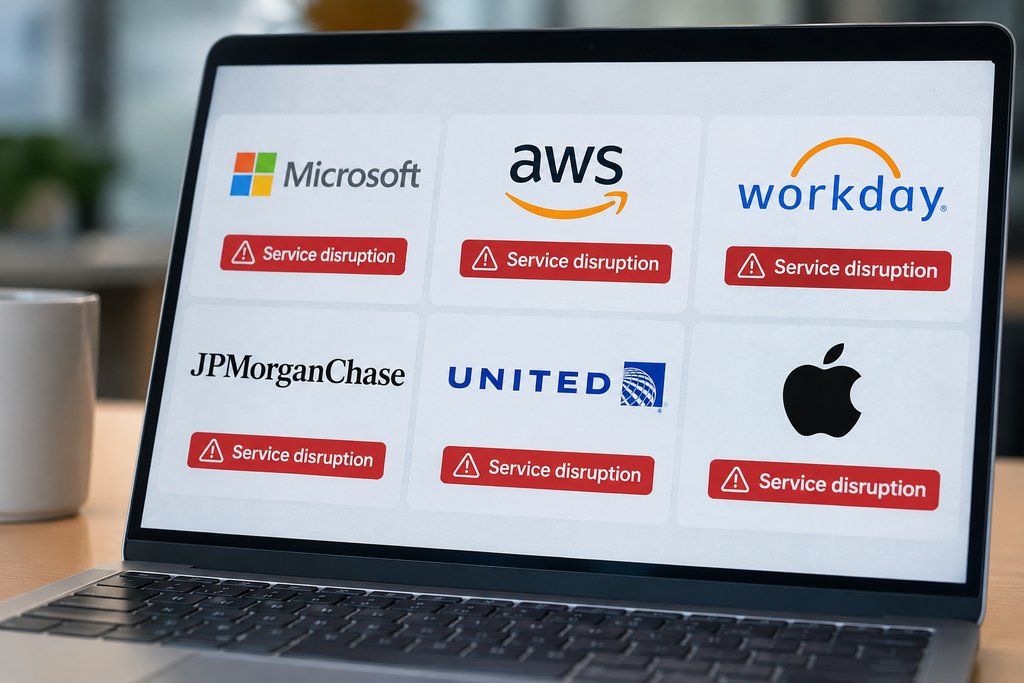
First, the inboxes stopped working. Then payroll systems stumbled, flights were grounded, and banking apps decided Monday was a good day to take a break.
November has been a rough month for anyone whose job depends on technology behaving itself.
Between Nov. 12 and Nov. 17, a string of outages disrupted Microsoft 365, Amazon Web Services (AWS), Workday, US air travel, banking services, and even systems at the National Security Agency (NSA).
The timing sparked speculation about coordinated cyberattacks. But so far, there’s no verified evidence connecting the incidents, and several organizations have attributed their problems to software defects, maintenance issues, or infrastructure failures.
For IT teams, the bigger question isn’t whether the outages were connected. It’s how many critical business operations can grind to a halt when a single technology service fails.
Here’s what happened, what organizations have confirmed, and what businesses can learn from a particularly troublesome week.
- November 2026 tech outages: Timeline at a glance
- Nov. 12–13: Microsoft 365 gives businesses an unexpected break from email
- Nov. 13: Workday, Claude, and the FAA encounter separate problems
- Nov. 15–16: AWS, Chase, and United Airlines add to the disruption
- Nov. 17: Even the NSA and Apple have a bad day
- Were the November tech outages connected?
- What IT teams can learn from November’s outages
November 2026 tech outages: Timeline at a glance
| Date | Organization | What happened | Reported cause |
|---|---|---|---|
| Nov. 12–13 | Microsoft 365 | Outlook and Exchange Online access was disrupted, along with features in other Microsoft services | Network gateway software defect and capacity problems |
| Nov. 13 | Anthropic Claude | Sign-in failures and separate disruptions affecting Claude's app, API, and coding tools | Not publicly established |
| Nov. 13–14 | Workday | HR, payroll, and other business functions became unavailable for affected customers | Problem involving disaster-recovery testing |
| Nov. 13 | FAA | Nationwide ground stop disrupted US air travel for more than four hours | Telecommunications network instability; final root cause under investigation |
| Nov. 15 | AWS | Authentication and connectivity problems affected services in US-East-1 | Technical cause not publicly established |
| Nov. 16 | JPMorgan Chase | Banking transactions and payments were delayed | Software bug involving on-premises systems |
| Nov. 16 | United Airlines | Departures were delayed after pilots lost access to flight-planning applications and final aircraft weights | Specific technical cause not disclosed |
| Nov. 17 | NSA | Internal systems experienced temporary degradation | Incident occurred during scheduled maintenance |
| Nov. 17 | Apple | Apple Music, App Store, AppleCare, and some iCloud services experienced disruptions | Internal software update |
The timeline covers reported incidents from Nov. 12–17, 2026. It does not imply the outages were connected. Details reflect information available as of Nov. 18.
Nov. 12–13: Microsoft 365 gives businesses an unexpected break from email
For office workers, the first sign of trouble was deceptively ordinary: Outlook wasn’t cooperating.
The Microsoft 365 disruption prevented many users from accessing Exchange Online mailboxes, while delayed email delivery created additional headaches.
Features in Teams, Copilot, SharePoint, OneDrive, and other Microsoft services that depend on Exchange Online were also affected, although many unrelated functions remained accessible.
According to Microsoft’s preliminary post-incident report, the main disruption lasted from 4:20 p.m. UTC on Nov. 12 until 4:10 p.m. UTC on Nov. 13, just under 24 hours.
The company traced the problem to a software defect introduced during an earlier network capacity upgrade. Subsequent traffic changes and reduced available capacity overwhelmed affected gateway servers.
Microsoft said it found no indication of malicious activity.
The incident illustrates a familiar cloud computing problem: multiple applications may look independent to users while relying on the same underlying infrastructure.
When that infrastructure fails, several services can become unavailable together.
Nov. 13: Workday, Claude, and the FAA encounter separate problems
Friday brought a particularly unpleasant combination of workplace disruption and travel chaos.
Workday’s disaster-recovery problem
Workday experienced a disruption affecting HR, payroll, timekeeping, and other functions for some customers.
According to Florida Atlantic University’s IT status updates, Workday identified a problem involving its disaster-recovery environment that resulted in inconsistent production data.
The company placed affected environments into maintenance while it investigated and restored service, with access returning on Nov. 14.
The irony is hard to miss: systems designed to help businesses recover from outages can introduce problems when testing or recovery procedures go wrong.
Claude experiences separate service failures
Anthropic also had a difficult Friday.
According to its official status history, Claude experienced two separate incidents involving sign-in problems and elevated errors across Claude.ai, Claude Code, and its API.
The company reported that the first incident was resolved after approximately two hours, while the second lasted about two and a half hours.
Separately, Claude’s Microsoft 365 connector and Claude for Outlook experienced errors because of Microsoft’s earlier disruption.
That distinction matters. Anthropic confirmed the Microsoft-related integration problem, but it did not establish that Microsoft caused Claude’s separate service failures.
The FAA’s nationwide ground stop
The Federal Aviation Administration experienced a telecommunications failure that prompted a nationwide ground stop on Nov. 13.
According to the FAA’s Nov. 15 explanation, the trouble began around 3:30 p.m. ET, and air traffic resumed at 8:15 p.m.
The agency said its legacy network became unstable after receiving approximately 1,000 connection attempts every four to five seconds, disrupting communications and radar feeds across 17 of its 22 Air Route Traffic Control Centers.
Investigators identified two possible sources of the excessive traffic, including an Arkansas communications site where contractor L3Harris had been installing a router.
The FAA said it had no indication of a cyberattack and was continuing to investigate the root cause.
The ground stop disrupted flights nationwide, with delays and cancellations continuing after operations resumed.
Nov. 15–16: AWS, Chase, and United Airlines add to the disruption
The following week didn’t offer much relief.
AWS authentication and connectivity failures
On Nov. 15, AWS reported problems affecting several services in its US-East-1 region.
According to the AWS Health Dashboard, customers experienced authentication, account registration, and connectivity errors between approximately 3:05 a.m. and 6:10 a.m. Pacific Time.
The disruption affected IAM Identity Center and services dependent on its authentication capabilities, including Amazon Connect and Kiro. A subset of Network Load Balancers also experienced connectivity problems.
AWS reported that affected services had recovered, but it did not establish a definitive root cause in its incident update.
The problem illustrates an important distinction: an application can be running perfectly well and still be inaccessible if the authentication system needed to reach it fails.
It’s a familiar cloud dependency problem. A previous AWS outage covered by TechRepublic similarly demonstrated how problems at a major infrastructure provider can affect services far beyond its own platform.
Chase customers experience banking delays
On Nov. 16, JPMorgan Chase experienced a technical problem that delayed banking transactions and payments, including some Zelle transfers.
Customers at other financial institutions also reported transaction problems involving Chase.
According to the bank’s explanation reported by news outlets, the disruption stemmed from a software bug involving an on-premises hardware system.
JPMorgan Chase said it found no evidence of a cyberattack.
The incident shows how financial infrastructure dependencies can carry the effects of a technical problem beyond the institution where it originated.
United Airlines pilots lose access to critical flight data
United Airlines also experienced a technology outage on Nov. 16, leaving pilots unable to retrieve the final aircraft weight figures and other operational information needed before takeoff.
According to TechRepublic’s report on the United Airlines outage, an internal pilots’ union memo reviewed by Reuters described a company-wide web-based disruption affecting multiple applications, including crew communications.
An internal alert obtained by CNN also identified problems accessing flight-planning, weather-briefing, and crew-management applications. Pilots were advised not to log out of certain systems because they might be unable to sign back in.
The outage disrupted departing flights across United’s US network. Flights already airborne and those operated by United Express were unaffected.
United spokesperson Leslie Scott told CNN that the interruption lasted approximately 30 minutes and directly affected fewer than 150 flights. The Associated Press reported that about 100 minutes elapsed between pilots’ initial reports and the airline’s resolution announcement.
The different durations reflect how the disruption was measured rather than necessarily conflicting accounts.
United said there was no indication of a cybersecurity-related incident. The airline has not publicly identified the failed component or explained what caused the outage.
The disruption came three days after the FAA’s nationwide ground stop, but the two incidents involved separate systems and are not connected.
For airlines, the lesson is simple: even a perfectly functioning aircraft isn’t going anywhere if its crew can’t access the information needed to fly it safely.
Nov. 17: Even the NSA and Apple have a bad day
By Tuesday, the outages had reached two organizations operating very different kinds of technology.
The NSA acknowledged temporary degradation affecting internal systems during scheduled maintenance.
According to reporting from The Guardian, the disruption involved a classified communications network, although the agency did not publicly disclose the full technical details.
The NSA said mission-critical capabilities remained operational.
Meanwhile, Apple users encountered problems accessing Apple Music, the App Store, AppleCare, and some iCloud services.
Apple acknowledged the disruption on its system status page and told the Associated Press that an internal update had caused some outages.
Users also reported Apple Pay problems, although those reports should not be treated as confirmation that every Apple Pay function was unavailable.
The incidents added to an unusually busy week for service-status dashboards. Neither is connected to the earlier disruptions.
Were the November tech outages connected?
When email, banking, flights, and government systems experience problems within days of one another, it’s understandable that people start looking for a common explanation.
But a cluster of outages isn’t proof of a coordinated cyberattack.
Microsoft and JPMorgan Chase attributed their disruptions to technical problems rather than malicious activity. The FAA likewise reported no indication of a cyberattack.
Other providers have not publicly established definitive causes.
What the incidents do reveal is how heavily businesses depend on complex systems that can fail in unexpected ways.
Three patterns stand out:
- Routine changes can introduce new problems. Microsoft’s network changes, Workday’s recovery testing, and the FAA’s telecommunications issues demonstrate the operational risks associated with infrastructure work.
- One failure can affect multiple services. Microsoft’s outage disrupted Exchange-dependent features across its productivity tools, while AWS authentication problems affected access to other services.
- Restoration doesn’t immediately erase the impact. Airlines must clear flight backlogs, banks need to process delayed transactions, and businesses may have to verify data after systems recover.
The common thread isn’t a proven shared cause. It’s the complexity of keeping interconnected systems running.
What IT teams can learn from November’s outages
Businesses can’t control whether Microsoft, AWS, or another provider experiences an outage. They can control how prepared they are when it happens.
| Lesson | What IT teams should do |
|---|---|
| Map critical dependencies | Identify which applications rely on shared cloud, identity, payment, and network services |
| Test disaster recovery safely | Ensure recovery exercises cannot unintentionally affect production environments |
| Prepare alternative workflows | Establish backup communications and manual procedures for essential operations |
| Improve incident communication | Monitor official status pages and give employees clear updates and workarounds |
One of the biggest risks is assuming redundancy automatically guarantees availability.
A business might operate applications across multiple cloud environments but still depend on a single identity provider. Or it might have backup communication tools that rely on the same internet connection.
Those hidden dependencies can turn a relatively contained technical failure into a much larger business disruption.
The outages also offer a reminder not to mistake speculation for evidence. When several systems fail close together, security teams should investigate possible threats without automatically treating every incident as an attack.
After a week that disrupted email, payroll, banking, and air travel, the bigger lesson is clear: Keeping individual systems online matters, but knowing what happens when they go offline matters just as much.
And if November has taught IT teams anything, it’s that even the backup plan deserves a backup plan.
In other tech news, security researchers found 35,578 Grok Build apps accessible without authentication, potentially exposing employee records, patient information, and confidential business data while raising concerns about access controls in AI-generated applications.