


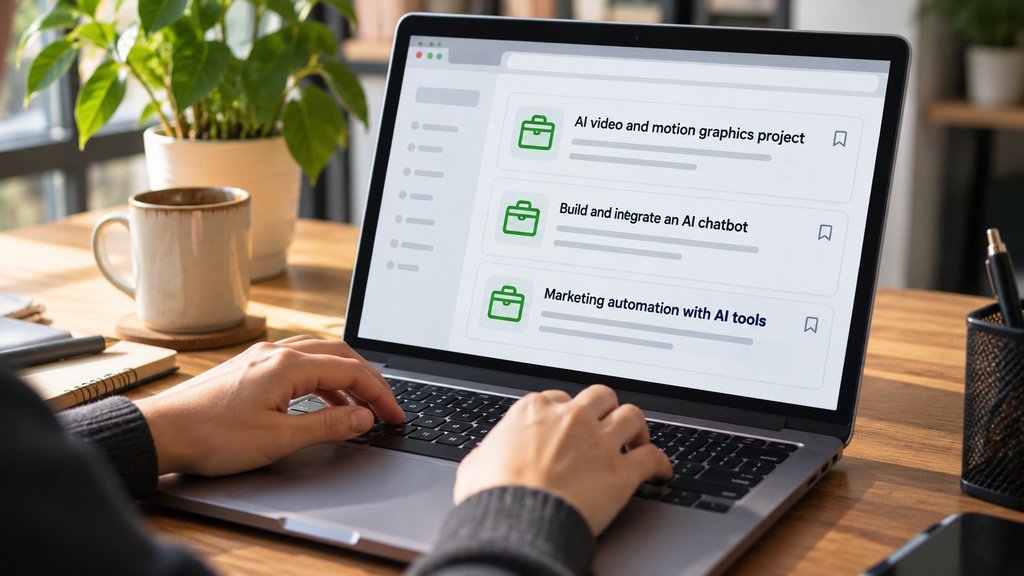
AI freelance projects on Upwork are attracting substantially larger budgets, but freelancers aren’t necessarily charging much more per hour. New research from OpenAI and Upwork finds that AI-related jobs have 52% higher advertised fixed-price budgets than comparable non-AI work, while the adjusted difference in posted hourly rates is just 1.5%.
The gap suggests clients are assembling larger projects that combine AI with software development, video production, marketing automation, and other services. Rather than paying a large premium for AI skills alone, businesses appear to be requesting broader work.
The joint study, published Nov. 10, examined Upwork postings and contracts alongside sampled ChatGPT activity. Its findings describe changes within one freelance marketplace, not the entire labor market, and don’t establish that AI caused the budget differences.
AI freelance jobs have bigger budgets but similar hourly rates
Researchers compared AI-related and non-AI jobs while accounting for work subcategory and posting month.
Three figures capture the difference:
- 52% higher fixed-price budgets: AI-related postings advertised larger budgets after adjustment.
- 1.5% higher hourly rates: The adjusted difference in advertised hourly rates was comparatively small.
- 41% more recorded hours: Among hired hourly contracts with positive recorded hours, AI-related projects logged more hours during their first 90 days.
These are separate measures. A posted budget isn’t necessarily what a freelancer ultimately receives, and more hours worked don’t automatically translate into greater profitability.
Before adjustments, AI-related fixed-price budgets were approximately 70% higher than non-AI budgets. Controlling for job category and posting month reduced the difference to 52%.
The findings are consistent with a shift toward larger and potentially more involved assignments, rather than a substantial increase in the advertised hourly price of AI-related labor.
AI projects are combining skills in new ways
The study found that AI-related postings averaged 3.35 distinct tasks, compared with 3.19 for non-AI jobs.
That difference is relatively small. The more notable change concerns which tasks appear together.
Historically uncommon task pairings accounted for an average of 8.4% of combinations within AI-related postings, compared with 2.4% in non-AI postings.
Researchers classified a pairing as historically uncommon if it had appeared together fewer than 200 times during their pre-AI comparison period.
Examples of emerging combinations include:
- AI video production: Generating video alongside editing and motion graphics.
- Software integration: Connecting AI APIs and chatbots to existing applications.
- Marketing automation: Combining AI-generated content with campaign management and workflow automation.
AI-related work has also become more diverse. The study measured a roughly 45% increase in the effective number of task clusters represented in AI postings between early 2023 and late 2025.
That describes broader activity across the marketplace, not a 45% increase in the skills required for every freelancer.
What the findings mean for freelancers and businesses
For freelancers, knowing how to use an AI tool may be less valuable than being able to deliver a completed project using that tool.
A client hiring someone to create AI-generated marketing videos, for example, might also need editing, platform-specific formatting, campaign integration, and performance reporting.
Freelancers who can handle connected tasks may be better positioned to pursue those projects.
However, the findings don’t establish that those workers earn more or enjoy stronger profit margins.
People interested in developing these capabilities can explore practical AI courses, but the study doesn’t evaluate training programs or identify specific certifications associated with higher freelance earnings.
What should businesses check before hiring AI freelancers?
The 52% budget difference shouldn’t be interpreted as a standard AI surcharge.
For businesses commissioning freelance work, the more useful question is what additional deliverables the larger budget covers.
Before approving a project, buyers should clarify:
- Scope: Which tasks are included, and what will be delivered?
- Technical integration: Does the work require connecting AI tools to existing systems?
- Quality assurance: Who checks AI-generated output for accuracy and usability?
- Maintenance: Who will fix or update the solution after delivery?
- Pricing: Is the project fixed-price or hourly, and how will changes be handled?
Those distinctions help businesses compare proposals based on actual requirements rather than the presence of an AI label.
They also fit a broader labor-market picture in which AI adoption can affect hiring in different ways. One 2026 employment study linked intensive corporate AI spending with increased hiring, while separate research on job losses identified displacement pressures in some roles.
The studies measure different populations and outcomes, so their findings shouldn’t be treated as directly comparable.
Does the study prove AI is creating better freelance jobs?
No. The researchers measured advertised budgets, hourly rates, contract activity, and how tasks are grouped.
They didn’t establish whether AI-related projects were more profitable for freelancers, delivered better results for clients, or generated sustainable demand over time.
The research also draws on Upwork data through April 2026. Patterns on other freelance platforms, among salaried workers, or in later months could differ.
Still, the findings offer businesses and freelancers a useful distinction: AI-related projects on Upwork are often larger in advertised scope, while posted hourly rates remain relatively close to those for non-AI work.
The practical opportunity is in understanding what clients need delivered, not assuming an AI label automatically commands a premium.
Want to learn more AI tips, tricks, and prompting techniques? TechRepublic readers get free 7-day access to The Neuron Academy, our practical learning platform designed to help professionals use AI more confidently at work. Browse all lessons →
Let us teach you How to Talk to AI for free! Try our six-minute course at The Neuron Academy and learn a few simple ways to write better prompts and get more useful results from AI, or browse our other AI course for free for seven days. Check out all the lessons here →