


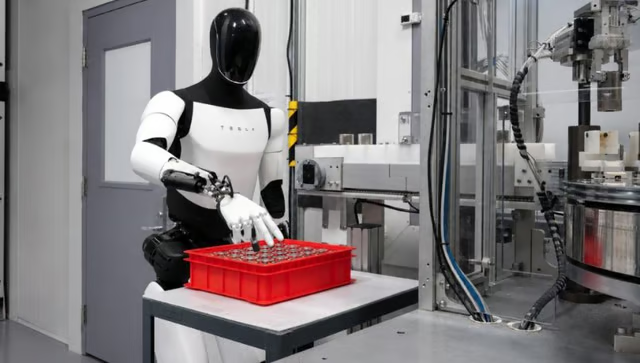
Elon Musk wants Tesla’s Optimus humanoid robots available for purchase by the general public by the end of 2027.
According to The Information, Tesla increased Optimus production at its Fremont, California, factory from a few dozen robots weekly during the second quarter of 2026 to several hundred in August. The reported increase comes as Tesla works toward Musk’s proposed 2027 public sales launch, although the company has not confirmed a release date or provided updated production figures.
For businesses exploring humanoid robots for manufacturing, logistics, and other physical tasks, the bigger question is whether Tesla can scale up production to machines capable of performing useful work reliably.
Tesla ramps up Optimus production ahead of 2027 target
Tesla’s reported production increase represents a roughly tenfold expansion between the second quarter and August 2026.
According to Electrek, citing The Information, Tesla managers are targeting an automated production line capable of producing more than 1,000 robots per week by the end of 2026. The longer-term ambition is reportedly to reach approximately 20,000 units weekly, although that figure remains a goal rather than an established manufacturing capability.
The reported production milestones and proposed sales timeline illustrate how quickly Tesla hopes to expand its humanoid robot business.
Tesla Optimus production and sales timeline
| Q2 2026 | A few dozen robots produced weekly | Reported production |
| August 2026 | Several hundred robots produced weekly | Reported production |
| End of 2026 | Automated line capable of producing more than 1,000 robots weekly | Reported internal target |
| Longer term | Approximately 20,000 robots per week | Reported ambition |
| Late 2027 | Optimus could become available for public purchase | Musk's stated target; not confirmed |
| Sources: September reporting from The Information, as summarized by Electrek, and Musk's January 2026 remarks. Figures and deadlines remain subject to change. | ||
In its January 2026 investor update, Tesla outlined preparations for its first Optimus production line, with production planned before the end of 2026 and an eventual annual manufacturing capacity of one million robots. That figure represents a long-term capacity goal, not Tesla’s current production output.
During the company’s January earnings call, Musk described plans to convert the Model S and Model X production space at Fremont into an Optimus manufacturing facility. He also cautioned that significant production volume would take time because Optimus requires an entirely new supply chain.
Those mass-production plans are distinct from the smaller-scale manufacturing and testing activities reported at Fremont earlier in 2026.
The Optimus V3 robots reportedly being produced in August were not necessarily identical to the version Tesla intends to offer customers. The company was still refining the commercial design, which would need to meet stricter durability and reliability requirements before reaching the market.
Musk previously said Tesla could begin selling Optimus robots to the public by late 2027, provided they meet expectations for reliability, safety, and functionality. As Axios reported, the proposed sales timeline depends on Tesla making further progress with the technology.
TechRepublic previously examined Tesla’s Optimus launch timeline, including Musk’s plans to expand production and move the technology beyond Tesla’s own facilities.
More must-read AI coverage
- SS&C Intralinks DealCentre AI vs. Datasite: Which platform is built for the future of dealmaking?
- SS&C Intralinks FundCentre AI vs. Juniper Square: Which platform better supports modern private markets fund managers?
- Why Data, Not Models, Determines AI Success
- The Rise of the AI-Native Factory: How Physical AI Is Transforming Manufacturing
Manufacturing challenges could shape Optimus rollout
Despite the reported increase in production, Tesla faces significant engineering challenges as it works toward commercial deployment.
The robot’s hands have been particularly difficult to manufacture. According to The Information, the Optimus V3 design includes more than 100 screws and other small components in its hands and forearms that, as of the September reporting, required manual assembly.
Tesla also reportedly encountered difficulties aligning precision components during automated manufacturing, while some suppliers struggled to maintain consistent quality at higher production volumes.
Software presents another obstacle. Optimus reportedly struggled to perform unfamiliar tasks without extensive training, limiting its usefulness as a general-purpose robot.
Most Optimus robots produced during the period covered by the report were reportedly used for internal testing, training, and data collection rather than regular commercial work. Those operating inside Tesla facilities were generally restricted to closely supervised environments and programmed for specific tasks.
That distinction highlights the gap between the capabilities described in the September reporting and Tesla’s ambitions for general-purpose humanoid robots.
These issues matter because commercial deployment depends on more than manufacturing volume. Robots intended for workplaces or homes must be able to perform tasks consistently, respond safely to unexpected situations, and operate without constant human intervention.
What businesses should expect from Optimus in 2027
Tesla’s plans for commercial deployment and public sales remain separate, with neither timeline finalized.
September reporting indicated that Tesla planned to initially lease Optimus robots to selected commercial customers rather than sell them outright. The company had not publicly confirmed when those leases might begin or which businesses would qualify.
The reported leasing arrangement could allow Tesla to retrieve, upgrade, or refurbish the machines while collecting operational data to improve their AI capabilities. Tesla was reportedly considering businesses with factory or warehouse environments similar to its own facilities.
Separately, Musk has targeted late 2027 for sales to the general public, provided the robots meet his expectations for reliability, safety, and functionality. Tesla has not established how that goal would align with the reported commercial leasing strategy, nor has it announced final pricing, purchase terms, or a confirmed launch date.
For businesses evaluating humanoid robots, the distinction matters. An initial leasing program could provide opportunities to test the technology in controlled environments, but it would not necessarily indicate that Optimus is ready for widespread commercial deployment.
Companies should also distinguish between a robot that can complete a demonstrated task and one that can perform that task reliably throughout a normal workday.
Maintenance requirements, safety, training time, operating costs, and integration with existing workflows will help determine whether humanoid robots offer practical advantages over conventional automation.
Tesla’s reported August production increase suggests manufacturing progress, but it is not yet evidence of commercial readiness.
The milestones worth watching are whether Tesla can demonstrate reliable performance in less controlled environments, reduce manufacturing complexity, and establish a viable deployment model. Those developments will ultimately determine how useful Optimus proves to be for businesses beyond Tesla’s own factories.
Also read: For a broader look at the humanoid robot market, TechRepublic examines how 7,000 robot sales in 2025 highlight the gap between growing production ambitions and real-world workplace adoption.