


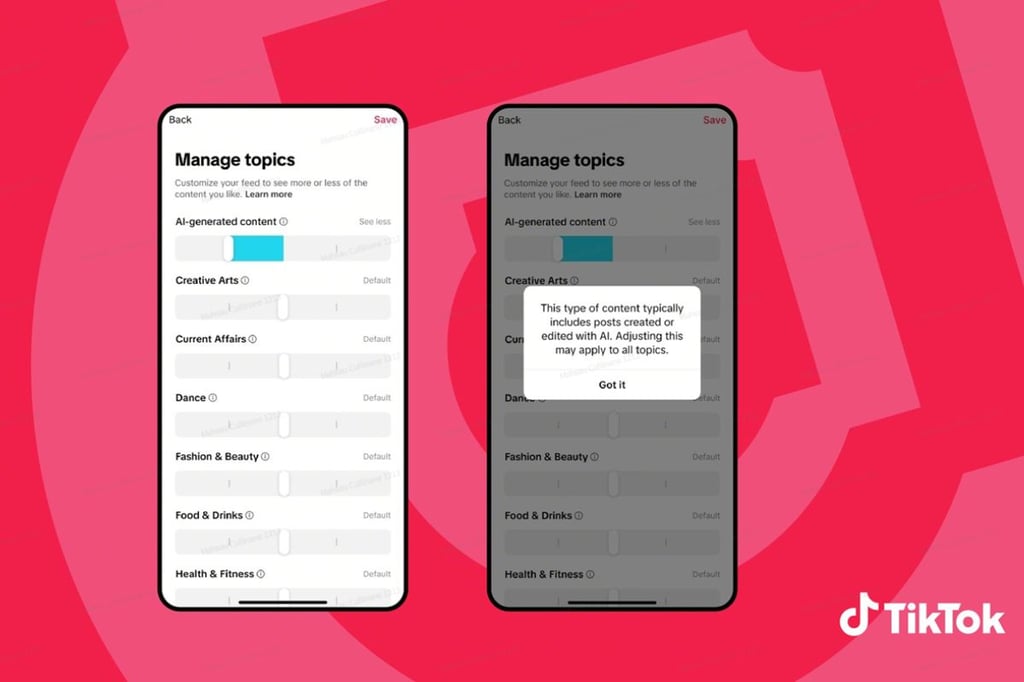
TikTok is letting users take the reins on their AI intake, with new features designed to help people better control the AI-generated content (AIGC) they see on the platform.
This update comes amid growing conversations about AI transparency, especially as AI-generated media becomes more convincing and widespread.
More control over AI on your fyp
One of the most significant changes to note is a new setting inside TikTok’s Manage Topics tool that lets users determine just how much AI-generated content appears in their For You feed. Similar to how you could adjust how often you see content about topics like sports or food (yes, you can do that), now you can do the same for AI content.
But before any AI-gen content haters start rejoicing, this doesn’t mean that AI can be removed completely. Instead, the feature allows users to fine-tune it. Therefore, those who are not as interested in synthetic content can scale it back, just not completely remove it from their feed.
As for lovers of things like AI-generated history explainers or AI digital art creators, anyone can now easily draw more of that content directly into their feed.
This development follows Pinterest’s recent launch of a similar feature. Its “GenAI interests” setting lets users limit AI-generated visuals to specific categories such as beauty, art, fashion, and home décor. It’s a sign that more platforms are moving toward giving users a real say in how much AI they encounter in their applications.
Upgraded labeling and invisible watermarking
TikTok is also improving how it labels AI-generated media, moving away from its previous reliance on factors such as creator labels, its own detection models, and C2PA Content Credentials to flag synthetic content. Of course, traditional metadata-based labels can easily disappear when a video is edited or reuploaded elsewhere.
To solve that snafu, TikTok is testing “invisible watermarking,” a hidden marker embedded directly in the AI-generated content that only TikTok’s systems can read. The idea is to make it more difficult for labels to disappear when content is reshared or modified. These watermarks are set to first appear in content created with TikTok tools like AI Editor Pro and in uploads accompanied by C2PA credentials.
More must-read AI coverage
- SS&C Intralinks DealCentre AI vs. Datasite: Which platform is built for the future of dealmaking?
- SS&C Intralinks FundCentre AI vs. Juniper Square: Which platform better supports modern private markets fund managers?
- Why Data, Not Models, Determines AI Success
- The Rise of the AI-Native Factory: How Physical AI Is Transforming Manufacturing
Investing in AI literacy
A key issue TikTok acknowledges is that AI is sometimes easy to spot and, at other times, really not. Stylized filters, cartoonish visuals, or clearly synthetic characters usually stand out as obviously AI-generated. But add in today’s more advanced deepfakes, realistic voice clones, and subtly altered videos, and these can be far less distinguishable from human-made content. It’s this kind of hard-to-detect AI that poses real risks, from spreading misinformation to identity fraud, which is why sturdy labeling systems have become increasingly important.
To back up the tech changes and support broader education, TikTok is launching a $2 million AI literacy fund to help experts and organizations like GirlsWhoCode create content on responsible AI use. At the same time, TikTok is deepening its collaboration with groups like Partnership on AI to push for industry-wide standards around synthetic media.
As AI continues to evolve rapidly, TikTok says it will keep updating its transparency features as part of its ongoing effort to balance creativity and user safety, and to help users stay informed in an online era where not everything is what it seems.
Finnish telecom giant Nokia has unveiled strategy changes and ambitious goals in the world of AI.