
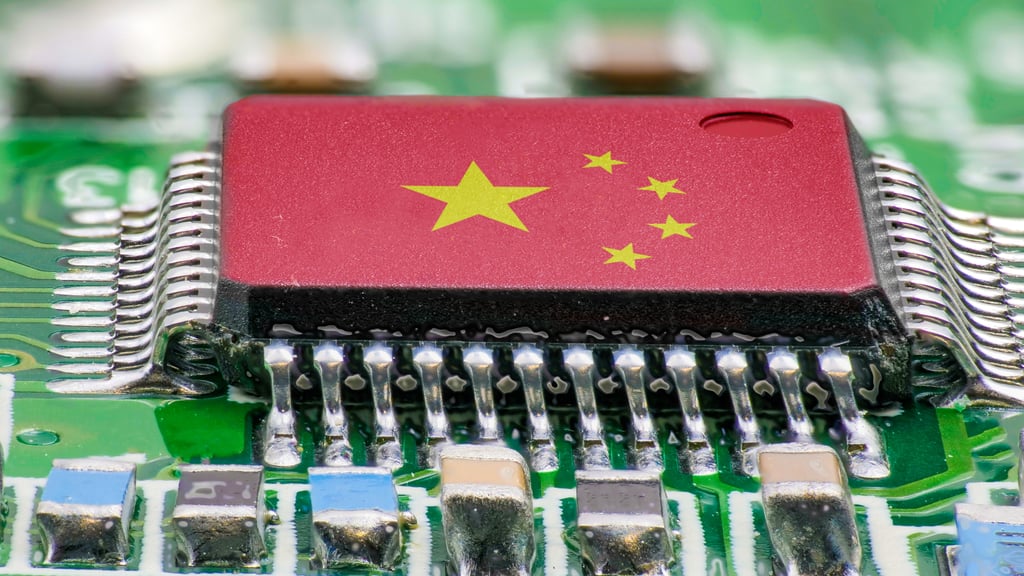


Nvidia remains caught in the middle of the US-China technology rivalry, as yesterday’s talks between the two countries yielded more questions than answers on US export restrictions and China’s tightening controls over foreign tech access.
US President Donald Trump met with Chinese President Xi Jinping in Busan, South Korea, to discuss semiconductors and broader trade issues. Trump told reporters afterward that the two leaders discussed “taking chips,” with the US acting as “referee” between Nvidia and Chinese regulators.
Tensions and uncertainty over chip diplomacy
The remarks injected further confusion into an already complex policy landscape, especially after earlier reports suggested that the Trump administration might ease restrictions on advanced AI chips.
Nvidia, which this week became the first company to reach a $5 trillion valuation, was hoping to gain clarity on whether the US might adjust existing export limits that have kept its most advanced Blackwell AI chips out of China.
“I don’t have any new insight from the meeting,” Nvidia’s CEO, Jensen Huang, said at a news conference. “I hope that we will have new policies that allow Nvidia to go back into China, for China to welcome Nvidia back.”
Huang has argued that US restrictions overstate the national security risks and that isolating the Chinese market could weaken America’s leadership in AI.
Before Trump took office, Washington had already placed limits on the sale of Nvidia’s most powerful processors to China. Trump’s administration initially banned exports of the company’s downgraded H20 chip, which was built to meet earlier restrictions, then reversed that decision in July.
The decision allowed limited sales of the chip while requiring the US government to take a 15% cut of related revenue. Beijing responded by discouraging Chinese firms from buying the chips, citing its own security concerns, effectively closing Nvidia’s last channel into the market.
The Trump-Xi talks did little to change that reality. Trump has left it up to Chinese officials to host direct discussions with Nvidia about taking the chips, but gave no timeline or details.
More must-read AI coverage
- SS&C Intralinks DealCentre AI vs. Datasite: Which platform is built for the future of dealmaking?
- SS&C Intralinks FundCentre AI vs. Juniper Square: Which platform better supports modern private markets fund managers?
- Why Data, Not Models, Determines AI Success
- The Rise of the AI-Native Factory: How Physical AI Is Transforming Manufacturing
What’s Next for Nvidia
The lack of a clear path back into China has not dampened Nvidia’s global market standing.
During his trip to South Korea, Huang announced a deal to supply more than 250,000 AI processors to Samsung, Hyundai, and other major firms supporting South Korea’s national AI initiative. The agreements underscore the company’s continued efforts to build new partnerships in Asia, even as China’s borders remain blocked.
“It’s critically important for America to be back in the China market,” Huang said. “As an American company, we would like to see American AI technology be the global standard.”
For Nvidia, the outcome in Busan keeps policy uncertainty intact but reinforces its global leverage. The company remains the standard-bearer for AI hardware, even as access to China’s vast market remains out of reach. With such a strong global foothold, it will continue to define the pace of AI infrastructure development as it deepens established ties to offset the strategic loss of China.
Want to dig deeper into how AI infrastructure is being reshaped? Check out the story “BlackRock, Microsoft and Nvidia lead $40B deal for Aligned Data Centers” on TechRepublic.