



Tableau, the two-decade-old data platform that Salesforce acquired for $15.7 billion in 2019, will get enhancements that allow for data automation, predictive analysis based on user preferences, thanks to the addition of large language model generative artificial intelligence. The new features include:
- Tableau GPT gives access to AI-powered analytics to make data digestible for a wide range of users, regardless of the technology or data analysis savvy.
- Tableau Pulse, an instance of Tableau GPT, will provide automated insights and a personalized analytics experience to business users and data consumers.
What is Tableau GPT?
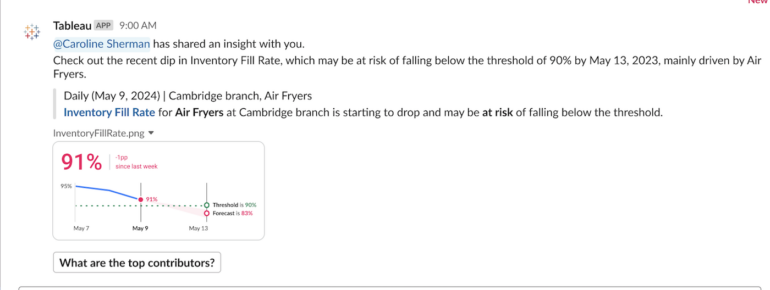
Tableau GPT, which was built on the native LLM that Salesforce built for its CRM AI platform Einstein, lets users query Tableau with natural language requests for a wide range of data visualizations and analysis. It will be integrated with Salesforce’s other platforms, like Slack (Figure A).
Figure A
Francois Ajenstat, chief product officer at Tableau, said that when Tableau was a startup out of Stanford two decades ago, data visualization consisted of tabular reports.
“These were static and boring. The world of data has changed in the last 20 years and it is being used in completely new ways,” he said. “It became interactive. We have the opportunity to change data again and empower more people to use it.”
More must-read AI coverage
- SS&C Intralinks DealCentre AI vs. Datasite: Which platform is built for the future of dealmaking?
- SS&C Intralinks FundCentre AI vs. Juniper Square: Which platform better supports modern private markets fund managers?
- Why Data, Not Models, Determines AI Success
- The Rise of the AI-Native Factory: How Physical AI Is Transforming Manufacturing
He said fewer than 30% of people in organizations have access to data. Salesforce’s own research said 41% of business leaders lack an understanding of data because it’s complex or not accessible enough and 67% of business leaders are not using data to decide on pricing in line with economic conditions, such as inflation.
“There are challenges of bringing data analytics to the whole organization,” said Ajenstat. He added that getting to the broadest set of consumers requires the ability to deliver data in diverse ways, not just dashboards. “It has to be easy and familiar.”
What is Tableau Pulse?
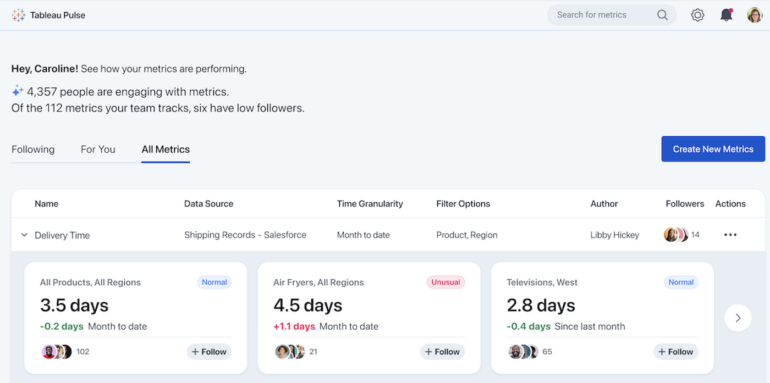
Salesforce said Tableau Pulse uses AI to personalize work experiences, employing Tableau GPT to deliver analytics on user-customized metrics, surfacing insights in natural language and visual formats.
It will comprise a new suite of tools that infuse AI throughout the platform, making querying data “feels more like conversation,” said Pedro Arellano, SVP and GM at Tableau. Tableau GPT combines Salesforce’s proprietary models, surrounded by security and governance, he said.
Arellano said Pulse is a reimagining of the analytics experience that expands how people work with Tableau.
“It is no longer just exploring data. It’s also communicating and consuming it. Not just expressing through visualization, it’s language.” Arellano called it a “personal guide for your data, that knows the goals you are trying to achieve and helps you reach those goals.”
GPT and Pulse are designed to be scaled, Arellano explained. “With elasticity and flexibility and lots of breadth and reach, and that Salesforce is infusing ChatGPT-type large language models throughout the company’s services and platforms,” he said (Figure B).
Figure B
“You will see it in Slack and Pulse,” he added. “Because we are taking analytics out of a strictly analytics tool in order to reach recipients of insights where they are today.”
Caroline Sherman, VP of product management at Tableau, said the goal of the new technical innovations is to give people a new way to engage CRM and collaborate with data. “Tableau GPT with Slack and Pulse is a trifecta for people who haven’t been able to adapt data to everyday work,” she said.
Generative AI? Yes, but with caveats
Salesforce’s survey found 57% of senior IT leaders are bullish on generative AI, with 80% seeing it as a boon for data comprehension; 75% said they planned to implement generative AI over the next 18 months.
But 71% said they believe generative AI will introduce new security risks to their data and 66% said their employees don’t have the skills to successfully leverage generative AI. Fifty-five percent of those polled said they believe companies need accurate, complete and unified data for generative AI to work.