


Parse away, but dire is the climate news these days, including the potential of the world to breach a 1.5c temperature increase threshold by 2027. Such consequences of global warming as fires in Hawaii, the cloak of orange haze from record Canadian fires, and July coming in as the hottest month on record since 1880 increases the pressure to slash carbon emissions as the collective “we” race to meet net zero by 2050.
How is the tech sector addressing its carbon footprint, including the data centers that feed it, the coding that defines it, as well as AI, wireless throughput and other energy-intensive processes that populate it? The sustainability efforts of Apple, Google, Cisco and other tech companies are explored.
- Tech’s impact and role in sustainability
- Net zero, carbon neutral, carbon free or carbon negative?
- Google investing in carbon removal solutions
- Microsoft launched Cloud for Sustainability, cut operational emissions
- Apple is using its Daisy robot to turn phones to dust
- Cloud and security firms looking to greener processes
- Are ecommerce and cloud services like eBay and AWS inherently sustainable?
Tech’s impact and role in sustainability
Data centers, most of which are in the U.S., and transmission networks account for up to 3% of global electricity and 3.5% of global greenhouse gas emissions (Figure A).
Figure A
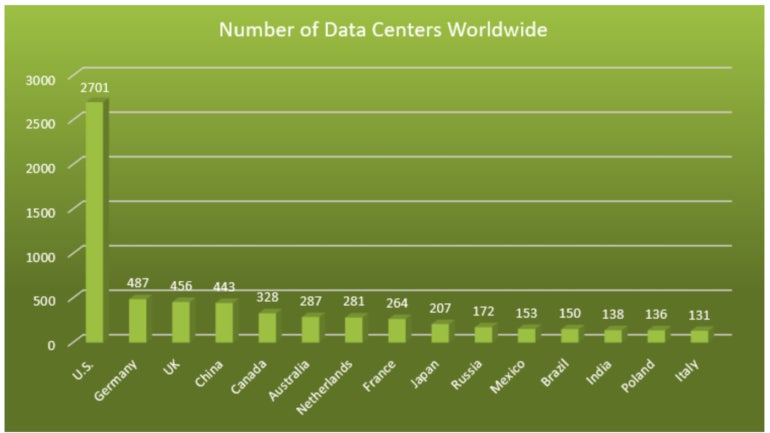
That percentage is also approximately the same as produced by the airline industry, and a little less than the entire energy from the manufacture of fertilizers, pharmaceuticals, refrigerants, oil and gas extraction, which produce approximately 3.6% of carbon emissions worldwide.
Of the 1,325 enterprises that responded to EY’s Reimagining Industry Futures Study, published in February 2023, 54% said emerging technologies can play a vital role in accelerating sustainability. 41% said they believe these technologies can play a largely positive role but also present some risks. Only 4% believe their potentially detrimental impact would outweigh their positive impact.
SEE: Sustainability tops Gartner’s 2023 strategic tech trends list (TechRepublic)
“One of the things I would highlight is that the tech industry has been very forward on the sustainability agenda,” said John Grant, sustainability expert, author and co-founder and former head of strategy at London creative shop St Luke’s.
“Companies including Microsoft have said they are going to remit all the carbon they have ever emitted historically,” he said, adding that Spotify is also a big investor in carbon removal technology. “Generally, tech companies are trying to be really good actors in this space.”
Net zero, carbon neutral, carbon free or carbon negative?
Net zero
The World Economic Forum defines net zero pretty much the way it sounds: taking out what you put into the atmosphere, or as the WEF puts it, “Carbon dioxide emissions are still generated, but an equal amount of carbon dioxide is removed from the atmosphere as is released into it, resulting in zero increase in net emissions.”
Carbon neutral or carbon free, similar but…
Some disambiguation from Energy Tracker Asia helps: The regional energy guide describes carbon neutral as a balancing act between greenhouse gas emissions through offsetting an equivalent amount of carbon from the atmosphere, usually through buying carbon credits.
SEE: How about hardware? Check out how semiconductor makers are going beyond carbon offsets (TechRepublic)
Carbon free, a more challenging proposition, means directly reducing emissions to zero. “For example, if a country or company is carbon-free, all the energy and electricity comes from renewable sources, like wind or solar,” the group said, noting that Washington, California, New Mexico and Hawaii have carbon-free targets in place requiring 100% clean or renewable electricity.
Carbon negative
More about Innovation
- Sovereign AI Explained
- The Rise of the AI-Native Factory
- Why Data Determines AI Success
- SS&C Intralinks DealCentre AI vs. Datasite: Which platform is built for the future of dealmaking?
How about carbon negative, which companies like Microsoft have committed to? Carbon offset company Terrapass explained in a blog that a carbon negative would mean, in theory, emitting less than zero carbon dioxide and carbon dioxide equivalent (CO2e) greenhouse gasses. “Since it is impossible to emit a negative amount of carbon (or any other physical substance), being carbon negative refers to the net emissions you create. To be carbon negative means to offset more carbon, through carbon capture, sequestration or avoidance, than you contribute to the environment.”
Scope 1,2, 3 carbon emission schedule
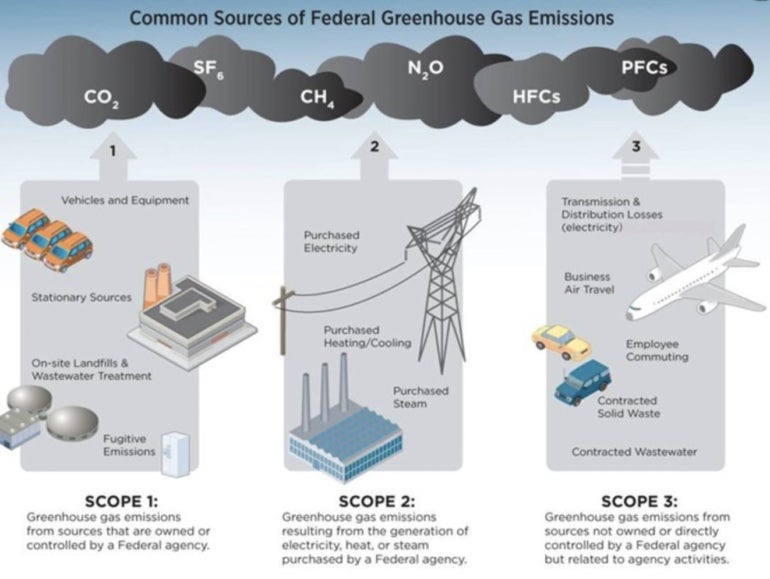
Many companies, tech and otherwise, adopted carbon-reduction targets based on the Scope 1, 2 and 3 carbon emission schedule (Figure B) from the U.S. Environmental Protection Agency. This three-part agenda defines emissions by government entities:
- Scope 1: A company’s own emissions from on-site combustion, processes, transportation, etc.
- Scope 2: Indirect emissions from the sources of generated power consumed by a company.
- Scope 3: Emissions associated with water treatment, employee travel and waste disposal.
Figure B
Google investing in carbon removal solutions
In 2020, Google’s CEO Sundar Pichai announced the company would commit to operating on 24/7 carbon-free energy by 2030. The company has approached sustainability from several fronts, including applying AI to search in order to provide carbon-emissions data to travelers. In addition, Google plans to invest in carbon removal solutions to neutralize emissions with a goal of running on carbon-free energy worldwide on every grid it uses by 2030.
The company reported that last year it achieved 64% carbon-free energy globally. The company said it consumed around 7 GW of renewable energy globally last year (Figure C).
Figure C

Grant pointed out that Google managed to drop the energy used to cool its data centers by up to 40% by using AI developed by DeepMind, and for years has been buying renewable energy from wind farms physically close to its data centers. He added, “These are key projects Google is including in its calculation of how to reduce their carbon emissions.”
Microsoft launched Cloud for Sustainability, cut operational emissions
Microsoft, which set its first carbon emission goals in 2009 and was carbon neutral in 2012, committed in 2020 to being carbon negative by 2030. They said that by 2030 it will remove more carbon than it emits, “Setting us on a path to remove by 2050 all the carbon the company has emitted either directly or by electrical consumption since it was founded.”
The company said its Microsoft Cloud for Sustainability helps users take such actions as:
- Unify their data intelligence around Scope 1, 2 and 3 energy use goals.
- Build a sustainable IT infrastructure.
- Create green end-to-end value chains.
- Meet other environmental, social and governance goals.
- Innovate around resilience and other sustainable business models.
In Microsoft’s most recent environmental sustainability report, the company said that In 2022, when business grew by 18%, its overall emissions declined by 0.5%. This is in part because of a 22.7% reduction in Scope 1 and 2 (operational) emissions.
Apple is using its Daisy robot to turn phones to dust
Apple, which has committed to being carbon neutral by 2030, has been using technological innovations such as its Daisy robot to recycle basic materials.In April 2023, Apple reported progress on its climate goals, which included:
- It had decreased its carbon footprint by over 45% since 2015.
- It had directed over 40,000 metric tons of electronic scrap toward recycling.
- 20% of all materials shipped in its products came from recycled sources. Apple said the majority of aluminum in its products are recycled, and that it employs a new, zero-carbon smelting process.
“Apple is one of the most aggressive companies in the world in terms of reclaiming minerals,” said Grant. “However, while they are using their Daisy robots to grind up phones to reclaim the component materials, there are numerous regulations preventing e-waste from being moved across borders. So the collection and delivery of materials is proving very difficult,” he said. This year, Apple pledged to use 100% recycled cobalt batteries by 2025.
SEE: Sustainable solutions for tacking plastic waste (TechRepublic)
Cloud and security firms looking to greener processes
Most cloud, software-as-a-service and security firms are looking at ways to reduce their hardware and server farm footprints through renewable sources of energy and recycling plans, partnerships and consumer programs. Below we focus on efforts from Cisco, Akamai, WithSecure and Gigamon.
Cisco aims for net zero by 2040
In 2021, Cisco announced its goal to be net zero by 2040, including products, operations and supply chain. The company’s plan aligns with Scope 1, 2 and 3 emissions targets, using 2019 as a benchmark.
The company is aiming for:
- 90% reduction in Scope 1 and 2 greenhouse emissions by 2025. Cisco said it would neutralize any remaining emissions by removing an equal amount from the atmosphere.
- 30% reduction in Scope 3 emissions from purchased goods and services, upstream transportation and distribution and use of sold products by 2030.
- Net zero greenhouse gas emissions across its value chain by 2040.
Akamai aims for 100% renewable energy and waste recycling
In 2021, cloud services and web security company Akamai Technologies said 50% of its energy needs had already been met by renewable sources. Akamai also announced 2030 sustainability goals toward 100% renewable energy at data centers, offices, network program partners and other sources of electricity, and said it will use “attestable and traceable sources of renewable energy certificates” to reach them.
One focus is on efficiency of its edge platform, which Akamai characterized as its greatest point of energy consumption, comprising approximately 325,000 servers in more than 135 countries and nearly 1,435 networks around the world as of 2021. In addition, Akamai announced a global expansion of its 100% electronic waste recycling program.
WithSecure launches W/Sustainability initiative
Earlier this year, threat intelligence and response firm WithSecure launched W/Sustainability, designed to make sustainability and transparency part of its strategy and operations, including a green coding initiative to lower energy consumed by software.
Gigamon creates power savings calculator
Gigamon recently launched an Energy Savings Calculator as part of its Network Efficiency Appraisal Team to get customers to cut power consumption, carbon footprint and costs associated with data centers by as much as 87% over five years. The calculator looks at the volume of network traffic sent to tools and the annual growth rate in network traffic to see where energy efficiencies are achievable.
Are ecommerce and cloud services like eBay and AWS inherently sustainable?
Grant asserted that the business models of ecommerce and cloud services companies like eBay and AWS are inherently green because they are marketing their spare capacity. He said, for example, that Amazon’s web service came about because the company was sitting on huge unused capacity, and therefore unnecessary energy costs on unused service.
“AWS was invented, to some extent, because they needed so much capacity at peak moments that they were not using 80% of their service at other times,” he said. “So, renting some of that spare capacity out to people that didn’t have the same peaks that they did made a lot of sense. And that is actually a sustainability business model — it’s like a service economy rental that takes some amount of physical resources and passes it around. So, if I were counting Amazon’s carbon footprint, I’d put a big tick in the margin for that on the positive side. It’s a commercial and sustainable win-win.”