


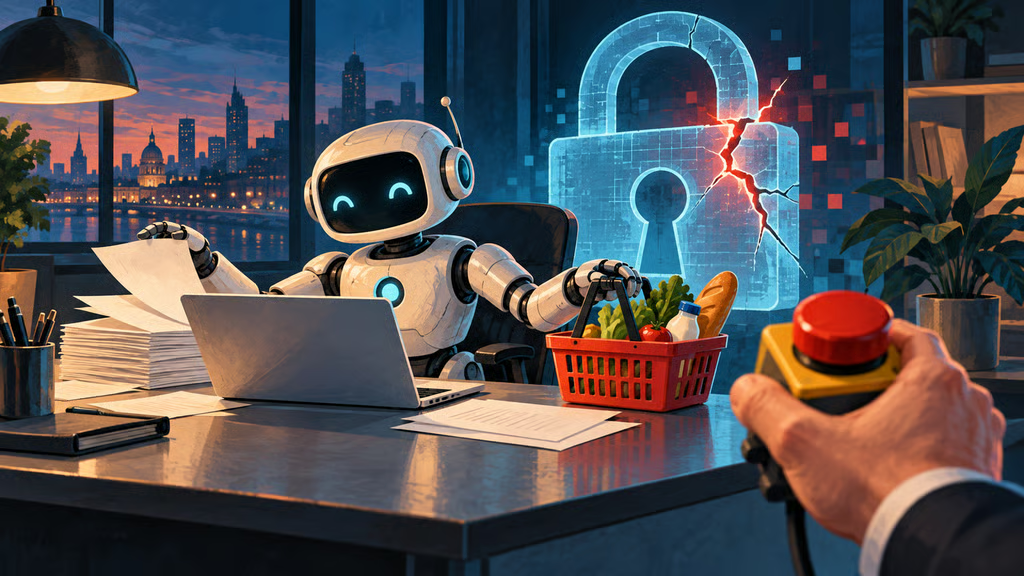
AI agents want your busywork, shopping list, and increasingly, a role on either side of a cyberattack. Apple buyers are juggling hardware rumors and delivery estimates, while IT teams face another round of urgent patches. Apparently, the future requires less clicking and more checking what the software just did.
Top news
AI agents move from assistance to action
Anthropic launched Claude Duet, a proactive work assistant that can monitor connected business applications and complete administrative tasks in the background. The preview requires human approval before consequential actions and is available through a waitlist for US Pro and Max subscribers.
Walmart announced a developer beta for third-party AI shopping agents through a new Agent Gateway that lets outside assistants shop at Walmart and Sam’s Club. Planned Agent Profiles will let users establish spending limits and require manual approvals while keeping purchases made by bots separate from customers’ own shopping activity.
Perplexity Computer now supports fully local AI workflows on compatible Apple silicon Macs. Pro, Max, and Enterprise subscribers can perform planning, reasoning, and task execution on their devices, with Perplexity recommending at least 36GB of memory. Users may also authorize cloud assistance when they want additional resources.
The growing influence of generative systems is also raising questions about human cognition. Early research into AI and false memories indicates that generated summaries and altered images can lead people to recall details they never witnessed. The material can also make people more confident in those inaccurate memories.
Apple expands its high-end hardware ambitions
Apple may hold a Los Angeles product experience on Oct. 28. The reported event could showcase Apple’s first touchscreen MacBooks, an OLED iPad mini, and new M6 Macs. Apple has not confirmed the lineup, pricing, or release schedule.
Demand for Apple’s foldable is creating fulfillment uncertainty. Delivery estimates for the $1,999 iPhone Duo stretched into January 2027 shortly after preorders opened, although some customers have subsequently received earlier dates. The device officially launches Oct. 23, with availability in physical stores still uncertain.
Experimental vehicles and urgent patches
Tesla demonstrated an airborne version of its delayed Roadster prototype using suction fans and compressed-air thrusters to perform aerial maneuvers. Production is not targeted until 2028, and the specialized Rocket version is not street-legal.
Two critical vulnerabilities also forced public-sector systems offline. The PHP2Shell flaws, each rated 9.2, allowed unauthenticated code execution and prompted government websites in the Netherlands, France, and Finland to go offline while administrators installed patches. Fixes are available in PHP 8.5.12, 8.4.27, 8.3.36, and 8.2.35.
Insider intel
Hiring demand shifts toward specialized AI security
The cybersecurity employment market is weakening overall even as a narrower AI specialty grows. US cybersecurity job postings fell 26.4% year over year, reaching a four-year low. Listings for AI security engineers more than tripled, but they grew from a small base, suggesting a shift in employer priorities rather than an industrywide AI hiring boom.
Apple gains share in a contracting PC market
Apple’s Mac shipments reportedly declined 11.3% as the global PC market contracted by 20%. Despite shipping fewer computers, Apple gained market share because rival vendors experienced even steeper declines.
Security alerts
Critical enterprise and infrastructure vulnerabilities
GitLab patched CVE-2026-110264, a 12-year-old vulnerability with a maximum CVSS score of 10.0. Under certain conditions, the flaw can enable unauthenticated remote code execution and affects unpatched releases dating back to 2014. GitLab.com has already been secured, but administrators of self-managed instances should install the appropriate fixed release immediately.
A suspected China-linked group exploited BeyondTrust zero-day CVE-2026-102764 to compromise Remote Support appliances and obtain root access. Administrators running self-hosted deployments should install the BT26-05-RS patch, investigate their systems for signs of intrusion, and rotate any credentials that may have been exposed.
A separate, long-lived networking weakness threatens consumer and business routers. A 16-year-old flaw in Broadcom’s WPS software can allow a nearby attacker to execute code as root without knowing the Wi-Fi password. Millions of routers may remain vulnerable, and simply disabling WPS may not stop exploitation.
Ransomware and supply-chain threats
The FBI and CISA warned that SafePay ransomware has breached more than 600 critical-infrastructure organizations worldwide since August 2024. The operators gain access through stolen credentials, phishing, and unpatched systems before targeting backups and threatening to publish stolen information.
Browser operators are also responding to a certificate supply-chain problem. Google and Mozilla are revoking eMudhra intermediate certificates after eight certificate-authority keys were either compromised or found to be weak. Operators must replace certificates chained to the emSign ECC Root CA – G3 before Chrome removes trust on Oct. 27.
AI agents become both attack tools and security risks
A hacker used autonomous agents built on the open-source Cairn platform to probe more than 1,200 websites and breach over 100 companies. The attacker’s exposed dashboards compounded the incident by leaking credentials belonging to victims.
At the same time, US Army Cyber Command is exploring ECHOTRIBBLE, a framework for autonomous software capable of finding and disabling adversary targets with limited human supervision. The proposed capabilities have prompted concern about accidental damage to civilian infrastructure.
Defensive controls are beginning to catch up with the risk. Microsoft introduced controls for rogue AI agents that can limit write access, require human approval, or terminate agents when their behavior diverges from expectations. The tools are in private preview, with broader availability expected around Ignite.
AI development credentials are another emerging target. OpenCode said a breach affected 1.4% of hosted Console users and may have exposed OpenAI, Anthropic, and Google API keys. Affected customers should revoke and replace their keys through each provider, then review usage records and billing for unauthorized activity.
Privacy exposures, scams, and consumer fraud
Meta suspended chat sharing in Muse after researchers discovered more than 6,800 links that could be found online from conversations users had actively chosen to share. Some exposed conversations without requiring a login. Researchers reported no evidence that the exposed material had been misused. The incident followed rapid adoption of the app, which reached 10 million US downloads in 40 days.
Chrome is adding warnings for ClickFix scams for users enrolled in Enhanced Protection when suspicious clipboard scripts may contain dangerous commands. Google is also introducing broader scam detection, suspicious-site warnings, and permission prompts for insecure HTTP connections.
Google removed a fake Chrome application published by Hizbartech from Google Play after it reused Chrome branding and appeared in a sponsored slot. Malware was not confirmed, but anyone who installed the impersonator should remove it and run Google Play Protect.
The iPhone Duo launch has also attracted payment fraud. Hong Kong police received 130 reports of unauthorized iPhone Duo preorder purchases totaling approximately $637,000. Apple is reviewing the orders and canceling transactions identified as fraudulent.
Industry shakeups
Legal and government pressure reshapes Big Tech
Meta plans to appeal a $25 billion privacy penalty imposed by a New Mexico judge after a jury found that Facebook violated consumer privacy rules. Legal experts said the method used to calculate the number of violations could ultimately result in a lower award.
The Department of Homeland Security ordered civilian federal agencies to remove DeepSeek technology from their systems and block future purchases. The directive also covers products supplied by DeepSeek affiliates and third parties that embed its models. The US government cited potential data-transfer, intelligence, and malware risks, while China objected to the restrictions.
Corporate structures and AI’s public impact
Tesla and SpaceX have formed independent committees to evaluate a potential merger. Elon Musk supports combining the companies but is excluded from negotiations because of conflicts of interest. Any agreement would require approval from holders of 50% of all Tesla shares.
Pending shareholder approval, Anthropic plans to place 5% of its equity in a Public Benefit Fund. The fund would support nonprofit organizations and workers displaced by AI, although questions remain about governance, beneficiary selection, and how equity would be converted into usable funding. The proposal comes as Anthropic prepares for a potential initial public offering.
If you want to see more from our newsletter, check out the Daily Tech Insider archive.