


I see total commerce shifting from buzzword to real buying criterion for retail IT. In this guide, I show where total experience fits, how to make store, ecommerce, service, and data act like one system, the stack I actually recommend, and a 90-day pilot I’d run without a replatform. I’ll also clarify how total commerce differs from omnichannel and unified commerce, which capabilities drive ROI (reliable buy online, pickup in-store/BOPIS, return anywhere, order-aware support), and the KPIs I track to prove impact.
- What is total commerce?
- Omnichannel vs unified vs total: The quick definitions
- Why total commerce and TX are important right now
- Total commerce strategy: 5 capabilities that drive ROI
- Total commerce architecture: The practical stack
- Suite vs composable stack: How to choose
- Pilot total commerce in 90 days: Single-location guide
- KPI scorecard (formulas + targets)
- Bottom line
What is total commerce?
When I say total commerce, I refer to how your store and online shop (and other sales channels) behave as one system: same prices and inventory, reliable pickup and returns, and support that already sees the order. Practically, it’s one shared view of products, orders, customers, and inventory used across ecommerce, POS, fulfillment, and service.
Is total commerce the same as total experience (TX)?
Not exactly. Total experience (TX) is the broader approach that connects customer (CX), employee (EX), partner (PX), and brand (BX) experiences. Total commerce is the retail execution layer that makes TX real at the counter, on the site, and in support. In short: TX is the strategy; total commerce is how it shows up in day-to-day operations.
Omnichannel vs unified vs total: The quick definitions
Here’s how I use these terms in this guide and why the differences change what you buy first. Teams often use omnichannel, unified commerce, and total commerce like they are interchangeable. They are related but different, and the differences drive what you buy and in what order.
- Omnichannel commerce: Being present in many places to shop, often on separate systems. Experience quality can vary by channel
- Unified commerce: One data and transaction backbone so prices, inventory, orders, payments, and profiles match across channels.
- Total commerce. The unified data is surfaced in store tools and support workflows, so staff and customers see the same information. That enables reliable pickup, return anywhere, and order-aware support. This aligns with total experience thinking that connects customer, employee, partner, and brand experience.
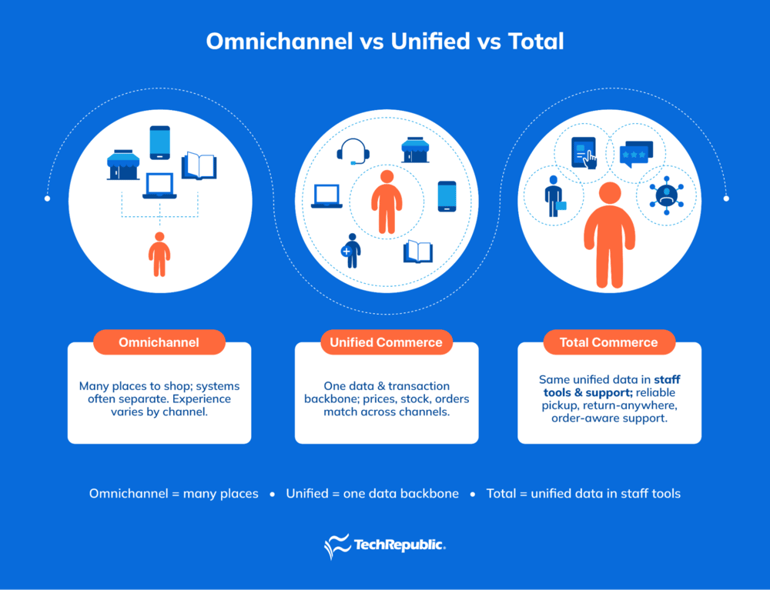
Example business: Ridge Outfitters (apparel + gear)
To make the differences concrete, let’s follow one shopper and one product across three setups. Meet Ridge Outfitters, a small chain that sells jackets, boots, and trail gear online and in two stores. We will follow the same shopper and the same rain jacket through three scenarios.
First, Ridge runs a basic omnichannel setup where systems are separate and results vary by channel. Second, Ridge moves to unified commerce with one data backbone so prices and inventory match everywhere. Finally, Ridge operates as total commerce, where that unified data is available in staff tools and support, so pickup, returns, and answers are consistent end to end.
Omnichannel (many places, separate systems)
- Scenario. A shopper finds a rain jacket on Instagram, checks the website, then visits the store.
- What the customer sees. Price on Instagram promo is $119, website shows $125, store tag is $129. Store says, “Call to check stock.”
- What staff experiences. POS and ecommerce are separate; store associates phone the stockroom and guess on availability. Returns for web purchases require emailing online support.
- Where it breaks. BOPIS is a banner but not reliable. Customer gives up or waits. Refunds take days because the store can’t process web returns.
Unified commerce (one data backbone)
- Scenario. Same shopper, same jacket.
- What the customer sees. Price and promo match at $119 across social, web, and in-store. The product page shows, “Pickup today at Main Street.”
- What staff experiences. Inventory, price, and orders live on one backbone, but the store uses one app and support uses another. The associate lacks a single screen to view the web order.
- What works. BOPIS is dependable because stock and prices align.
- What still hurts. The customer can’t return the web order at the counter without a manager switching systems. Support asks for order details twice because their view isn’t enriched.
Total commerce (unified data in staff tools and workflows)
- Scenario. Same shopper, same jacket.
- What the customer sees. The product page shows “Pickup 2-4 p.m. today.” After checkout, a “ready for pickup” text arrives with the order code. If the fit is off, the customer walks to the counter and returns it on the spot.
- What staff experiences. One screen to search by name/email/order number. Pick tickets print with aisle/bin; staging shelf holds labeled bags. Counter app processes web returns with reason codes and fires a same-day refund. Support sees the same order, status, and tracking, and closes questions in one reply.
- What improves.
- Speed: Single-item BOPIS staged in under 5 minutes; pickups ready on time ~95%.
- Clarity: Same policy text on site, emails, and receipts; fewer “Is it ready?” calls.
- Trust: Same-day refund initiation; fewer escalations; repeat purchases rise.
Why total commerce and TX are important right now
Zooming out, these market shifts explain why tech buyers are prioritizing a single, shared view across channels. Total experience is rising because dependable operations now matter as much as assortment or price. Tech buyers are prioritizing one shared view of products, orders, customers, and inventory so promises made online are kept at the counter and in support.
- Choppy conditions reward brands that keep promises. When costs and demand swing, brands that keep pickup windows real, refunds predictable, and support answers consistently hold onto loyalty. TX helps by aligning policies and data across teams so friction does not creep in during disruptions.
- AI is useful only when the data is unified. Generative and predictive tools can route tickets, suggest next best actions, and tailor recommendations, but they need clean product, order, and customer records. TX gives AI a reliable substrate so “personalization” improves resolution time and conversion rather than adding noise.
- Employees and partners expect modern workflows. Staff want one screen for lookup and returns. Partners want clear SLAs, cleaner integrations, and self-serve status. TX supports both through unified portals, consistent policies, and live dashboards that reduce handoffs.
- Omnichannel expectations are now baseline. Shoppers move from social to site to store and expect the same price, inventory, and policy everywhere. Treating stores as fulfillment nodes for BOPIS, curbside, and return-anywhere only works when the same order and inventory view is available to associates and support.
See also: AI in E-commerce: The Ultimate Guide to Growth & Automation
Total commerce strategy: 5 capabilities that drive ROI
These are the capabilities that reliably move KPIs and reduce exceptions — you can verify each weekly. For each, I explain why it matters, how to roll it out with buyer-level detail, the minimum data you need aligned, and a realistic target.
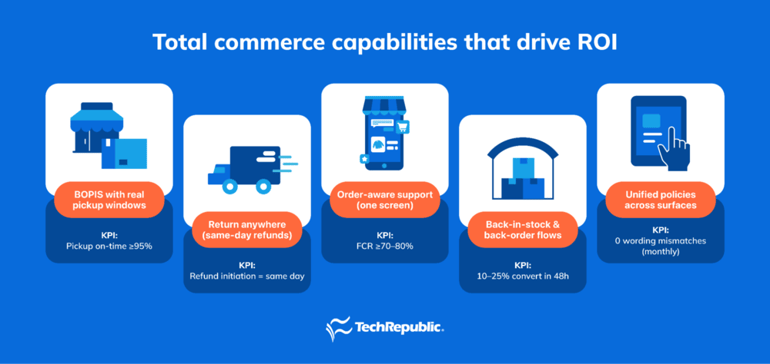
Reliable BOPIS with real pickup windows
Pickup converts nearby web traffic without shipping cost and smooths store traffic, as long as the promise is real. The goal is simple: show accurate local availability, commit to a pickup window, and hit it. When location-level inventory, store hours, and order timestamps (“promised_at” vs “ready_at”) are aligned, you’ll see higher conversion and fewer “Where is my order?” contacts.
How to implement:
- Show local stock on product pages and a specific pickup window at checkout (e.g., “Today 2-4 p.m.”).
- Print a pick ticket with aisle/bin; stage by last name on a dedicated shelf near the counter or stockroom.
- Mark orders “Ready for pickup” and send a short SMS/email with store hours, ID requirements, and pickup code.
- Run a daily 5-minute review of late pickups; tag the cause (stock not received, price mismatch, staging delay) and fix the top offender.
Aim for pickup on time ≥95% of the time and single-item stage time at ≤5 minutes, powered by clean ATP (available to promise) by location, consistent pricing between site and POS, and basic customer contact fields for notifications. Promising pickup before the PO (purchase order) lands or safety stock is set leads to no-shows; buffer fast movers with a small location safety stock. Price mismatches between site and POS erode trust; spot-check top SKUs weekly and fix at the source, not at the counter.
Return anywhere with same-day refund initiation
Fast, predictable returns protect loyalty and reduce chargebacks, if the counter can find the order and issue the refund without a hand-off. The aim is simple: one lookup, one script, and a refund initiated the day the item comes back in good condition. When cross-channel order data, reason codes, and refund methods line up, support volume drops and trust rises.
How to implement:
- Add a “Returns” button on the POS home screen that searches by name, email, or order ID.
- Use a one-page script: greet, verify, inspect, select outcome (refund/exchange/credit), state refund timing.
- Post the refund to the original tender with an idempotency key; print/email a receipt with reason code and timing.
- Set a clear exception path (e.g., suspected fraud, worn/used items) with a manager review rule.
Aim for counter handling time ≤3 minutes and same-day refund initiation for eligible items, backed by reliable order lookups, mapped tenders, and consistent reason codes. Paper-only web returns and mismatched refund text (site vs receipt) create disputes; keep the copy identical everywhere and remove any requirement for printed emails.
Order-aware support on one screen
Most “where is my order” questions are solvable in one reply when agents see status, tracking, and return history without switching tabs. The goal is one screen with the facts and macros that echo your policy word-for-word.
How to implement:
- Surface order ID, payment state, tracking link, pickup window, and return history in the help desk sidebar.
- Create macros that paste the exact pickup/refund wording; include a direct tracking URL.
- Route order-status contacts to a queue that always shows carrier state and last event.
- Tag ticket topics (order status, return, exchange) to spot bottlenecks and fix upstream.
Target first-contact resolution at 70%-80% for order topics and reduce average handle time as agents stop “swiveling.” Gaps usually come from missing integrations or inconsistent policy text in macros; connect the help desk to your ecommerce/OMS and centralize the copy so everyone says the same thing.
Back in stock and back order flows that convert pent-up demand
Sold-out interest is free demand. Alerts and clear back-order windows turn that demand into revenue without more ad spend, if timing and consent are handled correctly.
How to implement:
- Add “Email me when it’s back” and, where appropriate, a “Reserve from next shipment” option on high-demand SKUs.
- Deduplicate signups by email/phone; trigger alerts the moment available-to-promise rises above zero.
- Include store pickup in the alert and send a next-day resend to non-openers.
- For back-orders, show an honest ship or pickup window and update buyers if it slips.
Aim for 10-25% alert-to-order conversion within 48 hours (category dependent) and a visible drop in “Do you have this?” messages. Misses happen when alerts fire after inventory is already gone or when timing is vague; wire alerts to real stock events and include a concrete window.
Unified policies across site, emails, and receipts
Consistent promises are the easiest way to cut disputes and training time. One source of truth for pickup windows, refund timing, and price-match rules keeps everyone on the same page.
How to implement
- Maintain one policy file (pickup SLA, refund timing, price-match rules) with version control.
- Publish the same text to product pages, checkout, order emails, receipts, and counter signs.
- Add a simple “if we slip” play (small make-good that fits your margins) and script it into macros.
Run a monthly audit for zero wording mismatches and aim for post-pickup/return CSAT ≥4.5/5. Most issues come from editing copy in one place only or staff improvising at rush; lock the source and train to read it verbatim.
Total commerce architecture: The practical stack
You don’t need an enterprise rebuild to start; this stack supports the five capabilities with minimal lift. Start with the lightest stack that can deliver your core capabilities (BOPIS, return-anywhere, order-aware support, alerts, unified policies). If a recurring blocker remains after process fixes, upgrade that one piece; don’t replatform.
1. Online store and POS
Your store site and registers handle product pages, cart/checkout, taxes, and basic inventory. If prices and SKUs match between site and POS, you can run reliable pickup and counter returns without extra tools. Avoid “fixing” price mismatches at the counter; correct at the source so web and POS stay aligned.
How to set this up:
- Starter options: Shopify or BigCommerce (site); Shopify POS, Square, or Lightspeed (in store).
- What I check first: SKU parity (same IDs both sides), tax rules aligned, and price sync on top SKUs.
- When to upgrade: Multi-store complexity, advanced inventory (kits, batch/lot), or B2B pricing rules that don’t fit defaults.
2. Order routing and shipping
This involves labels, routing rules, tracking, and light OMS. If you can print labels, route to the right location, and push tracking into emails and support, you’re ready for BOPIS/ship-from-store. Oversells usually mean stale counts or no safety stock on fast movers; fix those before swapping tools.
How to set this up:
- Starter options: ShipStation, ShippingEasy, or Easyship with your platform’s built-ins.
- What I check first: Location-level ATP, simple routing rules, tracking flowing into order emails and support views.
- When to upgrade: Multi-warehouse splits, purchase orders, returns routing, frequent oversells. Step up to Cin7, Extensiv, or Linnworks for deeper OMS.
3. Support desk
Email/chat/social with order context on one screen. If agents can see status, tracking, and return history without tab-swapping, FCR (first contact resolution) jumps, and handle time drops. Policy text drifts fast; keep one source of truth and render it in macros, website, and receipts.
How to set this up:
- Starter options: Gorgias or Zendesk with native ecommerce integrations.
- What I check first: Order ID, payment state, tracking link, pickup window, and return history visible in the sidebar; macros reuse the same policy text as your site.
- When to upgrade: Multiple brands/queues, complex SLAs, or deeper analytics/reporting needs.
4. Messaging for email and SMS
Order confirmations, pickup/return notifications, and back-in-stock alerts are where you get fast ROI. If messages are order-aware and permissioned, you’ll convert without extra ad spend. Deduplicate alert signups and resend once to non-openers — don’t spam.
How to set this up:
- Starter options: Klaviyo or Mailchimp connected to your store.
- What I check first: Consent flags flow in, events trigger on time (order created, ready for pickup, restock), and deliverability is healthy.
- When to upgrade: Larger list with advanced segmentation/testing or multi-brand orchestration.
5. Payments and buy now, pay later (BNPL)
Processing, refunds, express checkout, and dispute webhooks. If refunds post reliably and express pay works, you’ll cut friction at checkout and counter. Train staff to initiate refunds the same day items are received; queue exceptions for manager review, not everything.
How to set this up:
- Starter options: Stripe or your platform’s processor; Shop Pay, PayPal, or Afterpay if they fit your audience.
- What I check first: Idempotent refunds (one API call = one refund), dispute webhooks into support, express wallets enabled.
- When to change: Unfavorable rates, missing tenders, or unreliable refund/chargeback webhooks.
Vendor menu: Starter options and upgrade signals
Use this as a menu, not a prescription. Pick tools that match your team, budget, and timeline.
| Online store | Product pages, cart, checkout | Shopify, BigCommerce | Complex pricing, multiple storefronts, heavy B2B |
| POS | Counter sales, barcode, basic inventory | Shopify POS, Square, Lightspeed | More registers/locations, advanced inventory |
| Order routing & shipping | Labels, routing, tracking | ShipStation, ShippingEasy, Easyship | Multi-warehouse rules, purchase orders, returns routing |
| Support desk | Email, chat, social with order lookup | Gorgias, Zendesk | Multiple brands, complex SLAs, deep analytics |
| Email & SMS | Order-aware flows, alerts | Klaviyo, Mailchimp | Larger list, advanced segmentation and testing |
| Payments & BNPL | Processing, refunds, express pay | Stripe or platform processor; Shop Pay, PayPal, Afterpay | Need lower rates, additional tenders, advanced risk tools |
Related guides:
- 7 Best Small Business Point-of-Sale (POS) Systems
- 8 Best E-Commerce Platforms For Your Business
- The 6 Best Payment Processing Companies
Suite vs composable stack: How to choose
- Go suite-first if the team is small, timeline tight, and your needs map to defaults. You’ll standardize faster with fewer vendors and less monitoring.
- Go composable-light if one or two domains truly need “best of breed” (most often support desk or shipping/OMS). Keep the core platform and add targeted components where ROI is clear.
Favor a suite when integration and monitoring work is consuming more than a day each week, and you’re seeing policy text or prices diverge between systems — those are signs you need fewer moving parts and tighter defaults. Lean composable when a suite module is clearly the bottleneck for returns, shipping rules, or the agent UI, and you’ve started building workarounds; that’s your cue to add a best-in-class component in that one domain rather than living with the constraint.
Map the five capabilities to your current stack. If you can hit the target metrics with configuration and a low-cost add-on, pilot now in one location. If a single blocker persists after cleanup (e.g., repeated oversells, slow refunds, missing order context for agents), shortlist one upgrade in that domain and pilot it before expanding.
Pilot total commerce in 90 days: Single-location guide
Here’s how I’d run a focused pilot without a replatform. Keep scope to one store and a small product set, wire your existing tools together, and prove the basics: on-time pickup, return anywhere, and order-aware support. The next 90 days outline what to turn on, who does what, and which numbers tell you it’s working.
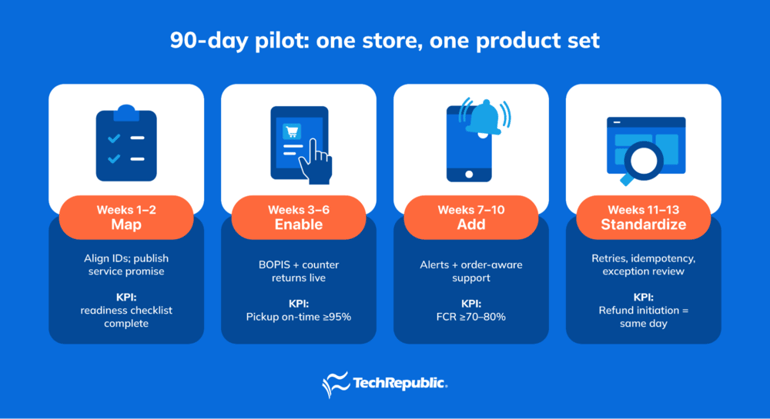
Weeks 1-2: Map and prepare
- Identify inventory systems, project or system owners, and connectors for POS, ecommerce, payments, shipping, and support. Note what is in use, who owns it, and where data moves.
- Align IDs for products, customers, orders, and locations. Confirm SKU parity and basic customer identifiers work across tools.
- Publish a one-page service promise that uses the same wording everywhere. Include pickup window, refund timing, and price-match rules.
- Write two short SOPs and post them where staff work:
- “Pick and stage for BOPIS”
- “Counter return script” with outcomes and refund timing
Weeks 3-6: Enable BOPIS and in-store returns
- Turn on “Pick up in store” with specific windows on product pages and at checkout.
- Add a staging shelf and print a pick ticket with aisle or bin so anyone can grab the item quickly.
- Train counter staff to look up orders by name, email, or order number. Initiate refunds the same day items return in good condition.
- Send a “ready for pickup” message with store hours and pickup code.
Weeks 7-10: Add alerts and order-aware support
- Enable back-in-stock alerts on popular items. Trigger email and SMS messages as soon as on-hand stock rises above zero. Resend once to non-openers the next day.
- In the help desk, show order status, tracking, pickup window, and return history on a single screen.
- Add macros that reuse the exact policy text: “pickup ready,” “return approved,” and “refund issued.”
Weeks 11-13: Tighten and standardize procedures
- Track weekly:
- Pickup on-time percentage
- Refund initiation latency
- First-contact resolution for order topics
- Optional: repeat purchase rate for the pilot cohort
- Add retries for notifications and require idempotency keys for refunds so duplicates do not post.
- Review exceptions. Focus on oversells, delayed pickups, and refund delays. Fix the top two root causes before expanding scope.
KPI scorecard (formulas + targets)
If these metrics move the right way in one store, you’ve earned the right to scale.
| Pickup on-time % | Reliability of BOPIS | on_time_bopis / total_bopis where on_time_bopis = count of orders with ready_at ≤ promised_at | ≥ 95% |
| Stage time (min) | Store ops efficiency | MEDIAN( minutes( staged_at − order_received_at ) ) for single-item BOPIS | ≤ 5 min |
| Refund initiation latency | Return experience clarity | MEDIAN( minutes( refund_initiated_at − return_received_at ) ) for eligible returns | Same day (≤ 1,440 min) |
| First-contact resolution (FCR) | Order-aware support quality | single_reply_tickets / total_order_tickets | ≥ 70–80% |
| Back-in-stock conversion (48h) | Demand capture from alerts | orders_from_alerts_48h / alert_sends | 10-25% (category-dependent) |
| Policy consistency defects | Trust and compliance | Count mismatches between website, emails, receipts in monthly audit | 0 |
| Repeat purchase rate (pilot cohort) | Loyalty signal from smoother ops | returning_customers / total_customers in 30- to 60-day cohort post-pilot | Rising vs baseline |
Bottom line
Total commerce doesn’t require a rebuild; it requires one shared view of products, orders, customers, and inventory, and tools that put that view in front of associates and support. Start with five capabilities that customers feel immediately: reliable BOPIS, return anywhere with same-day refunds, order-aware support, back-in-stock/back-order flows, and consistent policies.
Prove it in one store over 90 days, watch pickup on-time, refund latency, and first-contact resolution, and only upgrade a tool when a recurring blocker remains after process fixes. If those metrics move, you’ve earned the right to scale.