


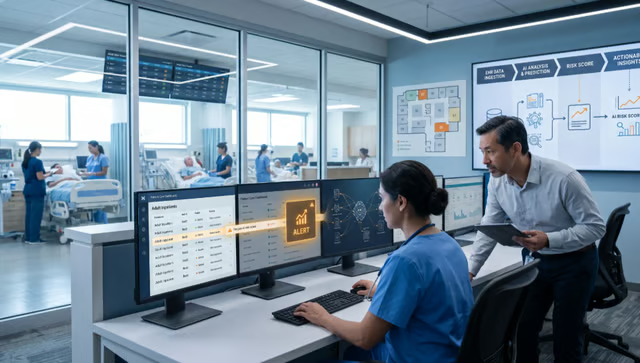
A patient’s medical record can contain warning signs that busy hospital staff may not immediately catch. Healthleap wants artificial intelligence to help find them.
The healthcare AI startup Healthleap announced on Wednesday a $38 million funding package to scale its clinical AI platform, which scans inpatient records daily to spot signs of neglected illnesses. The capital combines an $8 million seed round co-led by Sequoia Capital and First Round Capital with a $30 million Series A led by Hummingbird Ventures, as first reported by TechCrunch.
Healthleap did not disclose its valuation.
Sibling founders Jemima and Josiah Meyer launched the company in South Africa in 2022 after Jemima, working as a clinical dietitian, realized too many patients were receiving nutritional interventions far too late.
How Healthleap analyzes patient records
Rather than attempting to automate medical diagnosis, Healthleap acts as an administrative safety net. Each night, its natural language models ingest adult inpatients’ electronic health records (EHR), combining vital signs and laboratory metrics with free-form clinical notes.
The software searches for clues clinicians often lack the hours to cross-reference, such as passing mentions of appetite loss, muscle wasting, or difficulty swallowing. Come morning, risk scores appear directly in existing clinical dashboards.
“A patient’s chart holds two kinds of data. Labs, weights, and vital signs sit in structured fields, but the most telling signs sit in clinicians’ written notes: poor appetite, recent weight loss, muscle loss, trouble swallowing. Our developing approach is extracting affirmative or negated mentions of these clinical concepts in an easily extensible and scalable way,” Josiah Meyer told TechCrunch.
While starting with malnutrition, which affects up to half of admitted inpatients but is formally diagnosed in under 9%, the company has expanded to delirium and is validating models for conditions like congestive heart failure and aspiration pneumonia.
Hospital savings strengthen the business case for AI
Healthleap says it expanded from three to more than 50 hospital partners over the past year, reflecting growing interest in AI tools that can support clinical care while delivering measurable financial benefits.
The company says that its malnutrition screening technology generated an estimated $23.8 million in annualized value. That includes $6.3 million in additional reimbursements and $17.5 million attributed to shorter hospital stays.
These company-reported figures illustrate the financial appeal of identifying medical conditions earlier, although they do not establish how consistently other hospitals could achieve similar results.
The approach also raises questions about clinical oversight. Hospitals must ensure that automated alerts reflect genuine patient needs rather than reimbursement opportunities. Excessive alerts could also add to clinicians’ workloads if the systems are not carefully integrated into existing care processes.
As Healthleap expands beyond malnutrition screening, independent clinical validation will be important in determining whether its models can deliver reliable results across different hospitals and patient populations.
More must-read AI coverage
- SS&C Intralinks DealCentre AI vs. Datasite: Which platform is built for the future of dealmaking?
- SS&C Intralinks FundCentre AI vs. Juniper Square: Which platform better supports modern private markets fund managers?
- Why Data, Not Models, Determines AI Success
- The Rise of the AI-Native Factory: How Physical AI Is Transforming Manufacturing
What this shift means for patient care
For hospitalized individuals, silent complications frequently compound their primary illness; an overlooked nutritional deficit can quietly stall wound healing and prolong an ICU stay by days.
Automated surveillance ensures that frail, sedated, or non-verbal patients, who cannot advocate for themselves or answer routine admission questionnaires, receive specialist dietetic evaluations early.
However, identifying a potential risk is only the first step. Clinicians must still evaluate the findings, determine whether intervention is necessary, and decide on appropriate care.
Healthleap’s expansion will test whether AI can consistently turn information buried in hospital records into earlier clinical action, without adding unnecessary alerts or increasing pressure on already stretched medical teams.
Other news: XtalPi has introduced Kodexia, an AI-powered platform that combines generative AI and automated laboratory testing to accelerate RNA-based drug discovery.