Discussion Locked
Bob's Blog
0 helpful
70 replies
Closed to new repliesThis discussion is closed. It stays readable, but it takes no new replies.
blog root

After Hours
Wired has a good introduction to Greasemonkey, the Firefox plugin that allows you create custom browser behavior for individual websites. It also describes several examples of Greasemonkey applications.
Read the Wired article here
all i've used is google, but I absolutely swear by it.
What google desktop search pointed out to me is just how badly Outlook search works...and I put up with it for years without thinking of it. What an opportunity and tool...why didn't it happen before now? I'm kicking myself for not thinking of it.
by debuggist
I have Google Desktop search installed, but I rarely use it. It searches too much for me. Usually, I just want to search the filesystem or email but not both.
For Outlook search, I use Lookout. It integrates with Outlook, so I don't have to leave the application. And it works really well and is fast. It used to be here: http://sandbox.msn.com/ (this site has some cool tools). You can get it at http://www.lookoutsoft.com/Lookout/download.html.
by Jay Garmon
by jasonhiner
I was talking with my boss yesterday about mobile phones and kids. He was saying that it wouldn't surprise him if he ended up getting his son a mobile phone in 2-3 years, when his son would be entering first grade.
I agreed with him.
In my case, as a divorced parent with four kids, giving my older kids mobile phones has been a necessity for scheduling, as well as to alleviate my concerns about their safety.
And the trend is for me to get them at younger and younger ages. I got my son his phone when he graduated from eighth grade (age 14). My oldest daughter got hers when she started going to a new middle school (age 11). My two youngest daughters are 9 and 6, and I bet I end up getting them phones in the next couple of years. With the marketing of add-on plans, it isn't that much more expensive.
What about you - do you parents out there feel the same way, or are you putting this off as long as possible?
One trend I've noticed in my kids' use of technology. Last year, my kids were IM junkies. Specifically, they were AOL IM fanatics, spending lots of time online IMing their friends (and throwing their dad an occasional message).
This year, they hardly use IM at all - the ones with mobile phones have gone exclusively to text messaging.
I got a flier in the mail about a Disaster Recovery conference, and was looking at the session descriptions. I found the cliche I expected...guess what the title of the off-site data storage session is:
"Don't put all your eggs in one basket"
Couldn't they have livened up a little bit? How about:
Don't put all your Terrabytes in one basket
Don't put all your eggs in one RAID array
Don't put all your tapes in one non-protected, vulnerable to fire, theft or water damage basket
Anything...
First we here at TechRepublic offered ourBirthday Sweepstakes, and now NASA is getting into the act.
Wired is reporting that NASA is giving $250,000 away.
On first glance, that might seem more impressive than the being selected at random by TechRepublic to receive an iPod mini or a TechRepublic coffee mug.
On the other hand, our sweepstakes is a little easier to enter than winning NASA's cash - to get your hands on that, you have to be the first to design a system that turns lunar soil into breathable oxygen for astronauts.
This is only one of NASA's Centennial Challenges, which attempt to use the interest in the X-Prize to get solutions to technical issues facing future NASA missions.
Reading the various posts about Revenge of the Sith, particularly those from folks (like myself) who consider ourselves less hopeless, because we waited until Thursday afternoon to see the movie instead of lining for the midnight show, reminded me of the classic Geek Hierarchy Chart.
Based on this system of values, I'm hardly a geek at all - in fact, I'm only on the second level out of nine possible levels of Geek Hierarchy.
As opposed to, say these guys.
Over at the Joel On Software blog, Joel Spolsky has posted his list of the best books for programmers.
He created the list back in 2002. It's amazing to me how influential Peopleware and Code Complete have been in the past decade.
I can't tell you how many list of top programming books I've seen that reference these two books.
The Wall Street Journal has an interesting piece about a new job title: Chief Blogger. (Article free for now, but I don't know for how long).
Here is the money graph:
A small but growing number of businesses are hiring people to write blogs, otherwise known as Web logs, or frequently updated online journals. Companies are looking for candidates who can write in a conversational style about timely topics that would appeal to customers, clients and potential recruits.
Another interesting data point from the article: Microsoft has 1,500 employee blogs.
This BBC story about Paul Mockapetris, the inventor of the DNS system, receiving a lifetime acheivement award, struck a chord with me.
Why is it that the technology industry is so bad at remembering the achievements of those who built the industry? It's as if everyone who works in tech has a kind of collective amnesia.
I thought about this when I read about George Dantzig's passing recently. Dantzig was the inventor of the Simplex Method, the foundation of linear programming.
As Rex put it in his entry about Dantzig:
His discovery contributed so much to modern life. Could FedEx and UPS even exist without linear programming to optimize their delivery schedules? How would we route electric power efficiently across continental power grids? But while there's plenty of coverage for the season finale of Desperate Housewives, the passing of a 20th-century giant goes largely un-noticed.
So why is it that we can't remember the giants who came before us?
by jmgarvin
It isn't "news" to the media. While Dantzig should be a household
name, it isn't. He did so much for programming (and computer
science in general) that he isn't forgotten by the "geeks." He
was a great man and should have make more headlines with his
passing. You have to wonder what will happen as the other greats
pass? Sure there are the knobs that are politically involved and
come off as morons (Noam Chomsky comes to mind), but that doesn't
mitigate his contribution to the computing field.
On that note there is an exceptionally sad part to this. The post
Y2K world is turning into the 1980's all over again. Why?
We have great computer minds advancing the industry, but very few users
are educated (or care) enough to take note. Computers are still
toys to most business and the CEO/CFO/COO don't understand you need a
staff of people to keep things humming...don't the damn things just
work?
by gene.fellner
It infuriates me that the PC community acts as though mainframes never existed. They keep reinventing the wheel, and doing a pretty poor job of it. Deadlocks? Application program failures crashing the OS? We solved those problems on Univac mainframes more than 25 years ago.
But my personal favorite teeth-gnasher, the single reason that the so-called "information infrastructure" is nothing more than a glorified sandbox: Instructions masquerading as data and installing themselves in someone else's computer. You couldn't do that on a Univac mainframe. Instructions and data resided in physically separate areas of memory. You could not store anything into the instruction bank and you could not execute anything from the data bank.
The sandbox denizens who invented Windows get an F-minus in history. They wouldn't be allowed near an old mainframe shop with overalls and a mop.
Sure, the concept of securing a program library is different on a single-user PC than on a departmental mainframe. You don't have an operations staff with procedures that take a week to store a new version of a program in a production library, allowing time to verify that it wasn't compromised by a spy, criminal, or incompetent programmer. But hey, isn't everything supposed to be faster and more automated on PCs? Why don't we have software that does the job of the old production program librarians? More to the point, why don't the architects of the "information infrastructure" even care? They act as though it's one of the requirements of the technology to PERMIT strangers to infect each other's computers with cookies and whatnot.
Sorry, I guess I missed that day in sex education. We were taught never to accept cookies from strangers.
by unclegeorge
A similar question was recently asked about a local tribute to the famous new commentator Edward R. Murrow, who grew up in Bow, Washington. There is no such tribute. Murrow, you may recall, was insturmental in the collapse of Joe McArthy, the ultra-right pal of then little-known opportunist Richard M. Nixon. His radio show performing that feat was later recalled, "...as the week broadcasting recaptured it soul."
It is not to the advantage of consumerist America to reward education in any real way. Training, maybe, education, no. How else could the sheep be targeted by herd? Now we have the added attraction of the crazed zealot bunch pushing "creationism"? Unlikely the educated would jump on that "save-your-soul-my-way-only" bandwagon.
There's a story about the farmer spending so much time weighing the pig that the pig starved to death. Federal programs seem fixated on measurment. Nowhere has there been acknowledgement that we need to go not 30:1 but 1:1 if necessary to catch up to other nation's children and their culture of education.
"Educated people do not good draftees make." The value of education to the normal man has been pitifully degraded since WWII, and certainly since Viet Nam. While "The Greatest Generation" veterans received books, tuition, room and board for college, no such endowment has ever be granted since.
Maybe Ed Murrow broadcast's effect forever changed America. Maybe that was the point when the chioce was made to make education secondary to social engineering. Maybe when learned Americans heard, "Senator, have you no shame?", they reasoned that enough was, and had been, enought, and that the cheap, sensationalist, tactics of the fringe rightist McArthy were so transparant and shallow as to disgust even those who shared some of his conservative views.
The Greatest Generation can't really be blamed for forgetting its prodegy. Who knew? In the '60 we all thought Mars colonization was only a step away, television still held the empty promise of educating the masses, and those days of the rabble burning the library and skinning the curator alive with oyster shells seemed a long time ago.
Shuckey -- as that event was, it once again (and, again, and again) points out that education must be for the masses, not the elite. The idea that we can keep the populance ignorent ignores the fact that our system of govenment still lets them vote. And why have to think when you vote, those issues can be soooo complex. Let's just put some football jock who thumps the Bible loudest in there and party 'til the rapture! Maybe we can burn a few libraries in the process.
Want more? Ed Bennet, former Dept. of Education director -- Republican. Unlike other directors, asking for twice what's necessary to get what's needed, he asks for less. What were the end results of that? Flowery talk, but no money, no education. Works that way in other conservitive effirts, Wbat it to work? Give it money. Education is no different.
"Nations have recently been led to borrow billions for war;
no nation has ever borrowed largely for education...
no nation is rich enough to pay for both war and civilization.
We must make our choice; we cannot have both." -- Abraham Flexner
Higher education needs to be easily accessible and if it is to be
really efficient open on the basis of ability and earnestness.
A serious and general social loss is also incurred if superior
opportunities are lavished upon the stupid or indolent, for no
better reason than they are the right sort." --A. Flexner
Live and learn.
Best, UncleG
Technology Review has an interesting perspective on Apple's announcement of podcasting support in the next release of iTunes.
It's hard to disagree with this:
It's the ease-of-use attribute that many believe will boost the podcasting community.
"Podcasts today are still too difficult to bring to your device," says Tim Bajarin, president of Creative Strategies, a technology analysis firm. "Now, Apple is bringing the point-and-click approach to downloading podcasts
David Berlind over at ZDNet is our resident podcasting wizard. Interestingly, he devotes not a few blog entries to the mechanics of podcasting:
If a technology requires such high-powered support, it clearly isn't ready for the big-time yet. Maybe Apple's support will turn the corner.
There is a great piece in the Washington Post today recapping the FBI's failed attempt to move to an electronic case management system. The project, called the Virtual Case File, was finally stopped this past March, after the bureau spent $170 million trying to implement it. Many of the problems with Virtual Case File will be painfully familiar to anyone who's worked on either side of a custom development project:
So it's not just money. Even with an almost limitless budget, a poorly defined project, with constantly changing requirements, poor oversight and inadequate communication between the developers and the business unit is bound to fail.
by debuggist
"...Zalmai Azmi -- the FBI's new information technology chief and
the fourth person to occupy the position during the VCF project..."
Just a reminder that we have a number of people blogging from TechEd, which starts today. We're asking TechRepublic bloggers to use teh TechEd2005 tag in their posts.
Here is a list of blog posts about TechEd - more to come in the hours and days ahead.
by vetch_101
Hi,
John Sheesley mentioned in todays Tech Pro Guild message that he'd been to a session
entitled, "Tips and Tricks to Running Windows with Least Privilege".
Could you post an update on the options they recommended - I've been
working hard to find a happy medium between security and functionality
within a corporate environment...
Many thanks,
Joe
Jason Hiner is one of the folks who are down at TechEd.
He's taken a bunch of photos along with commentary from the event.
You gotta love those bean bag chairs...
I'm back from vacation, and currently waiting for Outlook to try and process 60MB of unread messages from the past week and a half.
I'm curious: what do you do on vacation: stay pretty wired in to email, etc. while you're out to make the return easier, or truly try to get away?
I've tried both, and I'm not sure there is a right answer.
If you've looked at the new features we've introduced here on TechRepublic lately, you can see that we're aggressively supporting RSS feeds where ever possible. This is only natural, as most of us are enthusiastic consumers of RSS feeds, for both professional and personal use.
Our sister site, News.com has even created a web-based RSS service that is becoming increasingly popular, called Newsburst.
However, much as I use and enjoy the benefits of RSS feeds, I'm not sure I agree with those that predict RSS readers will eventually eliminate the need for email newsletters.
To my mind, email newsletters have some advantages:
What do you think?
(BTW, I've listed some resources on this topic - click on my Links tab
by dalej
THe fact of the matter is most newsletter publishers are happy to get a 20% open rate with their newsletter email lists. It is not a question as to which is better: email or RSS. Email as a conduit for delivering newsletters is dead. Spam has killed it. There might be all sorts of reasons why email is better than RSS, but it is irrelevant if email does not work.
Newsletter publishers must change and adapt to the new realities of spam filters and firewall blockages. To assist them, tools like http://www.NewslettersByRSS.com are cropping up. This is a "bridge" product allowing newsletter publishers to continue to post their new issues by email - but creates an RSS feed of these new issues for those readers who prefer RSS.
And for publishers who want to immediately show their readers the value of their content, use http://www.WebRSSReader.com - a browser based RSS reader with the traditinal "3-panel" look. It is a pne-click method of seeing whether or not an RSS feed is worth subscribing to.
Dale Janssen
ToolButton Inc.
Given the introduction of Google Maps, and more importantly the API that others are using to build new apps on top of it, more and more people are finding creative ways to overlay data on maps.
Of course, this is not a new phenomenon. Recall the famous Blue vs. Red maps of the 2000 and 2004 U.S. Elections, which show the winners at the county level.
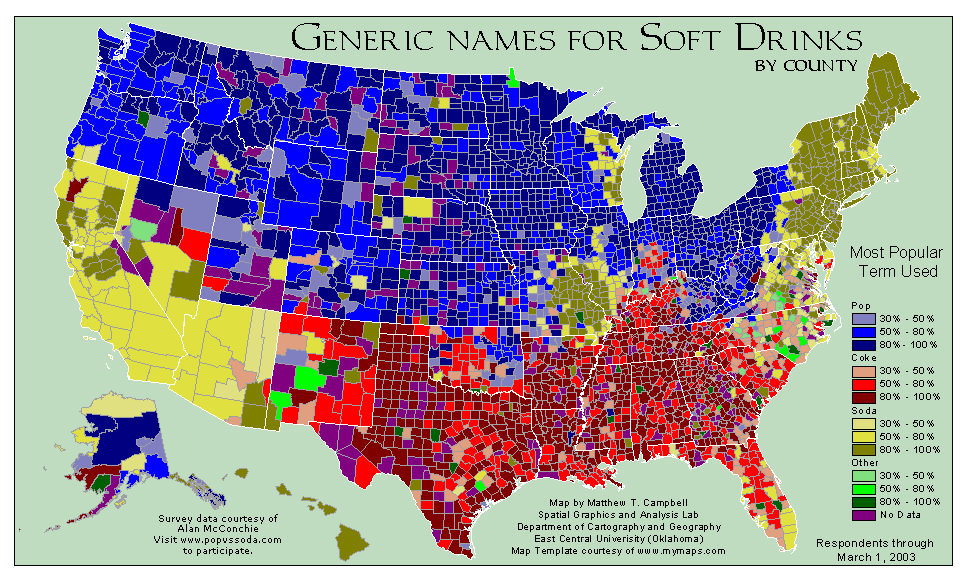
My favorite is the map which overlays the terms people use for soft drinks in various parts of the United States. (Since I know you're curious, I say "pop," betraying the fact that my formative years were spent in Chicago, while my kids say "coke," reflecting their years in the South.
This kind of thing is fun for most of us, and critical for many professionals. Where I live, for example, people have tried and failed for years to create a comprehensive map of the country which overlays all the various cabling from all municipal utilities and telecom providers. The rise of web-based mapping systems makes such a project feasible for the first time.
So far, so good.
However, I do get worried from time to time about our increasing reliance on maps and graphics to convey information. It is certainly true that a graphical representation of data can reinforce a primary message in such a way that a column of figures can never hope to match. Further, a well-designed map or data graphic can also illustrate the relationships between two variables, relationships that you might miss when looking at a spreadsheet.
At the same time, we can't lose sight of the fact that data mapping of this kind almost always involves some kind of simplification. By definition, when we map something, we filter it at the same time we try to represent it. This doesn't imply some kind of paranoid conspiracy theory ("watch out for the mapmakers!"), but is just a fact of life.
Maybe it's my background in database design, but I like to be able to query the actual numbers myself. When I find the relationships that I'm looking for, I'll make my own maps.
Of course, one can argue that much data mapping saves effort - why reinvent the wheel, and force everyone to query the same data sets to produce the same maps?
I agree, and I'm not suggesting that the new web-based mapping services aren't terrific. I use them all the time.
I just don't want to people to think that clicking on the Zoom In and Zoom Out indicators on a Google Map is the same thing as designing a SQL query.
by dxmoody
You're right, of course. I was trying to exaggerate to make a point.
by marc_pearl
Download the free ESRI viewer, then you can drill down to your hearts desire on thousands of maps with detailed data attached.
Marc
Last post, I was blathering on about my concerns about the increasing use of graphical data displays. While I love the power that web-based mapping applications from Google and others give developers to overlay data, I am concerned that people fail to understand that the image is NOT the data, but a representation of the data, and one that is simplified.
For me, these kind of discussions always go back to Edward Tufte, the guru of good data displays. If you've heard of him, it's probably in connection with his (deserved) rants about the limitations of PowerPoint.
Check out this thread on effective project management visual aids.
Interestingly, I liked the comments on the use of sticky posts as a way to start the project management display process. This also ties into the notion that the best way to view a project management display is to be able to see the whole thing, so that each subroutine is viewed in context to the larger project. This means instead of looking at a piece of a Gannt chart on a computer monitor, that it is more effective to use a whiteboard or wall chart. Here is an example of how one PM did it:

The entire thread is well-worth reading.
In fact, Tufte is worth studying in some detail.
A comment to a post of mine about TechEd asked
"John Sheesley mentioned in todays Tech Pro Guild message that he'd been to a session entitled, "Tips and Tricks to Running Windows with Least Privilege". Could you post an update on the options they recommended - I've been working hard to find a happy medium between security and functionality within a corporate environment... "
I asked John about it, and he shot off this quick response:
"The basic idea behind that session was that users should not be allowed to have Adminsitrator rights on their own machines in a network environment. Administrator rights give users too much free access to the underlying parts of Windows that can allow them to get in trouble. It's nothing against the users themselves. Spyware and viruses use the Administrator rights granted to users to insert themselves on a machine.
"User-only privileges blocks access to changing Windows system files, stopping many viruses in their tracks. Without proper privileges, a user can't install software, and therefore viruses and spyware can't auto-install itself.
"Most of my notes are at home, but off the top of my head, the session recommended that users run only with User rights. Not even SuperUser, which is essentially the same thing as Admin. There were several suggestions for emergency Admin needs like using the RunAs command for times when a user HAS to run something as admin. There were also demos of Fast User switching in XP Home that gets around the same problem. There was mention that Fast Switching will be a part of Longhorn when it ships. There was also discussion of some third party utilities that may help.
"One of the biggest complaints about User Only mode as that users can't change Date and Time on their own machines. Longhorn will fix that restriction as well."
by jasonhiner
I have a blog post that links to a Webcast of that session:
https://www.techrepublic.com.com/5254-6257-0.html?forumID=99&threadID=174062&messageID=1796073&id=3053951
Even non-chess players heard when former World Champion Gary Kasparov was knocked off in a match by an IBM supercomputer a few years ago.
Since then, computer programmers have not rested on their laurels. There are now PC-based programs that can beat all but the best human players in the world.
Right now, Grandmaster Michael Adams of England is getting pasted by a computer program called Hydra. (You can follow the games here.) After three games, Hydra is ahead 2.5 - .5. Adams is no slouch - in fact, he's one of the top human players on the planet.
Will the future be more of the same? Probably. Chessbase quotes an email from fellow Grandmaster John Nunn, with his predictions on the man vs. machine chess struggle:
Ever looked at a book's ranking on Amazon and asked, I wonder how many sales that book generates?
(Or is that just me?)
If you're curious, here are one author's estimates of how rankings relate to sales:
Amazon Actual
Rank Books Sold per week
--------- -----------------
75-100 250-275/wk
100-200 225-249/wk
200-3001 50-200/wk
450-7507 5-100/wk
750-3,000 40-75/wk
3,000-9,000 15-20/wk
10,000+ 1-5/wk
I guess this author has never had a book ranked higher than 75th on Amazon. (These taken from a posting on the Computer Book Authors listserv.
I would have thought the sales would be higher - at least at the top of the list.
There has been a lot of news lately about different cities considering entering the ISP business, building wireless mesh networks to provide internet service, both where broadband is not available, or where it is considered too expensive.
I filmed a couple video whiteboards on the topic this morning, because I think the topic is going to be huge in the months ahead.
I've also included some resources on my Links tab. Simply search on the tags for this post.
I'll update this entry when we post the videos.
Everyone is interested in tagging content these days.
News.com (another CNET Networks property) is experimenting with different tag lists.
Here is a list of tags in alphabetical order
Here is a list of tags in order of use.
The NY Times has a piece today about hospitals that webcast operations, not as a teaching tool for new surgeons, but as a way to educate potential patients about different surgical procedures.
More power to them, but I can't imagine anything less likely to make me want to run right in, lay down on the gurney, and announce, "Let the cutting begin!"
The long-delayed release of Microsoft CRM 3.0 is due to begin customer testing this month, according to this report.
Almost more important than the feature upgrades, at least to my mind, is the change in pricing:
Perhaps the most significant addition to Microsoft's CRM package, at least from a competitive standpoint, may be its move to make the tools available as an on-demand offering. The company had previously allowed some of its resellers to market a hosted version of the software whereby the applications were run off-site and accessed online, but the expanded on-demand strategy will offer customers subscription-style pricing for the applications and a version of the tools built with Web-based delivery in mind.
Wilson said Microsoft added on-demand because the company believes its best chance to grow CRM market share is to give customers as many delivery options as possible. He said that small and medium-size businesses in particular are seeking on-demand applications today, but he added that giving customers alternatives will be the industrywide model in the future. Not even those companies interested in hosted software will want to continue to pay subscription fees to license the applications forever, he said.
"We want to encourage a host of models. If you want to rent it you can, or our partners can host it for you, or they can deliver it on premises, and it's all the exact same code," said Wilson. "We want to be agnostic about delivery, and it's good to give people a choice."
As you may or may not know, one of TechRepublic's sister sites is based in the UK. Silicon.com provides news, information and analysis for IT pros and technology leaders in England and Europe.
When the bombings happened yesterday, our first thoughts were about the staff there - fortunately, everyone seems to be OK.
Today on their site, Silicon tackles somes of the IT-related aspects of this horrifying event:
by sheeva
A very sad day for the British citizens, my heart goes to them. And a
sad reminder that in spite of all our efforts globally to secure our
"peoples" they have failed and will continue to fail as long as those
who are intent on actualizing their fanatical, crazed objectives cannot
come to the basic human demand for non-violent discourse. Passports, ID
Cards, travel visas, restrictions are tools of a society that
recognizes laws. Terrorism is the tool of groups of people who
wish to reshape society based on their personal convictions. We have
seen this very same nature of terrorism time and time again throughout
history - Russian Revolution, French Revolution, American Revolution,
People's (China) Revolution, and on and on. No matter what the outcome,
who wins or who loses, we, who are part of the social contract of laws
must persist in our fight against terrorism if we wish to continue to
see our standard of life maintain it's high levels of laws and
principles.
If you're in the online content business, you have to keep one eye on what's happening now, and one on what will be happening tomorrow.
That's as true about the technology we use to publish as it is about anything else.
For the past couple of years, it's been obvious that mobile phones, smart phones, blackberrys and similar devices are going to become more widespread in the future.
The challenge for web sites is how to make your sites viable for these new formats while also working for your existing audience.
One possible aid would be a way to demarcate "traditional" web sites, from those designed specifically for mobile users. The adoption of the new .mobi top level domain name should make that easier. ICANN announced their approval of .mobi today.
by ecacofonix1
The registrations for dotMobi TLD have started and are currently in their sunrise period..very soon, generic words and names can be registered on an FCFS basis
dotMobi is quite different from other TLDs introduced so far mainly because this was introduced to fulfil a specific functional need. When you consider there are four mobile users for every PC users, you realise that this is worth a try
More inputs on dotMobi can be had at Mobinomy.com - the dot mobi Directory . Mobinomy also plans to start a directory of dotMobi only web sites soon.
Some thoughts from http://www.eit.in
Declan McCullagh at News.com has published an FAQ on the legal issues surrounding using your wireless modem to surreptitiously access someone else's wireless network.
It's useful, but unfortunately the answers tend to boil down to:
That's the problem with new law - no precedents. But never fear, even as you read this, no doubt platoons of lawyers are hard at work, trying to devise a strategy for bringing a class action suit - or two or three....
by Jay Garmon
I like it
I was looking at Robert Scoble's blog today (to be honest, I was trying to get to the bottom of his scrap with my colleague David Berlind at ZDNet), when I came on this:
I was just doing some searches on Ichirio Suzuki. Look at Google's result. Look at Yahoo's results. Then look at MSN's. MSN now includes a neat little chart. Oh, I want this for myself! Searching for "Robert Scoble" doesn't have a cool chart like that.
I have to admit that the MSN Search result is very cool, though I wonder what other applications such a presentation might have.
Also, interesting in Scoble's entry are the links to the MSN Search Blog, detailing the API for writing add-ins to Microsoft's new Desktop Search.
If you watch the Video Whiteboard series at ZDNet, (and if you're not, you're missing out), you know that I'm fascinated by Bayes Theorem, and its use in the design of modern spam filters.
To shrink an incredibly complicated subject into a single sentence, using Bayes Theorem, it is possible to look at spam and non-spam and email, and teach a filtering program how to determine if a particular message is or isn't spam. (See my Whiteboard on the topic for more background.)
Here is the really cool part. Over at SourceForge, Laird Breyer has wiitten a fascinating article describing his project to teach his spam filter (a Unix-based program called dbacl) how to play chess.
What I think is amazing is that, unlike most programmers working on chess gaming, he didn't write a chess computation and analysis engine. Instead, he wanted to learn if it was possible for dbacl to learn how to "play" chess simply by analyzing the records of thousands of chess games (and the outcome: win/draw/loss).
Instead of building a chess engine that analyzes positions, makes determinations about the strength of potential moves and decides which to choose, dbacl simply looks at all the records of past games in its database, and finds the potential moves in the same sequence that has the highest correlation with victory. Dbacl doesn't know a rook from a bishop, doesn't know how pawns or queens move, or how to castle. But apparently it does know (or can be taught) that in the move sequence e4 e5 Nf3 Nc6, the move Bb5 is more likely to lead to victory for White than the move Be2, regardless of the fact that it really doesn't "know" what Bb5 means.
Check it out.
by yyq123
Technology Review is reporting on a BBC research project that uses a PC to record everything that would be on TV, instead of having to use Tivo or your DVR to select in advance what you want to watch.
I like this part:
The device itself is built on just a "commodity" PC, according to Dominic Ludlam, the lead developer of the Promise team. Well, not quite. It also links together several hard drives that combined can hold a massive 3.2 terabytes worth of video.
That's what I want - a 3.2 terabyte hard drive.
by lisa
Hello....I am NEW to blogging......can you or any one tell me how I could post some open technical jobs I have. I am a Technical Recruiter in New Hampshire. These positions are in Massachusetts.....
Thank you.
Lisa Curtis, Technical Recruiter, Curtis & Sanborn Staffing, 603.626.7485, lisa@curtisandsanborn.com
This is a video whiteboard (short: 3.5 minutes) I did recently explaining how cities are planning their own wifi systems using mesh networking. I give a brief overview of the technology and explain why it might be particularly well-suited for this kind of application. (I mentioned this last month when I shot the video, but we just recently published it online.)
Here is a list of all the videos in the ZDNet Video Whiteboard series (and yes, they are all free.)
This discussion is closed to new replies.
Sort by Trending