Discussion Locked

What was your first computer?

0 helpful
60 replies
Closed to new repliesThis discussion is closed. It stays readable, but it takes no new replies.

TechRepublic members, please tell us about your first computer. We're planning on putting together a Geekend post and gallery on the topic, and we would like to include reader input.

If you have a photo of your first computer that you're willing to share with the community, please email me the photo at mary dot weilage at cbs dot com, and I'll feature it in the gallery.

Thanks in advance,
Mary Weilage

60 replies

by tink!

Or...apparently...Franklin ACE 2000.

http://en.wikipedia.org/wiki/Franklin_Electronic_Publishers

I was 5 years old and it was the family computer. My dad taught me how to do simple math calculations on it and I learned how to type using a 5" floppy disk game called MasterType. (When I say "type" I mean real "touch typing". I was typing 60-90 wpm by the time I was in grade school.)

Ah the memories. :D

by op gene

My first computer was a TRS-80, Model 1.
It used a casette tape drive for storage.
I wrote a program in micro-basic to balance my check book.

by ganyssa

I wasn't old enough to have a checkbook, though, so I wrote programs centered around my Algebra homework. It would have been faster to just do it.

by arpboy

I remember this one - my first computer. I had one of the early one's (serial number was around 4,000). 4K RAM, 4K ROM, and the early one's blew their power supply at any voltage spike (ask me how I know this). I remember getting the expansion chassis, then 1, then 2 floppies; the loudest and slowest dot matrix printer known to man, and finally 48K RAM!

I found a hardware modification in a magazine that allowed lower case - I added it, and it worked great (after you loaded a driver), except my p,g,and y characters didn't descend below the line - they were tall.

I learned Assembler on that little machine; once I got that figured out, there was actually quite a bit I could do on that machine!

I remember when LDOS came out - a really elegant operating system for the day. This machine led me to staying with the platform for a long time: the Model 1, Model 3, Model 4, Model 4P -- until I finally jumped to IBM with the Model 1100 (their XT clone - with color CGA graphics!! oooh!!).

by jmajette

I bought my TRS-80 Model I on November 21, 1979. In the spring of 1980 I upgraded to 16K RAM and Level II BASIC (the numeric keypad was part of the upgrade). I added the Orchestra 85 sound module in 1981. I wrote a program to automate my personal phone book in BASIC. The program allowed you to enter a name and it would search the cassette tape storage for the results. After nearly 4 years of service, I sold the still-functioning system to a travel agency for $200 in the summer of 1983. Fond memories!

by hal 9000

That you never learned anything about the error of your ways and continued with these devices trying to understand what made them work right?

Well I'm here to help you understand how they work it's called Electricity. Like most things in our society it needs electricity to work and without it it's just a piece of useless junk. ;)

Only good thing with the advent of Silicon Circuity it started using far less electricity than the older multiphase systems used to require. It almost made it economical for the average person to have one in the cost of Electricity to run it. Of course the cost of the Shrink Bills to cure yourself from what the computer did to you is a different story. :^0

Col 0:-)

by smittyjk

Kaypro 8088 Dual Floppy with a 14 in monitor. Had Windstar. Upgraded to a Zenith Z-100 with Lotus and Condor. My first laptop was a Zenith 184. Actually comunicated with office with DOS.

by rufuscat

These were brilliant machines.
The CPM operating system was tidier than the early MSDOS and enabled easy machine code writing (8080, Z80) and the hacking of small Utility Programs.
This was a good entry path to get to know the electronics behind the computing and the mode of operation of CPUs.
I also built a breadboard machine based on the RCA CDP1802 COSMAC Microprocessor. I may still have it somewhere!

by maxwell edison

It had (if my memory is accurate):

- 80286 processor.
- Math coprocessor (an upgrade from standard).
- 512K RAM (upgrade from the standard 256K).
- 20 MB hard disk drive.
- Color EGA graphics card.
- 14" color monitor.
- 5-1/4" floppy disk drive.
- Wide-format (11") dot matrix printer.
- DOS 2.0
- DeskMate

$4,500 in 1987.

I installed:

AutoCAD version 2.5
SMART Word Processor
Various games

by michael jay

dust covered, in my mothers attic. If it is I would suspect the box, with all paperwork, should be nearby.

by arpboy

I don't remember whether it was the digicomp 1 or 2 - it must have been about 1971. I had always wanted one of those, but never got it. It's OK - a few years later I got a TRS-80 Model 1 and got a lot of enjoyment out of that.

by michael.slifer

I was about to post a picture of the IBM 360/20 which was my first computer in college but then the Digicomp 1 showed up which was my high school science club project.

Thanks for the memory!

by hal 9000

What do you mean here by [i]What was your first computer?[/i]

The first one that any of us ever used or the first one that we as individuals bought?

That can be a very different thing for us Dinosaurs who where working with Computers before there was any IT, CS or anything like that thought of. When I started with Computers all you needed was a Working Knowledge of Electronics and if you have a degree in that so much the better. Me having a phud in it made me an immediate Expert in all things related to computers which I still find funny. And that was way after Punch Cards. ;)

Col

by maryweilage

We were thinking first computer that you bought, although it would be interesting to hear about the first computer used too.

I appreciate you pointing this out.

Thank you,
Mary

by notsochiguy

The first computer I ever used was the Apple II, thanks to my speech pathologist.

The first computer I ever owned was a TRS-80.

In preparation for the next Geekend post and gallery, here was the first home video game system I owned: http://en.wikipedia.org/wiki/Vectrex

Fun stuff! :)

by jost

I can remember, that Processor, did not have
any Registers on Die.

Instead, it completely relied on so called " Work Spaces " in different parts of the Memory Pages.
when one operation was completed, it Jumped to a new " Work Space " Bringing with it, the return address.So it knew where to return, when needed to go back to this particular " Context ".
So, the code jumped From one " Context " to the Next " context " Workspace, never forgetting to provide a Return Address.
The Speed of operation, depended entirely on the Speed of the Main memory, where all code instructions operations took place.
I believe this was the only Processor around,
operating on this priciple

by charles bundy

PC, Status and workspace. 16 General purpose registers were in primary memory (WR0-WR15) any of which could be used as conventional registers (accumulator/address pointer)

TI took a hit on OPs but had a major win in interrupt context switch speeds. Great little chip for multitasking, and one of the first 16 bit processors I ever worked with.

Too bad TI neutered the 99/4A by making it a 'black box'.

by mjd420nova

My first was the 4004 process controller. Yes, it could be considered a computer, a four bit chip, but a computer none the less. The RAM was all of four kilobytes, four bit bytes and programs were loaded using a bank of toggle switches.

by nicknielsen

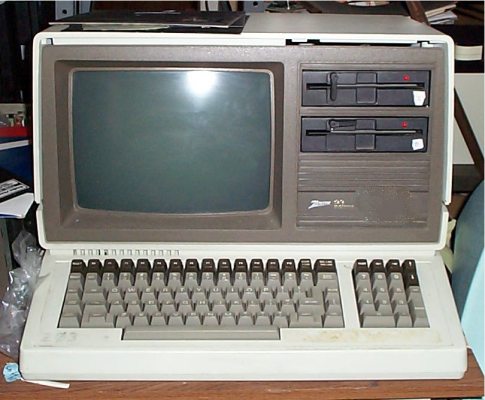
At work, a Z-120 with two 5-1/4" drives, and enough RAM to run both the system AND a 512KB ramdrive. http://www.retrotechnology.com/herbs_stuff/z100hp.jpg

I was writing training materials at the time, but somebody had designed a unique two-disk boot process.
1. Floppy 1 (A:) - Z-DOS. Boots the PC, installs the ramdrive, loads essential OS files to the ramdrive, and transfers control to the ramdrive (command c: /p).
2. Floppy 2 (B:) - Wordstar command files. Copied onto the ramdrive, along with the printer drivers.

Start it up and get a cup of coffee. When you get back, insert the Wordstar dictionary diskette into in A:, data diskette in B:, and go to town. Almost instantaneous response except when writing data to floppy. I didn't know how spoiled I was until I got a Z-248 with a hard drive and had to wait for everything to load. It was fast, but not as fast as that ramdrive.

My first home PC was an off-brand on sale at the PX in Wiesbaden. It was a 386DX-20 with 2MB RAM, priced and placed as one of the 286 machines the exchange was closing out, so I got it for less than $500 (with monitor!) in 1988. It also included a 20 MB hard drive, a 720K 3-1/2" A: drive, and a 5-1/4" B: drive. With the addition of a 40MB hard drive, that PC lasted me until 2005, when I built one myself.

by squidproquo

Cool little package, 16K RAM with a 8908 processor at first, I think. Then, third party accessory vendors started popping up all over and offering lots of cool stuff that Radio Shack didn't offer. Even had a devoted magazine for several years. For a while, I used it with a phone modem to connect to Georgia State University's Univac for a class in PASCAL programming. Good memories (no pun intended).

by dfrank_robinson

My son, now a Linux software engineer, cut his earliest chops on a TRS-80 Mod 1, but mostly on a CoCo with a very Unix-like operating system called OS-9. I still have three CoCos in storage just for sentimental reasons. BTW, the processor was a 6809.

by jmcmillan1

The TRS Color Computer was a different machine. The TRS-80 II was a serious business machine. It could come equipped with 64Kb RAM and 4 x 512Kb floppy drives for a total of 2 MB of online storage available at one time in 1980. We ran CP/M on it instead of TRSDOS and wrote BASIC programs for it. Later we put a 5MB Corvus hard drive on it. That was one impressive drive in that it was a 12" platter. It sounded like a jet engine starting.

by charles homan

My first computer was the TRS-80 CoCo, and it looks nothing like the TRS-80 II. In the fist place, it had no monitor; it plugged into your TV. Also, the only storage devices (on ours, anyway) were read-only cartridges and a cassette tape recorder.

My brother and I would copy BASIC programs out of computer magazines, modify them to suit, and then save them to audio tapes. (Radio Shack was also more than happy to sell you "data" tapes that were basically high-end audio tapes.)

by darryl~

There was a CoCo (silver in color), a CoCo 2 (white and not a deep as the original CoCo), and a CoCo 3 (looked the same as the CoCo2 except was 64K).
The TRS-80 Model II was a business machine which had 8" floppy drives mounted vertically.

There were also TRS-80 Model III & IV which were self contained units with the keyboard & monitor enclosed in a single case....the III was silver & the IV was white.

edit for spelling

by 3xp3rt

My first computer was an Independent 8080 computer with four 8? floppy drives, with tape drive. Also in the same time I work on Spectrum Z80 computer with CP/M op.System. I used Kermit for moving data from Spectrum to Independent. There was a funny time?.. :-)

by edean65

The TI/99 4A was my first computer. I added the PANASONIC cassette tape recorder they recommended due to its variable tone control, and then added the Texas Instruments peripheral expansion box and disk drive and speech synthesizer soon thereafter. Everything still works except for the speech synthesizer, but overheats easily. That's no biggie, since I still love it and have it set up next to my widescreen TV downstairs. It's a real conversation piece when people come in. It used a TMS9900 processor, if I remember correctly, and a dedicated graphics processor. Its sprite handling in extended basic was beautiful and very easy to handle-- you could take any 8x8 character in the ASCII set and redefine its look using a TI extended basic statement that took as its argument a sixteen hex-digit string. Each digit's binary equivalent equated exactly to the bit pattern of 4 of the eight pixels in each row of the resulting redefined character. So 2 hex digits redefined the look of each row. You could also set these characters in motion as sprites. The floppy disk drive was accessible only when you plugged in the ROM pack that ran the disk drive, but this was pretty transparent and not a problem. I was a high school student at the time, and a big gamer on this machine. I played most of the Scott Adams adventures on this machine, and several TI proprietary games and some third party games. The sound was pretty good on this machine as well, but it couldn't compete with the three channel sound of the Commodore 64 by any stretch.

by jost

That chip, was the only one of his generation, Relying instead on So-called " Workspaces " Scattered around the Main Memory.
So the execution of the instructions, jumped from one " Context Workspace " to the next Context Workspace "
Each time Bringing with it a return address to the last one.
The speed of the computer was entirely determined by the speed of the Ram.

by santeewelding

Assisting Napier in a photo taken at the time, with you just off to the side, fashioning the wood pieces.

by hal 9000

We used bits of rock and kept moving them around till they looked like what was required.

We didn't have any tools capable of working wood. ;)

Stone Axes and so on came much latter. after the wheel was developed. :0

Though I must admit that designing Race Cars without wheels was very hard. :^0

Col 0:-)

by hal 9000

I have no idea what it is. :(

But I assume that it's nothing important as it was where the Lorikeets Bread [i]but they are now so fat that instead of being called Lorries they are known as B Doubles,[/i] is stored for the wild life that [b]SWMBO[/b] insists on feeding and sending me broke. ;)

Col

by nicknielsen

What I thought was there, isn't there now. I must have been looking at another picture and thinking of yours.

That, or it was the beans... :D

by thechas

Depending on what you want to consider to be a computer, my first 3 computers were:

Heathkit Microprocessor Trainer
This device has a boot ROM and programs in Motorola 6800 machine code. It has a Hex keypad and an LED display.
There is a breadboard area where you can wire up input and output circuits.

Next was the Mattel Aquarius computer that grew out of the Intelevision game system.
Z80 based, this has a 3/4 scale keyboard and connects to a TV. You either used plug-in program cartridges or a cassette drive.
There was an option for a CP/M based floppy disk drive expansion.

My first PC was an IBM XT clone I picked up off the clearance shelf at Sears. I think it was branded as a Leading Edge.

The first system I built myself used a 386 SX 16 CPU. Over time, I expanded it with a math co-processor and a full range of drives.

I still have all except the Leading Edge.

Chas

by maryweilage

Geekend contributor Nicole Bremer Nash created a TechRepublic photo gallery based on some of the comments in this discussion and in the Facebook discussion about this topic. Here is the link to the gallery, Photo memories of 18 first computers: http://content.techrepublic.com.com/2346-12847_11-431485.html.

Thanks to everyone for posting your comments! If we didn't feature your comment in this gallery, we may feature it in another gallery about members' first computers.

Thank you,
Mary

by myles5

My first computer was a Morrow. It had dual 6 inch floppy drives. Each drive was 15KB.One for the os and the other the program. There were about 27 different os at the time since there was not a "standard" os.
I still have the computer,its monitor and its printer, a Smith-Corona TP-1 in a closet.
myles5@optonline.net

by darryl~

It was a class project back in 1979 when I took electronics....we each built one....it was like a Heathkit type of thing but we had to lay out the circuits on the MB & etch the boards ourselves....it was a rather fun project.

http://en.wikipedia.org/wiki/AIM-65

But the first one I purchased was a TRS-80 COCO 1.....a silver one....4 kb RAM....I eventually boosted it to 32 kb by soldering two 16 kb sets of chips on top of each other.

by jost

Thank you for reminding me of those particularity of this Unique 16 Bit Chip.
Status and Workspace.
16 General Purpose registers.
WR0 to WR15, yes. Accumulator and Address pointer.
Fast Interrupt Context Switching !
Yes I remember.
Thank you

by beany02

My first Computer

CPU: Intel 200mhz
RAM: 16MB
HDD: 2GB
OS: Windows 3.11

was a good computer back in those days

by dfrank_robinson

I, too, worked for Radio Shack but briefly. I remember when the Tandy 2000 arrived at the store and no one knew anything about it. I believe it was a 16-bit 80186 processor unit. The only thing about it I could see was its graphics were better than the CoCo, but it couldn't run IBM PC software.

by art

My first computer was either a Wang 2200 or an IMSAI 8080. I don't remember which. I had them both at the same time and am not really sure which came first. I loved using the front panel switches to load programs on the IMSAI (and later on my PDP 4).

This discussion is closed to new replies.