Discussion Locked
Xtreme.Net-opia
0 helpful
27 replies
Closed to new repliesThis discussion is closed. It stays readable, but it takes no new replies.
blog root

After Hours
by xtreme.net
Took another of the Tickle tests... This is the result.. I think the downside part is quite true... :-
You are Balanced-brained

That means you are able to draw on the strengths of both the right and left hemispheres of your brain, depending upon a given situation.
When you need to explain a complicated process to someone, or plan a detailed vacation, the left hemisphere of your brain, which is responsible for your ability to solve problems logically, might kick in. But if you were critiquing an art opening or coming up with an original way to file papers, the right side of your brain, which is responsible for noticing subtle details in things, might take over.
While many people have clearly dominant left- or right-brained tendencies, you are able to draw on skills from both hemispheres of your brain. This rare combination makes you a very creative and flexible thinker.
The down side to being balanced-brained is that you may sometimes feel paralyzed by indecision when the two hemispheres of your brain are competing to solve a problem in their own unique ways.
by xtreme.net
Just a Question I came across browing one of my forums;
Q. How do I disable the enter key?
A. Well its just a piece of code which goes like this :
function modifKey(e)
{
var modif='';
if (event.altKey)
{
modif+='[ Alt ] ';
}
if (event.ctrlKey)
{
modif+='[ Ctrl ] ';
}
if (event.shiftKey)
{
modif+='[ Shift ] ';
}
getKey(e,modif);
}
function getKey(e,modif)
{
if (e.keyCode)
{
keycode=e.keyCode;
}
else
{
keycode=e.which;
}
char=String.fromCharCode(keycode);
xCode=char.charCodeAt(0);
if (xCode == 13) //Enter key is pressed!!
{
window.event.keyCode = 0;
}
else
{
return true;
}
}
So as you can see, we are trying to catch the enter key and return true if any key except the enter key is pressed!
Since we want this to work for the whole page, put this is the body tag of the page :
<~body MS_POSITIONING="GridLayout" onkeypress=' return modifKey(event);'>~<~/~body~>~
Note: Take off the ~ (cant put HTML tags here.. courtesy of google)
There you go, enter key disabled. :)
by xtreme.net
Problem:
We all require Modal Web Dialogs once in a while, and so came my turn. I used js to pop up a modal dialog like so :
function OpenModalDialog(strUrl,strFeatures,aID,hours)
{
if (strFeatures == '')
strFeatures = "resizable=no;dialogWidth:510px;dialogHeight:350px;help:no;
maximize:yes;minimize:yes;scrollbars:yes";
//set the cookie values
document.cookie = "AID=" + aID + ";path=/";
document.cookie = "Hours=" + hours + ";path=/";
var r = window.showModalDialog(strUrl,'',strFeatures);
if(r == true)
{
document.Form1.txhBool.value = '1';
}
else
{
document.Form1.txhBool.value = '0';
}
document.Form1.submit();
}
This function pops-up a modal web dialog. Now you have the modal dialog floating on top of the browser.
I wrote a few lines of code on the modal dialog and put a button in to make it submit. But to my surprise, another window(non-modal) poped up. I was very surprised and tried to get help but was told that modal dialogs cannot do a postback... Well I was very surprised at MS to let a loophole like this exist in IE. But I just continued my work due to lack of time to do some R&D. So now the only option was using js, so I used this function in my popup dialog and called it on the click on a <input> button (not asp button - as using asp button would force a postback!)
function ClosePopUp(val)
{
window.returnValue = val;
window.close();
}
What this fn does, is to pass the value val to the parent browser's function that poped this modal dialog up.
Lamentations :
So I process the value that is retrurned by the modal dialog and continued the processing on the parent page. The down side of this way according to me were three-fold.
1)All process had to be done on the page load of the Parent page(becuase the js function does a postback after getting a value from the child modal dialog.
2)A lot of time was wasted due to the fact that processing had to passed to the parent
3)The page modal was not so elegant
Many chances came where I needed to use modal dialogs, and all the way I used this method, thinking all this while that modal dialogs can't postback. Little did I know that I was so wrong!
Resolution :
Earlied when I was helping a person on one of the forums, Eliyahu Goldin, told me so!!
He said all I needed to do is to add this line inside the <head> </head> tag of the modal page :
<base target=_self>
Without wasting a second I opened one of the projects with the former js modal dialog implementation and tested it, and it worked totally!!!
So much time wasted, so much pain suffered just becuase I didn't bother to google for this one little piece of code! :(
I owe this to Eliyahu...Cheers man..
by xtreme.net
Wonder what does this signify?
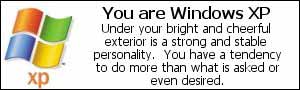
Which OS are You?
by xtreme.net
Gmail has decided to go all out and provide its customer with ever growing storage algorithm... Currently its 2052.517600 megabytes (and counting)..
I have no idea of what to do with so much space....
by xtreme.net
Well, finally after some persuation for kitkai, I am back on the blogging track...
I've wasted my 2 precious days installing VS.Net Beta 2 and SQL Server Server April CTP on my laptop, I was so lost I even had to reformat my system and lost all my mail and my favourites... What a shame... But that was because I ran out of patience and decide to do things in haste... Guess I deserved it...
Now that my PC is reformatted and I tried installing it all over again, VS.NET installed successfully. SQL Server CTP installed successfully. But, the shortcuts to SQL server are all missing...
nothing in the start menu... nothing...
Why me? why is this happening to me?
Just my luck with SQL Server CTP...
by xtreme.net
That is a question which would be best answered, If I start from what happened on 19th March 2005. I've left Jadelite Technologies for good and joined another company where I'm currently working on R&D for .Net 2.0... The plan is to come up with an enterprise project which will be helping as a framework for the company to build other applications upon...
I am planning to build it to be something like Avanade's ACA.Net, but perhaps a smaller version... I am just 1 man after all.. :)
It is a tough and tedious process which will take quite a long time to yeild some visible result, but the good part is I get to get my hands dirty with .Net 2.0 and sql server 2005...
by xtreme.net
All of a sudden, there was a problem, and I found myself infront of Active Directory code..
Well, good atleast i get to explore more of LDAP and AD, cause I know nothing of it!
Talked to few of my friends, got the feedback - "Active Directory is huge dude!!"
Hmm... Started on a path towards LDAP, although I lack the time to study AD first. Google found that this is a good enough article which could get u thru the pains of LDAP, But how about AD?
Turns out, apart from being interesting, it is quite a big concept, so started here on the road to AD! Long AD way ahead....
by xtreme.net
Manged to get VS.NET 2005 Beta 2 and SQL Server CTP working togther.. finally... phew...
But then, Justin diverted my attention to VS.NET 2005 Team Suite... Damn! How did I miss that??
Time to uninstall VS.NET 2005 Beta 2 Std Edition and go after Team Suite...
Damn! How did i miss that??
by xtreme.net
Well, simple answer - MSF!
I am planning to implement MSF in my enterprise level project, and since VSTS supports this, well why not?
Reading this also suggests VSTS is more appropriate in for developing Enterprise Level applications etc...
VSTS definetly looks a ton better than VS std edition, from my point of view...
by xtreme.net
Wow! Been so busy with all the new things happening around me that I couldn't finish this months newsletter on time... What little portion I had done for the newsletter was lost along my dearest favourites and my mail duing VS.NET 2005 Beta 2 and SQL Server April 2005 CTP!
And then at work, everyday we had a new challenge to solve. I must admit, past couple of weeks have been very hectic! I didn't even get to sleep properly... yawn...
Well, now things are settling down, newsletter is out, and the clouds in the sky are starting to clear :)
Great times are ahead! ;)
by xtreme.net
Then came web-farming issue just when life started to seem smooth sailing :)
I am planning to utilize ASP.NET 2.0 profiles in my project and everything was good, then came the scenario whereby the UI layer in running on a Web-Farm! Hmmm...
Profiles utilize a local database to keep the info and in a Web-Farm it would be kinda impossible to perform that feat! Good thing Profiles are configurable!
Not only ASP.NET profiles but membership, roles, and web-part personalization also support web-farms!
So what we do is to configure the profiles to read from a central db (in this case, the db that the web farm machines are pointing to). When u modify the state of the profile object, the modifications are saved between visits to the site. So if the request is directed to a different server within the same session (in web-farm scenario), the profile state will be intact, since its stored and accessed out of central db.
So in a web-farm scenario, this is what you should do :
1)Point each machine on the web farm to the same database server to store the profiles. You can set this by changing the connection string on the provider configuration. - Since Profiles are API and Schema over database access, there shouldn't be a lot of considerations while shifting the db target from local to the web-farm central db.
2)Now to make profiles use your application's db instead of its own, use the "aspnet_regsql" tool (Window\Microsoft.NET\Framework\[version]) which will let you add the tables utilised by profiles to your own db. Run it without any command line parameters to get the windows wizard that configures all this for you (you can also point to the db used by ur app with this wizard). [OR, run it with the -? option to see all the command line parameter, yea, i know u already know this ;)]
3)So now, the database tables that profiles are using is in ur own application's db (the tables utilized by Profiles, Membership, etc will have a ASP.NET prefix), now go ahead and create relationships between these tables and your own application's tables!
Remember, Adding fields to the tables utilised by profiles is not recomended, unless you write your own provider that can handle these fields!
Cheers!
by xtreme.net
Well, I got this confirmed, while I was trying to get a .net 2.0 Profiles sample up, I realised that the help installed with VS.Net 2005 Beta 2 is not up to date with the changes in Beta 2! It still contains some same files from Beta 1.
Nope, I never installed Beta 1 in this machine of mine...
by xtreme.net
Good News! The apps that are developed in 32-bit env. using .Net Framework 2.0 are fully supported by 64-bit processors!
Just transport your apps to the 64-bit machine with a .Net framwork and you are good to go!
Phew... and I was getting worried about porting my .net 2.0 app to 64-bit env...
by xtreme.net
LoneStar - which is the codename given to the project that i am working on is finally taking some shape. So after much sweat and blood, this is what is currently being formed in the new .net 2.0 application
UI Layer
calls
UIPC Layer
can call either BusinessFacade or WebService(in case of distributed system) - read from Web.Config
Web-Service layer or BusinessFacade layer.
If Web-Service is called, the web-service will call BusinesFacade in turn.
BusinessFacade will call the BusinessComponents
The job of BusinessFacade is to orchestrate the processings. I am also planning to plug in a Business Rule Repository into the Facade.
BusinessComponents call the DAL
I have kept the DAL in such a way that it is configurable as to which DAL should be used, we have a SQLDAL and a OracleDAL.
And finally DAL talks to the database -> we have a Microsoft.ApplicationBlock.Data dll here which is temporarily being used to to data transactions(as the app is still not in any solid stage)
Typed DataSets are being used as the bloodline of the application, which makes the developers job much easier (yes i did example the pros and cons of typed datasets in .net 2.0 :) )
Sorry, Been quite busy and the didnt post much for the last couple of months..
Cheers!
by xtreme.net
We have been using typed datasets(which are heavy as we all know) for LoneStar. But as we slowly move forward, more and more disadvantages are showing.
So we made a drastic decision. Change the blood line from Typed Data Sets to custom objects...
Considering the existing work that we have done, it will definetly take some time to change the business entity from datasets to custom objects, but there is a good news, we are still using the same typed datasets! Where? inside the custom classes!
We get some advantages here...
1) We still retain the typed tables in our custom classes making the job of the develope a lot easier, compared to classes with untyped datatables or untryped datasets or simple classes or even typed datasets!2) We make the bloodline of our projects ( the business entities) a lot more leaner compared to typed datasets!!3) We still have those typed datasets in the project, but they are now arranged logically accroding to the modules and all the dirty work is done by the lean custom entity classes.4) We still get to enjoy the benefits of Typed DataTables because of custom enties still contains those typed DataTables, but they are more leaner as the objects utilize _only_ the requried tables!
I will be posting a skeleton of how the above is done although most of you already get the idea!
Cheers!
by xtreme.net
VS.NET 2005 and VSS 2005 July CTP were released on 12th of July. Now upgrading my version from June CTP to July CTP.June CTP has some major changes over its predecessor including the Membership API changes which was pretty scary to fix. But we got all the api differences fixed and now anticipating what changes will the July CTP bring.. Hopefully nothing that breaks the code...
Anyone working with July CTP yet?
by xtreme.net
Just came back from a _small_ vacation in KL, Malaysia with friends. We drove all the way to KL and drove back... phew...
Nothing much to do there except to eat and drive around..
Please be carefull driving in KL, all the women seem to be F1 trained!
Lovely place, except the killer traffic!
And The Pertronas looks _amazing_ in the night time, so beautifully lit up... worth a second trip...
by xtreme.net
LoneStar is now somewhat in a visible shape, wobbling, but atleast it has a shape... Yes, its stucture still changes for the better, but again, it still has a shape...
I am looking into making some unit testing models for LoneStar, Yea we all have done unit testings here and there, implemented it maybe, or just wrote more tests into the test files...
But i came across this valuable post by Brian Button, followed by another one from Roy Osherove.
Very valuable indeed...
I have seen the test files written in the project files when i was working with Accenture, and trust me, ppl working in that project really need to read the above posts!
In accenture, we used N-Unit for testing purposes, but after using VSTS, the project created by VSTS looks nicer and easier to use and maintain...
But since we have moved to VS.NET 2005 Professional Edtion from VSTS, I'm planning to follow the test project pattern generated by VSTS to make testing models for LoneStar..
by xtreme.net
Finally, an excellent way for those who wanna try IE7 without messing with any of the IE6 current settings.For those who want quick instructions take a look at Jon Galloway's post and for those who want more technical details and wanna try other versions of IE other than 7, check out the entry by Joe Maddalone!
So hurry, what are u waiting for? :)
by xtreme.net
An interesting observation :
While I was posting my previous blog entry, I realised something, the formatting toolbars provided by Community Server are blocked by IE7! Cant bold, cant hyperlink!!
The whole toolbar of Community Server is gone!
Anyone else has a similar experience? Care to share?
Cheers!
by xtreme.net
Paul Glen wrote The truth about "useless" people, which is very interesting. Paul Glen, as you might know is the author of the award-winning book "Leading Geeks: How to Manage and Lead People Who Deliver Technology" (Jossey Bass Pfeiffer, 2003) and Principal of C2 Consulting.
With all due respect to Paul, I'd like to add a little something about The truth about these "useless" people.
Paul clearly mentions more than one time, that these "useless" people are intelligent and talented! They are good at technical analysis, documentation and strategy, but unfortunately not at delivery!
Paul catagorizes these people under "people who are seemingly paralyzed by ambiguity and are incapable of moving forward until every possible question has been answered".
From my experience, I would like to induce another notion here and catagorize these people under "Hackers" (not "Crackers")!
Now before you start running about screaming, perhaps you should take a look at the Hacker FAQ which talks about managing Hackers. Also, check out How To Become A Hacker!
All those who are planning to sue me for trying to make hackers out of people, pls do read the above mentioned papers which are very possitive and helpfull in understanding people.
Note : I didn't say Hackers are useless, I am merely suggesting catagorizing those "useless" people Paul talks about under the category of "Hackers"!
Why do I catagorize those "useless" people under Hackers?
Consider this : These useless people are undoubtedly talented, but they are unable to deliver! Why? Perhaps because their energy is not focused to the right direction?
Most of the students who like programming want to start off as programmers. But for most of them, "too much" programming at some point becomes mundane! They are so good at programming by this stage that programming does not pose the same challenge to them as it used to in the begining. They need more! More challenge!Consider the Hacker Attitude mentioned in How To Become A Hacker :1. The world is full of fascinating problems waiting to be solved.2. No problem should ever have to be solved twice.3. Boredom and drudgery are evil.4. Freedom is good.5. Attitude is no substitute for competence.
Clearly the third point takes effect - Programming becomes 'Boredom' from 'Challenge'!
Similary consider EmployeeA engaged in a project yeilds excellent results in analysis and stratergy, but when he is required to do coding, his performance suddenly goes slump!
So what's the solution?
Enter 'Project Manager'!
Paul mentioned the importance of Project Managers and I totally agree.
As you can see in the above scenario, the Project Manger should be able to see this performance slump of EmployeeA and assign him something that he will focus on with enthusiasm thus, boosting his performance. After all, as most of you would agree, a good Project Manager manages people well!
I've been in a similar scenario in the begining of my career, the CTO is happy with my performance, all projects sped up, I introduced time saving methodologies and framework, now the whole company is settling down and just doin projects, so my next task? Programming! And there is comes, drudgery! My head started screaming "Lord, Save Me!". I even bought this upto the CTO, but the company at this point simply had nothing to be done, but programming for the numerous projects running simultaneously!What happened? I quit!It was an obvious choice, either I quit, or suffer the drudgery... 'Have Road, Will Travel'...
Another question raised would be "Who will do the programming then?". Well, there are always people around who love programming, if not there is Mr. Project Manager,to provide incentives and apply other stratergies to make people do programming productively! :)
Any comments appreciated...
by jmgarvin
Part of the problem with the typical project manager is they haven't
been in the trenches. They don't understand why it takes 3 months
to write a very complex chunk of code. They don't get it when the
coders, documentation, and development people are constantly in
"meetings."
Software project management is pretty difficult because there is no
tangable product. While you can set milestones and benchmarks,
you can't aways "see" what is happening. Sure the documentation
people don't "look" like they are doing anything, but in the end they
will have structured and detailed docs for you. Should you check
up on them? Sure, but don't expect documentation to be done
overnight.
On that note, I fall on the hacker side. I hate coding in a
project environment, not only is it BORING, but it is reinventing the
wheel (over and over and over and over and over and over and over and
over and over again). To manage people like me (I know I've had
to manage people like me), you have to give them both the small view
and the large view. Let them go nuts trying to piece everything
together. I've always had good results with a bunch of hackers
and a general goal.
Now that isn't to say the project isn't structured, it is just a little more organic.
My suggestions for software project management:
1) Only those that can lead AND code should be project managers.
If you haven't been a coder, you shouldn't be a software project
manager. You don't have the background and you don't understand.
2) Let the project be more organic and set less strict hours.
Also, let the coders solve some problems in the project. Give
them a general goal or milestone and let them at it. Keep to a
pretty structured timeline, but if some dates slip...that is ok,
because you will typically come out even in the end.
3) STOP TREATING SOFTWARE PROJECT MANAGEMENT AS A TYPICAL ENGINEERING PROJECT!
4) Develop a strong team and stick with them contract to contract (if
possible). Once you have coders/documentors/developers that work
well together, don't split up the magic.
5) Understand that geeks think differently. Accept it and just deal with it.
by xtreme.net
Posted on behalf of EricB who sent me an email
For me, one of the solutions I have found if for me to do a couple of
things.
1. Work on small "things" (components, utilities, etc.). This way I get
done quickly before I get bored with it, and move on to something else.
2. Change the type of work I am doing. If I have been doing components for
a while, then I change to doing UI stuff. If I am totally burnt out with
the project, I find a small single purpose utility that is interesting to
me, and then work on that. Also, I can work on adding "utility" functions
to my "common" assembly (saving data to a file, creating a UI for displaying
exceptions, etc.).
Finally, if I really need a break, then I search through the MSDN library
and find some cool looking library that I haven't used before, and that
might be useful in the current project or in the future, read up on it, and
then write a little "test" program using the features of that library.
EricB
Wm. Eric Brunsen
MCSE Windows NT & 2000, MCSD, MCDBA, NT-CIP, CTT, MCT-Retired
Computing Systems Engineer
Dynicity, LLC
by xtreme.net
For long time we have been trying to use webparts in our application's menu. Something like what My MSN does. But an interesting observation is that all the web part links to pages that open up on seperate pages. But in our application: webparts are located in the master pages and all the links in the webparts are supposed to open up in the content pages, we have may webparts according to the different modules and each webpart contains serveral links pertaining to that module. So far so good; no probs. But then comes the moving around of webparts. Once the user moves around the webpart menus according to his own convenience, it should stay the same for all pages! But we found out that the webpart only stays the same for the particular aspx page that it was arranged for!! But what we are trying to do is to arrange the menu for all the pages for that particular user!
This kinda seemed impossible to achieve as the webparts are located in the masterpages and the personlization uses URL of the content page as the personlzation key!
So wondering how to achieve this? This is how my colleague got it to work!!!
You need to overwrite "System.Web.UI.WebControls.WebParts.SqlPersonalizationProvider" class with your own custom class. You need to perform a small hack here when you get or set the path. You can now put the web part in the master pages, drag, minimize, etc and when you navigate to a different page, the same arragement of webparts will be displayed. You just need to ensure the web.config is pointing to this custom class for personalization.
Web.Config:
Custom SqlPersonalization:public class CustomSqlPersonalizationProvider : SqlPersonalizationProvider{
private string GetPath{get{return "default.aspx";}}
protected override void LoadPersonalizationBlobs(WebPartManager webPartManager, string path, string userName, ref byte[] sharedDataBlob, ref byte[] userDataBlob){base.LoadPersonalizationBlobs(webPartManager, this.GetPath, userName, ref sharedDataBlob, ref userDataBlob);}
protected override void SavePersonalizationBlob(WebPartManager webPartManager, string path, string userName, byte[] dataBlob){base.SavePersonalizationBlob(webPartManager, this.GetPath, userName, dataBlob);}
protected override void ResetPersonalizationBlob(WebPartManager webPartManager, string path, string userName){base.ResetPersonalizationBlob(webPartManager, this.GetPath, userName);}}This solution has also been published in the asp.net forums
Enjoy!
by xtreme.net
TechED Asia 2005 happened right here in Singapore from the 24th of August to the 26th of August 2005! A great experience for developers and IT professionals here in Singapore and those who came in to join the fun!
There has been a big hype about TechED finally being organized here in Singapore for the first time, (we definitely hope, not for the last time!) for quite long. And I must say - the turn up rate was pretty good compared to the rest of the MSDN meets.
The TechED Asia 2005 was a dream-come-true for many developers and IT professionals in Singapore, who were unable to attend the TechED?s held in other parts of Asia over the past years.
Free passes went off like hot cakes to some lucky ones but the rest did not hesitate to pay for the TechED 3 day passes. Microsoft helped by reducing the prices and providing concessions for members of various User Groups.
Obviously, a lot of attention was paid to the upcoming Microsoft technologies - ASP.NET 2.0, SQL Server 2005, Visual Studio 2005, Windows Vista and .Net 2.0 in general just to name a few. The presenters did a great job of promoting these technologies and injecting the developers with great confidence to use them!
Apart from TechED, Microsoft also helped arrange the User Group Confluence; which was a joint User Group meeting of three of the Singapore?s User Groups (Singapore?s .Net UG, Singapore?s SQL Server UG and Singapore?s Windows UG). This User Group meeting was held during the after hours of TechED. Steve Riley, Rick Samona and Jay Roxe presented in this User Group Confluence.
Microsoft also organized ?Meet the experts? and ?discussions? sessions where the experts were ready to answer any queries you might have ? a brilliant idea indeed. Besides from being the dream of developers, it was definitely a massive help to many of them. After all, how many times do you really get a chance like this?
Event Breakdown:Day 1:Day one covered a lot of technical topics from ASP.NET 2.0 to web-services to VS.NET 2005. Undoubtedly, a heavy concentration of .Net was all around! The developers were quite satisfied by the topics and its deliveries. Given this time, when everyone is anticipating SQL Server 2005 and VS.NET 2005, the .Net 2.0 topics really propelled the enthusiasm amidst the audience.Day 2:Day two went easier on .Net 2.0 technical presentations and the event changed gear to data tracks. Excellent presentations were lined up on database design and performance tuning.Day 3:Now came day three which covered topics like BI and Data Warehouse. But that?s not all; long queues were formed for the Hands-On Labs. Yes, finally time to put everything seen and heard to practice. And of course, who can forget the lunch? Skewed Lamb, fish, sherry chicken, oysters, slurp?
The audience had mixed feelings over the organization. Some felt that the discussions were not in depth enough and that the information provided could easily be found online. But the majority was ok with the depth of topics delivered by the speakers. Quite a few of them also criticized the idea of multiple tracks running parallel which cost them quite a few of the important tracks that they came for, and most importantly ? paid for! Well, you gain some, you loose some. But overall, everyone was satisfied with the event organization.
In all, TechED presenters spruced up the interest of the developers regarding the upcoming products like VS.NET 2005, SQL Server 2005, VSTS and the various new tools which are going to be bundled along with them.
Presenters like Steve Riley, Jay Roxe, Jesper Johansson, Rick Samona, Joe Yong, William Tay and many others were the main attraction of the event. The audience made sure that they get their money?s worth by bombarding the speakers with questions after every presentation!
At the end of third day, everyone went home with a lot of goodies in their hands and a lot of new ideas zooming through their minds.
by xtreme.net
At some point you must have used the "Administer Website" option in order to create a user, and right when u enter the details and click to create a user, VS throws this error :
An error was encountered. Please return to the previous page and try again.
The following message may help in diagnosing the problem: Exception has been thrown by the target of an invocation. at System.RuntimeMethodHandle._InvokeMethodFast(Object target, Object[] arguments, SignatureStruct& sig, MethodAttributes methodAttributes, RuntimeTypeHandle typeOwner) at System.RuntimeMethodHandle.InvokeMethodFast(Object target, Object[] arguments, Signature sig, MethodAttributes methodAttributes, RuntimeTypeHandle typeOwner) at System.Reflection.RuntimeMethodInfo.Invoke(Object obj, BindingFlags invokeAttr, Binder binder, Object[] parameters, CultureInfo culture, Boolean skipVisibilityChecks) at System.Reflection.RuntimeMethodInfo.Invoke(Object obj, BindingFlags invokeAttr, Binder binder, Object[] parameters, CultureInfo culture) at System.Web.Administration.WebAdminMembershipProvider. GetWebAdminMembershipProviderHelperProperty(String propertyName) at System.Web.Administration.WebAdminMembershipProvider. get_MinRequiredNonAlphanumericCharacters() at System.Web.UI.WebControls.CreateUserWizard.AttemptCreateUser() at System.Web.UI.WebControls.CreateUserWizard. OnNextButtonClick(WizardNavigationEventArgs e) at System.Web.UI.WebControls.Wizard.OnBubbleEvent(Object source, EventArgs e) at System.Web.UI.WebControls.CreateUserWizard.OnBubbleEvent(Object source, EventArgs e) at System.Web.UI.WebControls.Wizard.WizardChildTable. OnBubbleEvent(Object source, EventArgs args) at System.Web.UI.Control.RaiseBubbleEvent(Object source, EventArgs args) at System.Web.UI.WebControls.Button.OnCommand(CommandEventArgs e) at System.Web.UI.WebControls.Button.RaisePostBackEvent(String eventArgument) at System.Web.UI.WebControls.Button.System.Web.UI. IPostBackEventHandler.RaisePostBackEvent(String eventArgument) at System.Web.UI.Page.RaisePostBackEvent(IPostBackEventHandler sourceControl, String eventArgument) at System.Web.UI.Page. RaisePostBackEvent(NameValueCollection postData) at System.Web.UI.Page.ProcessRequestMain(Boolean includeStagesBeforeAsyncPoint, Boolean includeStagesAfterAsyncPoint)
Looks familiar?
This is a problem, but not exactly what the error describes...
For a quick fix just make sure that you use a password meeting the requirements of the password settings. For the default password settings, a password like "RohanT!" would suffice... There you go! Now you can create users successfully.... :)
P.S : You also can also change the password settings if you dont wanna type the special character everytime ;)
Cheers!
This discussion is closed to new replies.
Sort by Trending