


Data management is a multidisciplinary process that keeps data organized in a practical, usable manner. At its most fundamental level, the goal is to ensure an organization’s entire body of data is accurate, consistent, readily accessible, and properly secured.
It is a total lifecycle information system that follows data from the moment it’s created until it ceases to be useful. As such, it involves tracking data from place to place, monitoring the transition of data from one form to another, and ensuring nothing important is left out of a business analytics model.
Data management also lays the groundwork for data analytics. Without a good plan, analysis is practically impossible at worst and unreliable at best. We would be staring at an ocean of 1s and 0s with no way to make any sense of it all.
SEE: Data Governance Frameworks: Definition, Importance, and Examples (TechRepublic)
 From Fragmented Data to Real-Time Decisions: How an Auto Insurer Modernized with AI A leading auto insurer modernized its data foundation to move from fragmented insights to real-time, AI-driven decisions. By unifying data and enabling advanced analytics at scale, it improved risk modeling, accelerated claims processing, and delivered more personalized customer experiences—turning data into faster, smarter action across the business. |
What is involved in a complete data management model?
While one might liken building a data management model to constructing a building, a better analogy would be a building that would grow beyond its foundation but still remain structurally stable and useful. The goal is to not just be able to structure and categorize data, but rather to be able to analyze it and make use of it in ways that were previously not imagined. Proper data management grows with an organization.
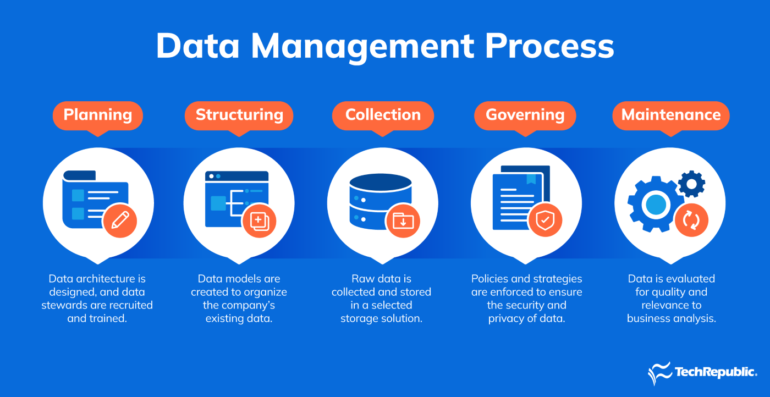
Planning
Planning covers the comprehensive examination of how existing data is currently managed. For organizations that have never had a centralized data management strategy in place, the initial “structure” of that data might look more like a “junk drawer.” Yes, everything might be there, but finding it is difficult, and there may be more than one authoritative copy of what someone might be looking for.
For example, an organization may have inadvertently created two lists of employees, with the payroll department having one copy and the benefits department having another copy. Which one is correct? Which one should be used? Businesses must consider what they should do to maintain both lists.
Data structuring
Data structuring involves deciding how all of this unorganized data will be structured. Keep in mind that, even if data is structured and organized by one particular taxonomy, a proper data management solution won’t lock an organization to that taxonomy. The data will be able to be modeled in any manner that the organization sees fit. A properly-structured model will ensure that, for every kind of data, there is only one authoritative copy of it.
Going back to the example in the previous process, an ideal repository of employee information could be a single table, which contains all possible information about employees that any department within the organization could need.
Data acquisition and storage
Data acquisition covers the collection and importing of raw data from any number of different sources, along with converting or repackaging the data into a more structured format. From there, businesses must consider where data must be stored, be it in the cloud, on a server, or someplace else.
Data safeguarding
An organization must not only implement and enforce data governance policies to govern which persons have access, but it must also ensure data is protected against unauthorized access from anyone inside or outside the organization. Data safeguarding must ensure data, like personally identifiable information, is further protected internally by the use of encryption and other security mechanisms.
Data maintenance
Data maintenance makes sure that, once data is properly managed, it does not revert to being the “junk drawer” that existed initially. This part of the model focuses on enforcing the structure that was created in the second process.
Data trailblazing
Data trailblazing takes an organization beyond the initial structuring created in the second process. This involves being able to use application or database programming to perform analyses of data that were not initially considered. This augments an existing data management model.
SEE: What Is Data Quality? or learn more about AI-ready data pipelines.
Benefits of data management
Properly-executed data management provides innumerable advantages to your organization. The single biggest one is not that you can query and analyze it flexibly, but rather, you are not locked into a particular taxonomy that might restrict how that data could be analyzed.
SEE: Data Governance Checklist (TechRepublic Premium)
Challenges of data management
Of course, proper data management is not without its issues. Organizational inertia, resistance to change, and having multiple disjointed data repositories that would need to be merged can create significant hurdles in creating a proper strategy.
SEE: How to Measure Data Quality (TechRepublic)
Popular data management software
Choosing the right data management tools from the onset can make a huge difference in an organization’s success. Data management can’t be done haphazardly — organizations will need to invest in solutions that can deliver all the results they need to be successful in managing and using data.
Some top platforms include:
- Collibra: Best for reference data management.
- Profisee: Best for managing large volumes of data.
- Hevo Data: Best for digital transformation.
- Google Cloud: Best for existing GCP users.
- Tableau Data Management: Best for unified data management and analytics.
When deciding on a platform, businesses should have a good understanding of the kind of data they have, how they want to host it, and their end goals for data management. Armed with that information, a data management team can make the best choice possible for the needs of their organization.
This article was originally published in April 2022. An update was made by the current author in January 2024. The latest update was by Antony Peyton in June 2025.