


Companies migrating to the cloud no longer choose their vendor strictly based on data storage capacities, performance and reliability. In the new era, cloud providers lure in organizations with built-in cloud innovations, services and solutions. And at this week’s Google Cloud Next ’22, the tech titan made one thing clear: It wants to lead the new era.
From new partners and artificial intelligence-powered solutions to workspace innovations for the hybrid world, Google pulled back the curtains for its new cloud environment. The company is chasing Amazon and Microsoft in the cloud market. Synergy reported in June 2022 that the market grew by 29% in the second quarter, despite economic turbulence, approaching the $55 billion mark.
Amazon, the market leader, strengthened its position by increasing its global share by almost 34%. Microsoft follows as the second top cloud provider, and Google ranks third. Together, the three giant cloud providers have 65% of the worldwide market. But, Google is meaningfully up-ticking its position.
Google calls its new innovations “what is next for the digital transformation of the cloud.” But, the reality is that digital transformation is now rushing towards digital acceleration, powered by innovative technologies, data and AI.
SEE: Digital transformation: A cheat sheet (TechRepublic)
“Cloud is one of our fastest growing businesses. It’s what enables us to share innovation and investment across Google with companies, governments and organizations worldwide,” said Google and Alphabet CEO Sundar Pichai during the inauguration session of Next ’22.
Pichai stressed that machine learning and AI are at the heart of the company’s new solutions.
“We’ve progressed in some of the most challenging research areas, including translation, computer vision and natural language processing. These advances are powering helpful product innovations,” Pichai said.
What’s new in the Google Cloud
The company presented new features and enhancements in four key areas: data cloud, open infrastructure, collaboration and security. Google says the new solutions add to the 1,300 new features previously released during the first half of 2022.
Jump to:
- Data cloud innovations
- Open infrastructure new features and Coinbase’s blockchain
- Hybrid workspaces and cloud collaboration
- Cloud security and sustainability
Data cloud innovations
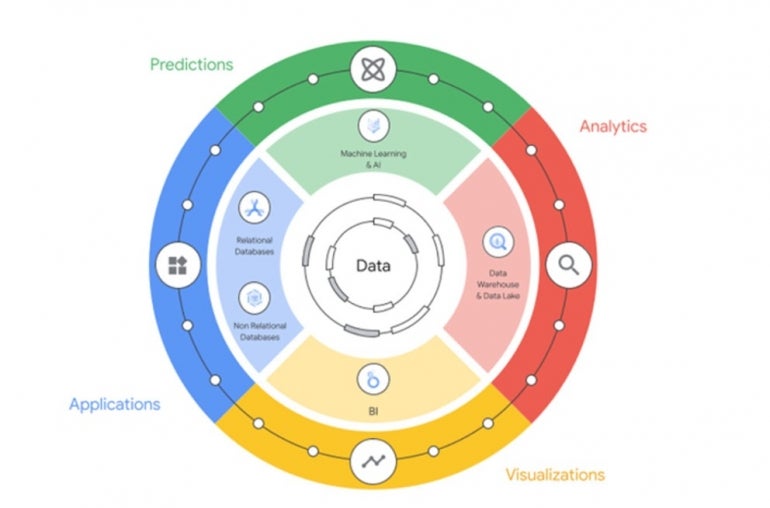
Structured and unstructured data alongside siloed data and multicloud environments are areas that Google wants to strengthen.
“Our vision for cloud computing is to simplify all of the technology that organizations need, making it accessible by simplification to every organization around the world as software platforms that provide the foundation for your business to digitize and accelerate,” said Thomas Kurian, CEO of Google Cloud.
Kurian spoke about BigQuery and how it can be used to analyze data stored in Amazon’s AWS, Microsoft Azure and other clouds, without needing to move the data-saving egress fee. From BigQuery, customers can use SQL queries and run programs written in Spark while leveraging built-in machine learning capabilities. BigQuery also supports vital storage formats and now supports Apache Iceberg, with the popular delta and ad formats coming very soon.
Another highlighted feature was Looker and Looker Studio. With it, customers can let self-service analysts secure and govern data, with enterprise support and governance capabilities. Looker also works with other popular tools like Tableau.
The new Google data cloud innovations are:
- BigQuery: A new capability to analyze unstructured, streaming data in BigQuery, designed to expand the ability for people to work with all types of data.
- Support for significant data formats: Google added support for widely adopted data formats, including Apache Iceberg, Delta Lake and Apache Hudi and offered a new integrated experience in BigQuery for Apache Spark.
- Looker Studio and Looker Studio Pro: The company unified Looker and Google Data Studio into one new platform, and it introduced a professional version, Looker Studio Pro, which provides organizations support and key governance capabilities.
- Vertex AI Vision: As a new service for computer vision and image recognition AI, the feature reduces the time it takes to create computer vision applications from days to minutes at one-tenth the cost of current offerings.
- Supporting all major open data platforms: Google expanded its integrations with many of the most famous enterprise data platforms, including Collibra, Elastic, MongoDB, Palantir Foundry and ServiceNow.
Open infrastructure new features and Coinbase’s blockchain
Google says that open infrastructure needs to change in two fundamental ways. First, customers increasingly want to use cloud infrastructure for new workloads, and second, new infrastructure advancements need to deliver performance improvement.
“We call this, at Google, workload-optimized infrastructure,” the company said.
Google claims it can run large-scale AI training workloads up to 80% faster and 50% cheaper than any offering. To boost AI capabilities, Google announced it had partnered up with NVIDIA. Furthermore, to drive blockchain and Web3 development, Google teamed up with Coinbase.
“We see our collaboration with Google as an opportunity to bring Web3 to a new set of users and provide powerful solutions to founders and developers,” said Coinbase CEO Brian Armstrong.
More about Cloud
- VMware Explore 2023: Keynote Highlights
- Cloud Data Systems and Edge AI Make a Major Impact on Today’s Data Science
- Lenovo’s New TruScale Services Take AI to the Edge for Rapid Business Deployment
- OneDrive Cloud Usage Policy
The Google-Coinbase partnership has four key aspects. Coinbase will use Google Cloud to build advanced data and analytics capabilities to better serve customers. In contrast, Google Cloud BigQuery will serve as the centerpiece of this new data processing architecture. On the other hand, AI will enable Coinbase machine learning engineers to train and deploy models more rapidly and at a greater scale than ever before.
“Combined, this new platform will enable Coinbase to streamline and rapidly scale its data processing and machine learning capabilities without being hindered by the complexity and cost of managing the underlying infrastructure,” Armstrong said.
Cloud node services will also allow developers to operate Web3 blockchain systems without expensive and complex infrastructure. Google will also use Coinbase Prime for institutional crypto services.
“Developers can go in there and access the whole world of blockchain data, build Web3 apps very quickly without having to manage and run their own nodes for all the different types of blockchains,” Armstrong added during Next ’22.
Other Google infrastructure announcements include:
- Global network expansion: Google announced five new Google Cloud regions: Austria, Greece, Norway, South Africa and Sweden. These add to the four regions previously announced in 2022. The company now has 48 live regions serving customers in more than 200 countries and territories.
- Workload-optimized infrastructure: These new features will augment customers’ workloads, including the C3 machine series powered by the 4th Gen Intel Xeon Scalable processor and Google’s custom Intel Infrastructure Processing Unit. The company is also delivering AI-optimized infrastructure with the general availability of TPU v4.
- Anthos enhancements: Enhancements to Anthos include a renewed user interface, an upgraded fleet management experience and the general availability of virtual machine support on Anthos clusters for retail edge environments.
- Dual Run and Migration Center: The new Migration Center brings assessment, planning, migration and modernization tooling together in one location, so organizations can migrate faster. Dual Run is designed to streamline the process by removing roadblocks from migrating 20-year-old and older mainframes into the cloud.
- Open-source AI commitments: Designed for users to rapidly deploy AI applications, the OpenXLA Project, is an open-source ecosystem of ML technologies developed by Google, AMD, Arm, Intel, Meta, NVIDIA and others.
Hybrid workspaces and cloud collaboration
“The success of any organization hinges on unlocking the talent and productivity of its people,” said Aparna Pappu, the new VP of Google Workspace. The VP presented the new features for Workspace in the Google cloud.
Google says its workspace has over three billion users, which is no surprise, as Pappu said, “every time you use Gmail, Calendar, Docs, Drive, Chat, Google Meet, you are using the Workspace.”
The company invested heavily in Smart Canvas, its collaboration experience that offers immersive connections. Smart Canvas is now extensible to third-party applications like Salesforce and Zendesk. Pappu highlighted improved noise cancelation, Mobile Companion, as a second screen and speaker spotlight in Google Slides.
For the future, Pappu explained that the company envisions a new era of communication, expression and co-creation, all powered by AI. Users can create presentations or marketing campaigns by combining prompts and data into an AI app, which automatically generates different styles and templates. These can be tweaked and modified until the final presentation is achieved.
Other workspace innovations presented by Google include:
- Google Meet immersive connections: These new capabilities for Google Meet, including adaptive framing with AI-powered cameras from Huddly and Logitech, let everyone in a conference room be seen clearly while spotlighting speakers.
- Smart Canvas: Smart Canvas acts as Google’s collaboration experience. Enhancements with custom-building blocks in Google Docs allow users to build their templates and share them. Additionally, new smart chips for AODocs, Atlassian, Asana, Figma, Miro, Tableau and ZenDesk will be released next year.
- Workspace for Developers: New application programming interfaces for Meet and Chat gives programmatic access to common functions like creating and starting meetings or initiating messages directly from a third-party app. Asana, Lumapps and ZenDesk will be the first partners to leverage these in their apps. Developers can embed their app directly into the Meet experience with a new Meet add-on SDK.
Cloud security and sustainability
Google also presented new cloud security solutions and sustainability data-driven features to help companies achieve zero-carbon goals. With the acquisition of Mandiant, the company is aiming for more action in the cybersecurity sector.
A new feature presented is Chronicle Security Operations. The cloud-based solution is designed to help cybersecurity teams detect, investigate and respond to threats.
The company also made the Google Cloud Carbon Footprint available to every customer directly in their cloud console for no cost. Moreover, the company announced that eco-friendly routing is coming soon to the Google Maps platform for developers to help ridesharing and delivery companies embed eco-friendly routes into their driver applications.
Throughout the event, the message from Google was loud and clear. They are out to supercharge their cloud offering with new services and technologies. The company is opening doors to work with third-party organizations and new partners and integrating most of the leading market solutions into their cloud. In the end, Google Cloud seeks to be the “one-and-final-destination” for everything cloud and more.