


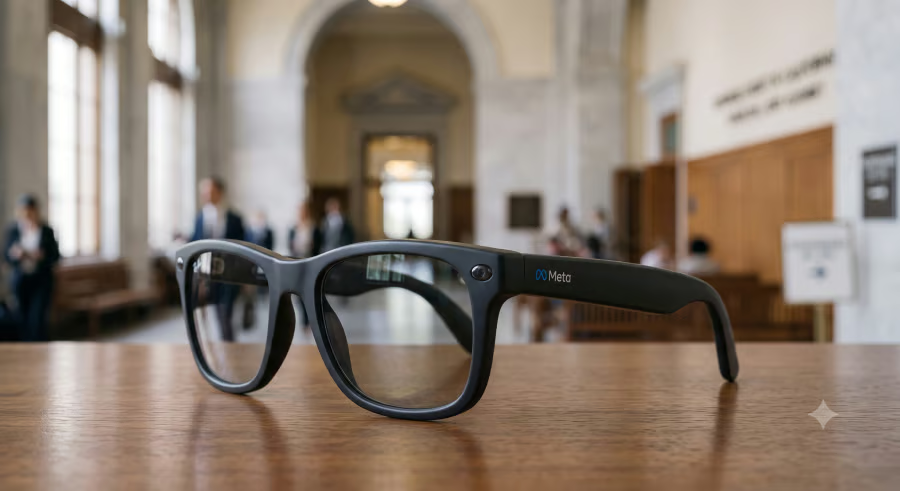
Meta’s AI-powered smart glasses have been on sale in Singapore since April. In New York, the same technology will be banned from every state court starting July 20, as officials move to stop recording devices that can quietly capture audio and video without drawing attention.
The move highlights a challenge Singapore has yet to confront directly. While local laws already prohibit unauthorized recording in courtrooms, they were written before AI-equipped eyewear blurred the line between ordinary glasses and always-ready cameras. As adoption of AI wearables grows, the question is no longer whether the technology will arrive, but whether existing rules are enough to govern it.
The rule New York needed, Singapore already has part of it
New York’s memo, issued July 1 and reported by Bloomberg Law, requires anyone entering a state, county, city, town, or village court to surrender camera-equipped eyewear or headwear before entering. The rule targets Meta’s Ray-Ban and Oakley smart glasses specifically because their recording indicator light is easy to miss, and because security staff have no reliable way to tell whether a device is filming, streaming, or simply sitting on someone’s nose.
Singapore never needed a glasses-specific memo for its courts, because the law already covers the act rather than the device. Under the Administration of Justice (Protection) Act 2016, unauthorized audio or video recording of court proceedings is contempt of court, regardless of who captured it, and is punishable by a fine or imprisonment. The State Courts already ask visitors not to activate camera functions on any device inside the building.
What the law hasn’t caught up to is a device designed to appear not to be recording anything at all — which is precisely the gap New York’s new rule is trying to close by banning the hardware outright rather than policing the behavior.
Smart glasses didn’t wait for the rules to catch up
Singapore became the first market in Southeast Asia to officially launch the Ray-Ban Meta and Oakley Meta glasses on April 20. Prescription-friendly Gen 2 models followed in May.
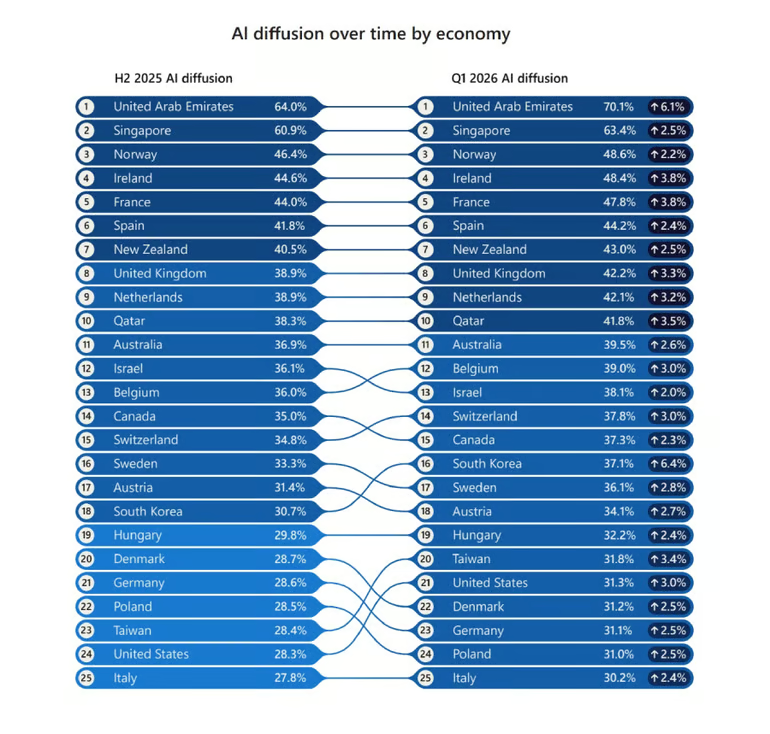
That head start is consistent with a country that already ranks second globally, behind only the UAE, in the share of its working-age population using generative AI tools day-to-day, according to Microsoft’s AI Diffusion Report.
Enterprise-level adoption is catching up too: Senior Minister of State Tan Kiat How said at ATxEnterprise 2026 that firm-level AI adoption rose to 23.5% in 2025, up from 4.3% in 2023. Singapore is, by most measures available, exactly the kind of market where a new wearable category shows up early and spreads fast.
More must-read AI coverage
- SS&C Intralinks DealCentre AI vs. Datasite: Which platform is built for the future of dealmaking?
- SS&C Intralinks FundCentre AI vs. Juniper Square: Which platform better supports modern private markets fund managers?
- Why Data, Not Models, Determines AI Success
- The Rise of the AI-Native Factory: How Physical AI Is Transforming Manufacturing
A governance framework that predates the eyewear
Singapore’s AI governance is often cited as a model for balancing innovation with oversight. Its approach combines the voluntary Model AI Governance Framework, the Personal Data Protection Act (PDPA) enforced by the Personal Data Protection Commission, and sector-specific rules from regulators, all aimed at providing businesses with clear guidance rather than broad restrictions.
But those frameworks were largely developed for AI systems operating within defined environments, not wearable cameras that can continuously collect information without other people realizing they are being recorded. The PDPC’s own leadership has acknowledged the gap is real.
Denise Wong, who became the commission’s fifth commissioner in April, told The Straits Times that Singapore’s data protection framework needs to adapt to a wave of AI-enabled devices that collect biometric data, often without the person nearby realizing it.
The regulator has reason to act: in May, two people in South Korea were caught using AI smart glasses to cheat on an English proficiency exam, prompting a ban on the devices in test venues there. That is the kind of enforcement question Singapore’s own institutions, from schools to courts to workplaces, will eventually face.
What this means for enterprises here
Locally, the more pressing task is internal. With Ray-Ban Meta and Oakley Meta now sitting on shop shelves rather than in a hypothetical future, any organization with a bring-your-own-device culture, client meeting rooms, or open-plan offices should assume some staff already own a pair.
Enterprises can update device and office policies before enforcement rather than after an incident, treating smart glasses the same way they already handle unauthorized cameras or recording apps in sensitive meetings.
Those who handle data protection compliance should be watching the forthcoming wearables regulation to see whether Singapore leans toward New York’s blanket-ban instinct or sticks with its consent-based, sector-by-sector approach. Whichever direction the country chooses will decide how much latitude Singapore’s employers get to write their own rules.