
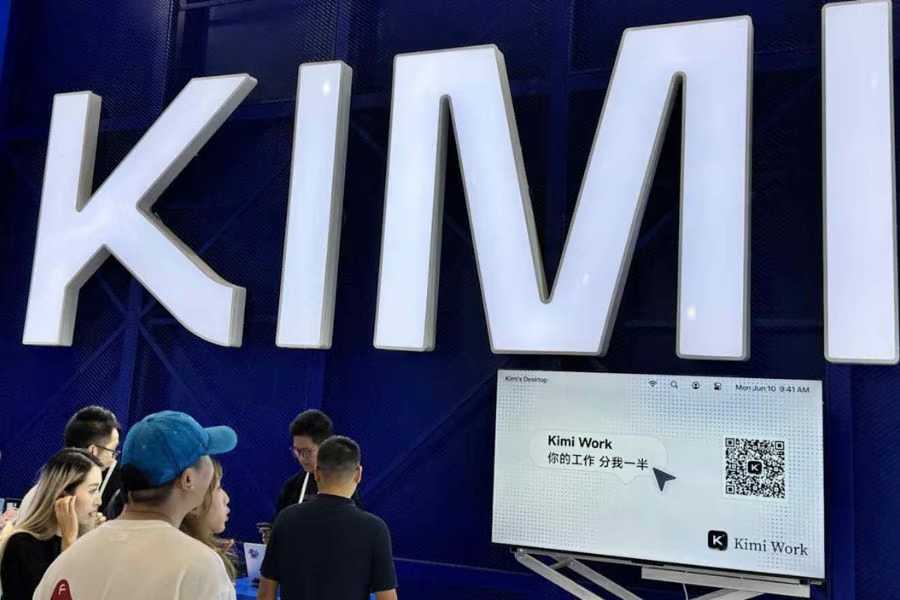


China’s Moonshot AI is reportedly telling investors that it plans to become a public company in as little as six months, capitalizing on the performance and reception of its Kimi K3 model.
The AI startup has seen its revenue surge recently, from a $200 million annualized revenue run rate (ARR) in April to $300 million by July. The launch of its latest model, Kimi K3, led to a huge increase in demand, forcing Moonshot to temporarily pause new subscriptions.
Kimi K3 is the world’s largest open-source AI model by parameter count and is second only to Anthropic’s Fable across all AI models. It has 2.8 trillion parameters, more than one trillion above the second-largest open-source model, DeepSeek V4 Pro.
That huge volume of training data has reportedly paid dividends in the sophistication of the model, with Kimi K3 surpassing Anthropic and OpenAI on several key benchmarks, although it remains behind both in overall capability.
China’s open-source AI models growing in popularity
Moonshot is one of several Chinese AI model makers gaining traction in its home market and overseas, selling access to frontier AI services at a lower price point than US competitors Anthropic and OpenAI.
This forms part of a growing trend in the AI market, where a business uses the best-performing AI model to build a service before switching to a cheaper model for day-to-day operations. While Kimi is more expensive than much of the Chinese field, it remains cheaper than GPT and Claude, without as significant a reduction in sophistication and understanding.
Alongside AI models, Chinese companies are also making inroads into data center infrastructure, chips, and supercomputers. This is despite restrictions across several key industries imposed by the US government in an attempt to slow technological progress by Chinese companies and the government.
More must-read AI coverage
- SS&C Intralinks DealCentre AI vs. Datasite: Which platform is built for the future of dealmaking?
- SS&C Intralinks FundCentre AI vs. Juniper Square: Which platform better supports modern private markets fund managers?
- Why Data, Not Models, Determines AI Success
- The Rise of the AI-Native Factory: How Physical AI Is Transforming Manufacturing
US-China friction may reduce customer numbers
Moonshot AI and others may fall victim to the US-China trade conflict, which appears to be expanding in scope as both sides try to restrict the other’s progress. Following the success of several AI models developed by Chinese companies, the Chinese government is now reportedly considering restrictions on the export of its leading-edge AI models.
Anthropic also listed Moonshot AI as one of the Chinese companies carrying out “industrial-scale” distillation campaigns, in which researchers create thousands of accounts and run millions of prompts to help train their own AI models. The White House has previously warned that models found to have been developed through this practice could be banned from use.
This could have major repercussions for businesses that have already shifted to a multi-model strategy, using American AI for certain tasks and Chinese AI for others. The lack of a third region, such as the EU or India, offering comparable AI models could lead to higher costs for customers and a narrower range of models to choose from.
Also read: Microsoft’s Project Perception would route security tasks across models from Anthropic, OpenAI, and Microsoft to reduce the cost of finding enterprise vulnerabilities.