


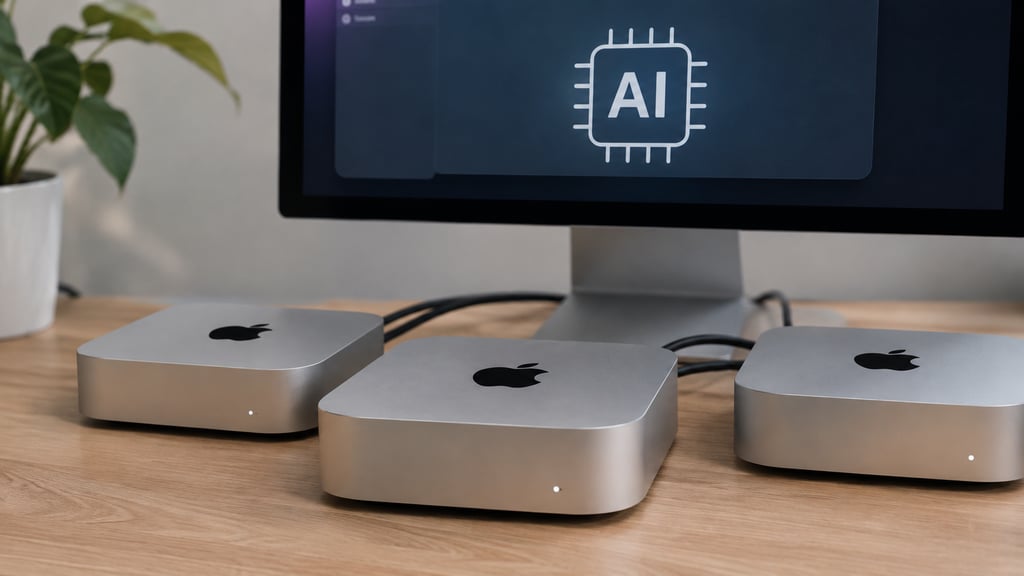
Your next AI server might already be sitting on your desk. Or perhaps it’s the Mac in the next cubicle that nobody’s using.
Apple subsidiary Claris is testing Harbor, an application designed to turn Apple silicon Macs into private AI servers. It would allow users to run open-weight AI models locally and connect multiple Macs to handle workloads that require more memory than a single machine can provide.
Rather than paying a cloud provider for every AI request, businesses could process supported workloads on their own hardware. Harbor also promises to simplify the technical work involved in setting up local AI infrastructure.
The application surfaced on November 10 via a now-removed App Store listing, as reported by MacRumors. Claris has also published an official preview page confirming the project’s core capabilities.
But Harbor remains in private preview, with no confirmed public release date or pricing.
What is Apple Harbor?
Harbor is designed to make running AI models locally easier, without requiring users to configure a dedicated server or rely on external cloud inference services.
According to Claris, users can establish a local AI endpoint on a single Apple silicon Mac. They can also connect compatible computers through Thunderbolt 5 to pool unified memory for larger workloads.
The application’s reported capabilities include:
- Local AI processing: Run supported open-weight models on Apple silicon hardware.
- Model management: Browse, download, and load models through the application.
- Automatic device discovery: Detect compatible Macs connected through Thunderbolt 5.
- Memory pooling: Distribute model workloads across connected machines.
- Simplified setup: Reduce the need for manual networking and command-line configuration.
Claris confirms local inference and memory pooling, while details about model management and automatic discovery come from the reported App Store listing.
The underlying technology isn’t entirely new. Apple’s MLX framework already supports local AI processing, and tools, although PAIR assigns separate tasks rather than pooling memory for one model.
Harbor’s potential advantage is making distributed inference easier to configure and manage.
How could Harbor run AI across multiple Macs?
Harbor’s most interesting capability is its proposed use of Thunderbolt 5 to connect several Macs into a shared AI resource.
Apple silicon uses unified memory, allowing the CPU and GPU to access the same memory pool. Large AI models can require more memory than a single computer has available.
By distributing a model across connected machines, Harbor could accommodate workloads that would otherwise exceed one Mac’s capacity.
The approach builds on Apple’s existing work with distributed inference and remote direct memory access (RDMA) over Thunderbolt 5, which reduces communication overhead between compatible Macs.
Apple has also been expanding the hardware available for demanding local workloads. Its 2026 Mac Studio supports up to 512GB of unified memory, giving developers more capacity to run large models on a single machine.
However, more memory doesn’t automatically mean faster AI. Performance depends on the model, available processing resources, and communication between connected computers.
Claris has not published Harbor-specific benchmarks, making it difficult to determine how its clustering approach compares with a single powerful workstation or dedicated AI server.
Why does Harbor matter for businesses?
Harbor could give organizations another option for running AI without relying entirely on cloud infrastructure.
Three potential advantages stand out:
- Greater control over data: Local inference could help organizations keep sensitive prompts and documents on hardware they control, although access controls and other security measures would still be necessary.
- Fewer usage-based charges: Claris advertises no cloud inference fees or per-token billing. However, hardware, electricity, maintenance, and potential software fees still contribute to operating costs.
- Easier experimentation: Simplified setup could make local AI more accessible to smaller IT teams interested in internal knowledge assistants, coding tools, and document processing.
The economics will depend heavily on the workload.
Businesses with predictable, frequently used AI applications might benefit from local infrastructure, particularly if they already own compatible Macs.
Organizations requiring rapid scaling or access to specialized models may still find cloud services more practical.
Harbor also enters a growing market for dedicated local AI hardware. For IT teams, the question is whether Harbor can make existing Macs useful enough to justify managing AI infrastructure internally.
What remains unknown about Harbor?
Despite Claris’s official preview page, several important details remain unanswered.
| Question | Current status |
|---|---|
| When will Harbor launch? | No public release date announced |
| Will it be free? | Final software pricing is unknown |
| Which Macs are supported? | Apple silicon is specified, but a complete compatibility list is unavailable |
| What does clustering require? | Thunderbolt 5 is specified; other requirements remain unclear |
| Which models will work? | No complete supported-model catalog published |
| How well does it perform? | No public Harbor-specific benchmarks |
The App Store listing identified by Perris has reportedly been removed, although Claris’s early-access page remains available.
Businesses should therefore avoid purchasing additional Macs specifically for Harbor until Claris confirms its requirements and capabilities.
For now, the application offers a glimpse of how Apple could make private AI infrastructure more accessible, particularly to smaller organizations already using Macs.
Harbor’s biggest promise isn’t replacing cloud AI. It’s making local AI simple enough that more businesses can realistically consider running it themselves.
Whether it delivers on that promise will become clearer once the software moves beyond private preview.
In other tech news, Apple’s rumored iPhone Air 2 could feature dual 48-megapixel rear cameras and an even thinner design, potentially addressing one of its predecessor’s biggest limitations, although the specifications and expected 2027 launch remain unconfirmed.