
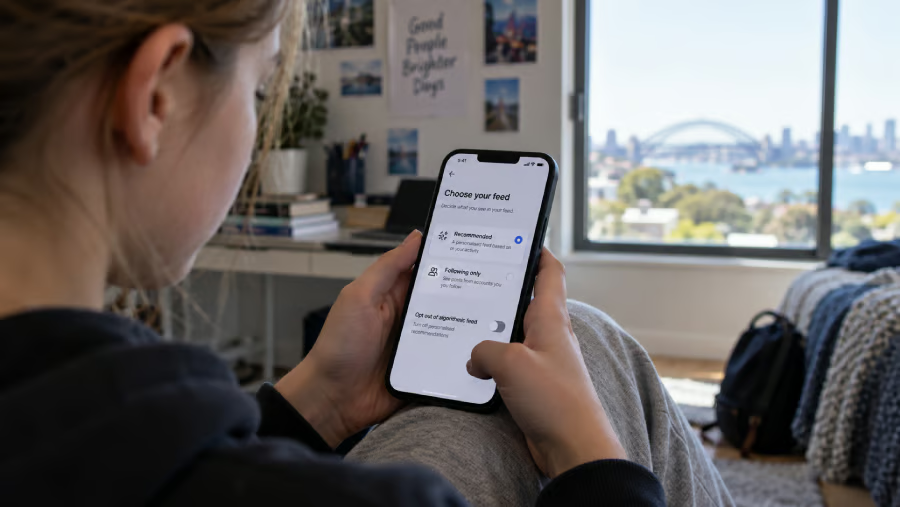


Australians may soon get a say in whether social media algorithms decide what fills their feeds.
The federal government has unveiled its “My Feed, My Way” proposal, which would require social media platforms to give users over 16 a choice between personalized recommendations and posts from friends and creators they choose to follow. Companies that fail to comply could face penalties of up to AU$109.2 million, or about US$79 million.
The proposal comes less than a year after Australia introduced its world-first social media ban for children under 16. The government is now moving beyond who can access social media and into how platforms shape the experience once someone is using them.
How Australia’s feed choice would work
Under the proposed rules, social media platforms would have to notify new and existing users about their feed options. People could continue receiving algorithmically recommended posts or choose content from accounts they deliberately follow.
Prime Minister Anthony Albanese described the proposal as a way to put more control in users’ hands.
“This is not about giving government control. It’s about giving people control. It’s about putting choice back into the hands of Australians online,” Albanese said, according to CNBC.
The government has not yet decided exactly how that choice will be presented. Communications Minister Anika Wells said officials are taking expert advice on whether algorithmic feeds should be something users opt into or opt out of.
Wells also acknowledged that many Australians find personalized recommendations useful and may decide to keep them.
“Big tech is not a protected species, and they should offer their customers basic safety standards,” Wells said, per BBC.
The Associated Press reported that platforms would have to give users over 16 a “genuine and enduring choice” and notify them about their default-feed options.
The proposal goes beyond social media algorithms
My Feed, My Way is part of a broader proposed Digital Duty of Care that would shift more responsibility for online harms to technology companies.
ABC reported that the duty would apply to online platforms including social media services, AI chatbots, and search engines. For Australians under 18, companies would be expected to take steps against content promoting eating disorders, misogyny, pornography, glorification of crime, bullying, abuse, and other material capable of causing serious harm.
For adults, the proposed duties are more narrowly tied to existing crimes, including child abuse, sexual violence, serious harassment, terrorist support, and encouragement of suicide.
Social media platforms would face additional requirements for younger users, including switching off personalized algorithms and endless scrolling. Australia already bans under-16s from holding social media accounts, so the proposal would add another layer of restrictions to how platforms can serve them.
“We have an opportunity to shape technology for the better, rather than let it shape us,” Albanese said, according to ABC News.
The proposal has also drawn criticism from opposition politicians over how much authority the communications minister could have to add new categories of harmful content. The government has rejected claims that the changes are intended to control political speech.
Australia’s teen ban shows how hard these rules are to enforce
Australia already has evidence that changing the law does not necessarily change how people use social media.
Three months after the under-16 ban took effect, more than 81% of Australian children were still using at least one age-restricted platform, according to eSafety Commissioner research cited by CNBC. Before the ban, the figure was 86%.
Daily or more frequent social media use also fell only slightly, from roughly 60% to 58%.
BBC noted that Wells acknowledged that no technology company had yet been fined for failing to enforce the age restrictions.
Australia’s under-16 ban has already shown how difficult social media rules can be to enforce. The same challenge could follow the proposed feed controls once platforms are required to put them into practice.
More Australia coverage
- Australia Passes Groundbreaking Cyber Security Law to Boost Resilience
- Australia Urges ‘High Risk’ Label for OpenAI, Meta, and Google LLMs
- Australian Businesses Urged to Invest More in Tech Adoption
- How Neudesic is Harnessing AI for Impact in Australia
What could change for users and platforms
Adults could still keep algorithmic feeds if they want them. The proposal would give users another option, but the experience could vary depending on how platforms apply the final rules.
The default could shape how many people switch
The government has not yet decided whether personalized recommendations will be opt-in or opt-out.
The default setting could make a big difference in how many people change their feeds. Users may be more likely to stick with whatever option is already selected for them.
Another question is what happens after a user chooses the alternative feed. The proposal says it would contain posts from friends and creators they follow. It is not yet clear whether those posts would appear chronologically or be ranked in another way.
Platforms may need more than a feed toggle
For social media companies, compliance could reach further into the product than adding a switch in account settings.
Depending on the final legislation, platforms may need to:
- Notify both new and existing Australian users about their feed options.
- Store and continue honoring each user’s feed preference.
- Apply age-specific controls, including restrictions on personalized recommendations and endless scrolling.
Platforms may need to change how their apps behave for different users, especially when age and location affect which features are available.
Australia could require its own product setup in APAC
Large social platforms often operate across several Asia-Pacific markets using shared infrastructure and product features. Australia’s proposal could require a different configuration for Australian accounts, particularly around defaults, age controls, notifications, and feed preferences.
Regional product and trust-and-safety teams may still have to apply separate rules for Australian users, even if the platform runs largely the same service across APAC. What a user sees could vary based on location and age.
Australia’s approach does not mean other APAC governments will follow it. It does give policymakers and technology companies in the region a concrete example of regulating recommendation systems through user choice rather than banning the technology itself.
The under-16 ban has already shown that writing a rule is easier than ensuring platforms and users follow it. With My Feed, My Way, much could come down to the product details: what Australians see when they are asked to choose, how easy it is to change that choice later, and whether their preferred feed continues working the way they expect.
Australia’s earlier social media rules have already forced platforms to change how they operate in the country, with Meta removing more than 750,000 under-16 Facebook and Instagram accounts.