


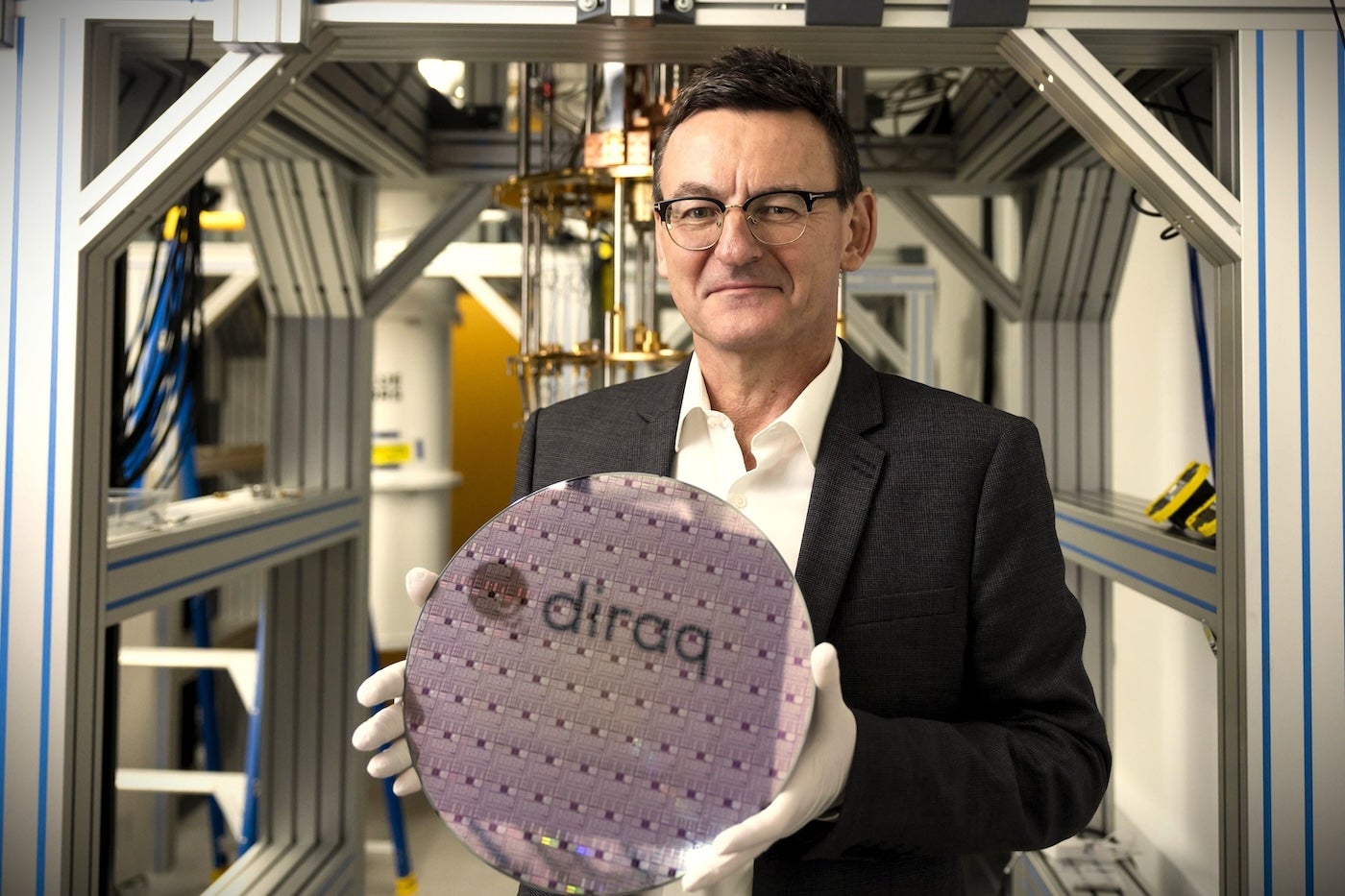
DARPA has awarded two Australian startups, Diraq and Silicon Quantum Computing (SQC), contracts for quantum computing research, the U.S. agency announced on April 4. Both Sydney-based companies will participate in the Quantum Benchmarking Initiative (QBI) program, designed to assess other companies to find which might have the potential to reach useful quantum computing within the next decade.
“For the chosen companies, now the real work begins,” said Joe Altepeter, DARPA QBI program manager, in a press release. “Stage A is a six-month sprint in which they’ll provide comprehensive technical details of their concepts to show that they hold water and could plausibly lead to a transformative, fault-tolerant quantum computer in under 10 years.”
Useful quantum computing (or utility-scale operation) is defined as a method in which computational value exceeds the build and operational costs.
Diraq teams up with other companies to manufacture quantum chips
Diraq entered into the QBI its silicon spin qubits approach to quantum computing, which is based on the CMOS manufacturing methods used to make computer chips. Diraq will place its method under more intense scrutiny as part of the program, testing its robustness.
“We are confident that our combined expertise, designs, and technologies can rapidly deliver a commercially viable quantum system concept in terms of capex per system, plus realistic considerations around equipment footprint, scalability, sustainability and operating costs,” wrote Diraq founder and CEO Andrew Dzurak in a press release.
To do so, Diraq has teamed up with other organizations:
- Emergence Quantum, which provides system architecture design, classical cryo-CMOS electronics, and qubit readout and control.
- Riverlane, which makes quantum error correction (QEC) technology.
- Semiconductor manufacturers Global Foundries and IMEC.
SQC brings intrinsically quantum qubits in silicon
Under the DARPA contract, SQC will work on intrinsically quantum qubits embedded in silicon chips. SQC performs its own manufacturing and said the company can iterate on new designs within one to two weeks.
“Not only is the associated funding incredibly useful, DARPA’s third-party interrogation of our path to a utility-scale quantum computer will be immensely valuable,” wrote SQC Founder and CEO Michelle Simmons in a press release.
SEE: Amazon showed a prototype of a quantum chip, Ocelot, that reduces errors with specially designed qubits.
More Australia coverage
- Australia Passes Groundbreaking Cyber Security Law to Boost Resilience
- Australia Urges ‘High Risk’ Label for OpenAI, Meta, and Google LLMs
- Australian Businesses Urged to Invest More in Tech Adoption
- How Neudesic is Harnessing AI for Impact in Australia
Quantum program looks ahead 10 years to possible commercialization
The QBI program will have three stages.
- Stage A is the assessment step and involves 16 companies from the U.S., U.K., Canada, and France, including IBM and Hewlett Packard Enterprise, as well as the two Australian businesses.
- Stage B will be a year-long program, during which DARPA will assess each company’s research and development approach.
- Stage C: An independent firm will assess each company’s hardware.
As InnovationAus pointed out, DARPA chose Australian company PsiQuantum for the Underexplored Systems for Utility-Scale Quantum Computing (US2QC) program, the group of companies the QBI program will assess. The program is not a competition between companies, DARPA pointed out. Instead; it is a survey of all companies deemed likely to produce a useful quantum computer.
Quantum computing is highly sought after as a commercial product, with its remarkable processing speed that could prove critical for drug discovery, materials science simulation, and other calculations. However, it has proven challenging to monetize and scale due to difficulties in scaling up the number of qubits able to be used in a computer; cost, especially of cooling the hardware to nearly absolute zero; and high error rates or noise.