


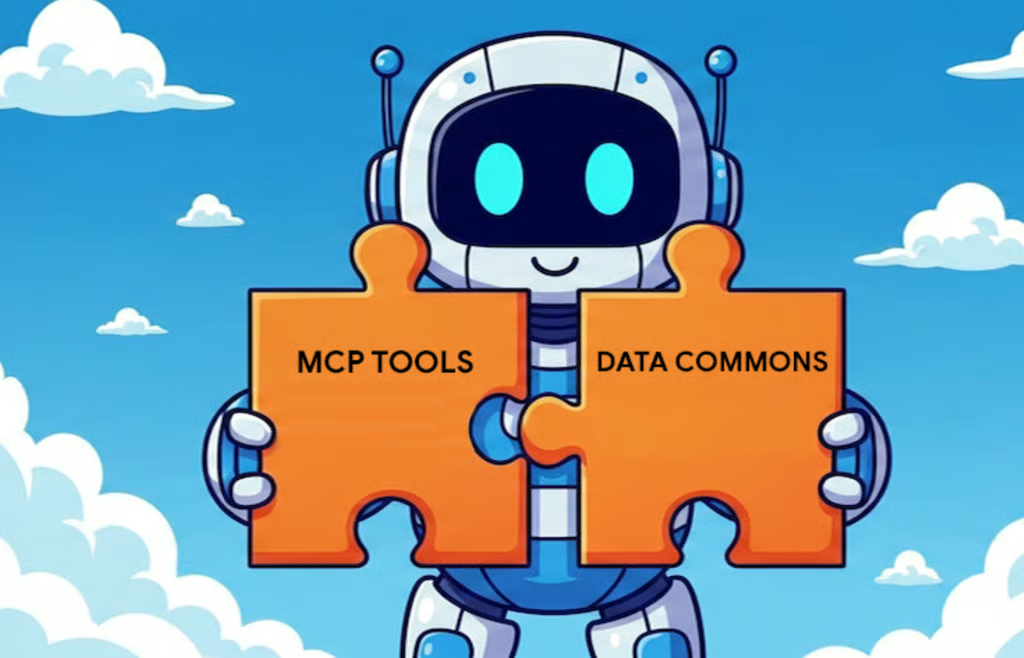
Google has released the Data Commons MCP Server, allowing AI agents to access public datasets and mitigate hallucinations by anchoring answers in real-world statistics. The company says the release is designed to accelerate the development of data-rich, agent-based applications.
Keyur Shah, a software engineer at Google, said the MCP Server makes public datasets instantly accessible and actionable. This would provide agents with a standardized way to consume the data and return trustworthy, sourced information without requiring heavy onboarding.
What is MCP?
MCP, short for Model Context Protocol, is an open framework that lets AI applications connect to external systems, such as data sources, tools, and workflows, through a consistent interface.
In practice, it gives agents a single path to fetch information and take actions rather than stitching together one-off integrations for every service. For developers, MCP reduces integration time and complexity; for users, it expands the capabilities of an agent by exposing a broader ecosystem of data and applications.
Google’s server applies the standard to Data Commons, bringing its public datasets directly into AI workflows.
From queries to reports in a single step
The Data Commons MCP Server integrates with Google’s Agent Development Kit and Gemini CLI, providing a seamless setup.
Agents can handle exploratory, analytical, and generative queries. Their capabilities range from scanning health data in Africa, to comparing life expectancy, inequality, and GDP growth across BRICS countries, to producing concise reports on income versus diabetes in US counties.
With a single query in Gemini CLI, an agent can systematically fetch information across Data Commons’ datasets and turn it into a structured report with sources attached.
Testing the server in the field
One of the first groups to adopt the Data Commons MCP Server is the ONE Campaign, which built an agent to support its policy and advocacy work.
The ONE Data Agent can query tens of millions of health financing data points in seconds, a task that previously meant searching through fragmented records across thousands of silos.
By consolidating that information, the agent delivers rapid insights for decision-makers and campaigners, turning what was once a needle-in-a-haystack search into a usable output.
Building trust into AI answers
Google positions the Data Commons MCP Server as a tool to improve the reliability of agent outputs. By tying responses to publicly available datasets, it is built to limit speculation and provide answers that can be checked against sources.
Google has made the server available as an open resource for developers, with starter packages on PyPI, sample code on GitHub, and a Colab notebook to test.
A timely step as AI hallucinations persist
AI is moving rapidly into everyday use, but the systems still struggle with hallucinations, or confident answers that can be false. The risk is amplified when AI is applied to sensitive fields such as medicine or law.
By rooting outputs in cited public data, Google’s Data Commons MCP Server could reduce that risk.
Google has also been reshaping Chrome, recently weaving Gemini into the browser in what it billed as its largest upgrade yet.