


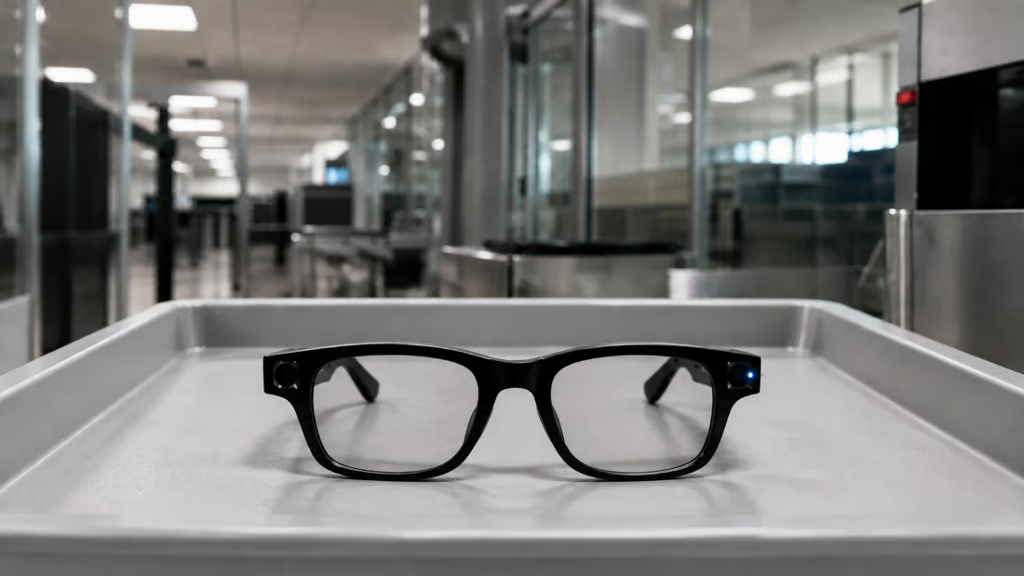
Last month, New York banned all camera-equipped smart glasses across its state court system. ICE has now reminded employees that personally owned recording devices, including Meta smart glasses, cannot be used while they are on duty.
The agency’s directive warns employees against wearing Meta smart glasses while working because the devices can capture, record, or transmit sensitive information, according to a memo signed by acting Immigration and Customs Enforcement (ICE) Director David Venturella.
ICE’s move is significant because it lands even as Meta reiterates safeguards such as a capture LED and technology that disables the camera when the indicator is blocked or tampered with.
But those measures do not change the larger question of whether a consumer AI device should be allowed in sensitive environments. For ICE, the devices’ ability to record or transmit information still presents a security risk in sensitive workplaces.
Accidental recording is the central concern
According to an internal memo dated Aug. 18 and seen by the New York Times, Venturella cautioned all ICE employees against using the glasses, citing the risk of accidentally capturing sensitive government information.
“The use of Meta Glasses or similar devices could unintentionally capture, record, or transmit sensitive information, potentially compromising privacy and legal protections,” the memo reads.
That says a lot about how ICE views Meta Glasses. The agency and its employees have faced heightened security threats, while sensitive information it holds has also been targeted, making the accidental exposure of government data an especially serious concern.
For ICE, allowing such devices and AI features into office and field working environments creates another potential route for that information to be captured or transmitted beyond ICE’s controls.
The risk becomes more significant when wearable cameras connect to external AI and cloud services beyond ICE’s direct control.
ICE restricts consumer smart glasses as DHS pursues its own
A DHS spokesperson described the memo as a reminder of an existing prohibition on personally owned body-worn cameras while employees are on duty. The guidance followed reports of DHS personnel wearing smart glasses during enforcement operations and highlights a developing contrast within the department.
The DHS recently requested $7.5 million to develop its own smart glasses for immigration enforcement.
The proposed system is intended to give agents real-time access to biometric identification data in the field, suggesting that the memo’s concern is not necessarily with smart glasses themselves but with who controls the technology and the data it collects.
That distinction makes ICE’s latest directive easier to understand. A government-controlled system can be designed around specific hardware, software, data storage, access controls and biometric systems, whereas a consumer device such as Meta Glasses sits within Meta’s ecosystem.
But it also raises a bigger question about the future of AI wearables.
If the technology becomes powerful enough for governments to build their own versions for surveillance and identification, then the debate will no longer be simply about whether smart glasses should be allowed. It will now also be about what they are allowed to see, what they can do with what they see, and who gets to control that information.