
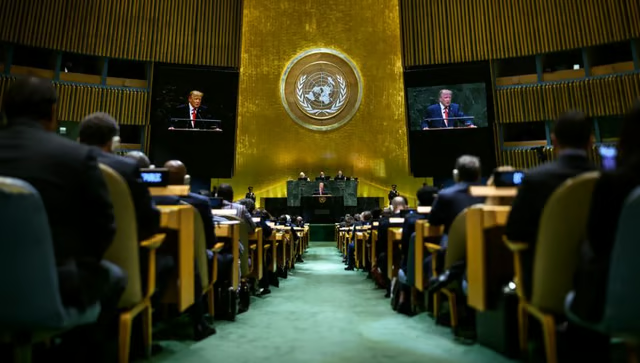


President Donald Trump wants to retire the “artificial” in artificial intelligence.
Speaking at the United Nations General Assembly on Tuesday, Trump said the U.S. government would begin referring to AI as “super intelligence,” arguing that “artificial” makes the technology sound fake. The White House also adopted the phrase in its summary of his remarks.
“The use of the word artificial makes intelligence fake,” Trump said, per The Verge. “It makes it sound fake, and it is not fake. It’s actually amazing. But we have to be careful. In fact, it is exactly the opposite of what it purports.”
He added that federal paperwork will immediately reflect the update: “From this point forward, all of the United States documents, and hopefully the world’s, will be changed to use the much more accurate term, super as opposed to artificial. So it’s super intelligence. In other words, welcome to the new world of super intelligence — SI.”
Trump, who previously tested options such as “superior intelligence” in online polling, framed the linguistic pivot as part of a wider deregulatory campaign. Rejecting what he termed a “globalist scheme to control” technology, Trump insisted the U.S. must outpace overseas competitors, particularly China.
“I’m not going to stifle growth of something that will be bigger than the Industrial Revolution,” Trump said, though he noted the Department of Justice would still monitor the field.
The change may sound cosmetic, but “superintelligence” already carries a different meaning in AI research, raising questions about how the administration’s terminology would translate into government policy, procurement, and regulation.
What ‘Superintelligence’ Usually Means in AI
In AI research, “superintelligence” generally describes a hypothetical system whose intellectual capabilities exceed those of humans across a broad range of tasks. That is considerably narrower than using the phrase as a replacement for artificial intelligence as a whole.
The distinction could matter if federal agencies begin adopting the new terminology in procurement documents, regulations, grants, or technical guidance while researchers, companies, and international organizations continue using established AI terminology.
The practical question is therefore not whether the government can change the words it uses, but whether the new terminology will also change how different technologies are categorized or regulated. The administration has not yet provided that level of detail.
More must-read AI coverage
- SS&C Intralinks DealCentre AI vs. Datasite: Which platform is built for the future of dealmaking?
- SS&C Intralinks FundCentre AI vs. Juniper Square: Which platform better supports modern private markets fund managers?
- Why Data, Not Models, Determines AI Success
- The Rise of the AI-Native Factory: How Physical AI Is Transforming Manufacturing
Shifting realities for everyday users
For consumers and daily software users, Trump’s rhetorical shift will not immediately alter how applications function. Your virtual assistants, search tools, and generative software will work the same tomorrow as they did yesterday.
The more immediate effects, if the administration follows through broadly, would likely appear in government communication, procurement documents, grants, and regulatory language.
- Consumer confusion: Users navigating enterprise software, school policies, or terms of service may soon see products labeled as “SI.” The rebranding risks misleading non-technical users into overestimating what these tools can actually accomplish, mistaking basic automated text generation for infallible machine omniscience.
- Bureaucratic inconsistencies: While federal forms and U.S. grant applications may shift to “SI,” international platforms, open-source projects, and foreign services may remain anchored to global standards. Everyday users working across international borders will face fragmented documentation, inconsistent compliance checklists, and contradictory technical disclaimers.
- Safety disconnects: As Washington de-emphasizes multilateral safety frameworks in favor of domestic acceleration, users can potentially bear more personal responsibility for spotting automated errors, bias, and algorithmic hallucinations without the safety net of standardized international oversight.
Companies operating internationally could also encounter different terminology between U.S. government documents and organizations that continue using “artificial intelligence.” The United Nations, for example, continues to use AI terminology in its ongoing work on international governance.
What remains unclear is whether “super intelligence” will function mainly as a branding change or eventually become part of formal U.S. policy definitions. Until agencies publish updated rules or guidance, the practical effect remains limited.
Other news: HP is partnering with OpenAI to deploy Frontier across its internal operations and customer experiences, highlighting how enterprise AI agents require data access, security controls, workflow integration, and capable endpoints — not just powerful models.