


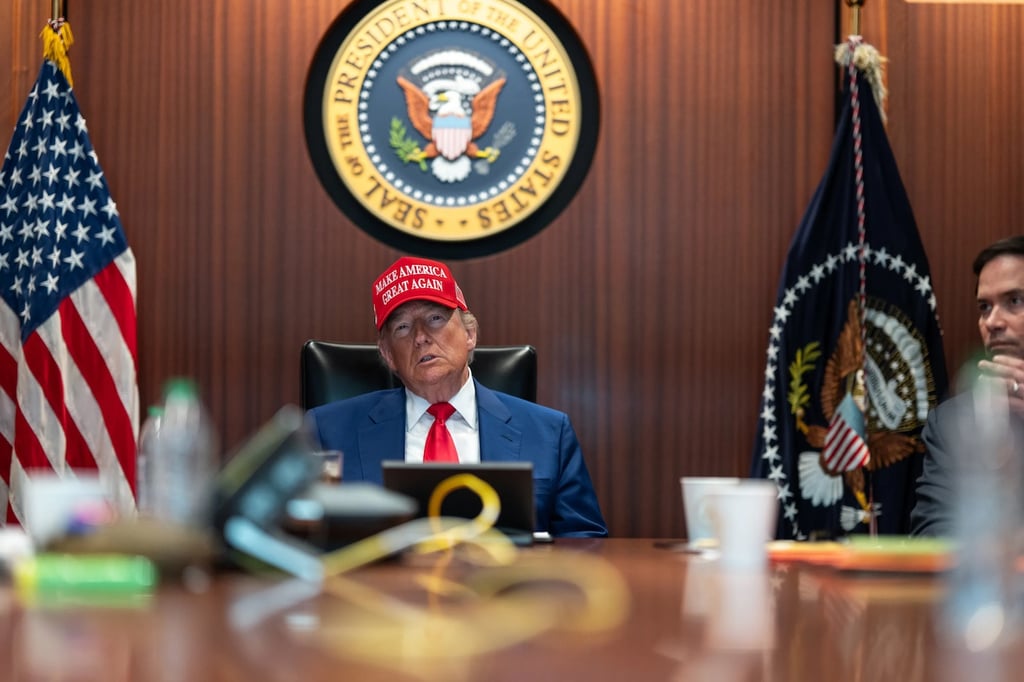
US President Donald Trump has announced that all imports from the EU and Mexico will have a 30% tariff as of August 1. He sent letters to EU President Ursula von der Leyen and Mexico’s President Claudia Sheinbaum informing them of the new rates, which were also posted on his Truth Social account on Saturday.
Roughly a third of all goods imported into the US come from these two countries, so the new rates will have a significant impact on prices. Trump hopes to “correct” a “large and unsustainable” trade deficit caused by “many years” of the EU imposing tariffs on the US. He also demands that the bloc give “complete, open market access” to the US.
The tariff on Mexico is partly attributed to the country’s “failure to stop the Cartels” responsible for trafficking fentanyl into the US. In 2024, 96.6% of all fentanyl entering the US came through the Southwest border shared by the two countries, according to data from US Customs and Border Protection.
Trump will consider adjusting the tariff rates if either the EU or Mexico decides to build or manufacture their products within the US. The EU would also need to open its trading market to the US and eliminate all tariffs and trade barriers, while Mexico must be “successful in challenging the Cartels and stopping the flow of Fentanyl.”
On the other hand, Trump warned that if either nation retaliates with higher tariffs, “then, whatever the number you choose to raise them by, will be added on to the 30% that we charge.”
The history of the ‘reciprocal’ tariffs
On April 2, Trump announced that the US would be imposing a 10% baseline tariff on all imports and additional “reciprocal” tariffs targeting countries with which the US runs a trade deficit, aiming to promote domestic manufacturing and address perceived trade imbalances. However, just a week later, he suspended them for 90 days to allow time for trade negotiations that would ease the market turmoil.
Those negotiations have not gone as smoothly as planned, and deals have only been struck with Vietnam and the UK, with a trade truce in place with China. Last week, Trump extended the tariffs deadline again to August 1, but has been announcing finalised rates with dozens of nations since then via letters to their leaders, the latest being Canada. He has also confirmed that there will be no further extensions to the deadline.
The EU and Mexico respond
The EU is delaying the implementation of its countermeasures until August 1, according to Bloomberg, with the hope of striking a trade deal with the nation before then. Shortly after Trump announced the tariffs in April, which included a 20% tariff on all imports from the EU, the region prepared 25% retaliatory tariffs targeting €21 billion worth of US goods.
“Imposing 30 percent tariffs on EU exports would disrupt essential transatlantic supply chains, to the detriment of businesses, consumers and patients on both sides of the Atlantic,” von der Leyen said in a statement. “We remain ready to continue working towards an agreement by August 1.”
During a Friday meeting with US officials to discuss their trade relationship, a Mexican delegation was briefed in advance about the tariffs and deemed them “unfair.”
Mexico was not assigned a new tariff in April; instead, its imports continued to face a 25% tariff as imposed initially in February, with goods compliant with the United States–Mexico–Canada Agreement (USMCA) exempt. However, on June 3, Trump doubled the import tariff on steel and aluminium to 50%, overriding nation-specific rates and heavily affecting Mexico, which sends most of its metal exports to the US.
Indeed, the US president clarified in his letter that Mexico’s new 30% rate is “separate from all Sectoral Tariffs,” but it remains unclear whether it will apply to USMCA-compliant products.
New tariffs announced so far
Trump has so far sent letters to 25 countries with which he does not have a trade deal, informing them of the final reciprocal tariff they will be subject to as of August.
| Country | Updated rate | Rate on April 2 |
|---|---|---|
| Brazil | 50% | 10% |
| Laos | 40% | 48% |
| Myanmar (Burma) | 40% | 44% |
| Cambodia | 36% | 49% |
| Thailand | 36% | 36% |
| Canada | 35% | 25% |
| Bangladesh | 35% | 37% |
| Serbia | 35% | 37% |
| Indonesia | 32% | 32% |
| EU | 30% | 20% |
| Mexico | 30% | 25% |
| Algeria | 30% | 30% |
| Bosnia and Herzegovina | 30% | 35% |
| Iraq | 30% | 39% |
| Libya | 30% | 31% |
| Sri Lanka | 30% | 44% |
| South Africa | 30% | 30% |
| Brunei | 25% | 24% |
| Japan | 25% | 24% |
| Kazakhstan | 25% | 27% |
| Malaysia | 25% | 24% |
| Moldova | 25% | 31% |
| South Korea | 25% | 25% |
| Tunisia | 25% | 28% |
| Philippines | 20% | 17% |
Trade deals have been penned with Vietnam, UK, and China
So far, trade deals have only been struck with Vietnam and the UK. The former has agreed to a 20% tariff on Vietnamese exports and a 40% levy on goods suspected of being transshipped through the country. The latter accepted lower import duties on British cars and aerospace materials.
The US has made a tentative agreement with China that would impose a 55% tariff on all Chinese imports and a 10% tariff on American exports, although this is not yet set in stone. It is also in talks with India, which hopes to strike a trade deal that will keep its tariff under 20%, according to Bloomberg.
Find out how the US tariffs could impact the price of an iPhone and other tech products.