


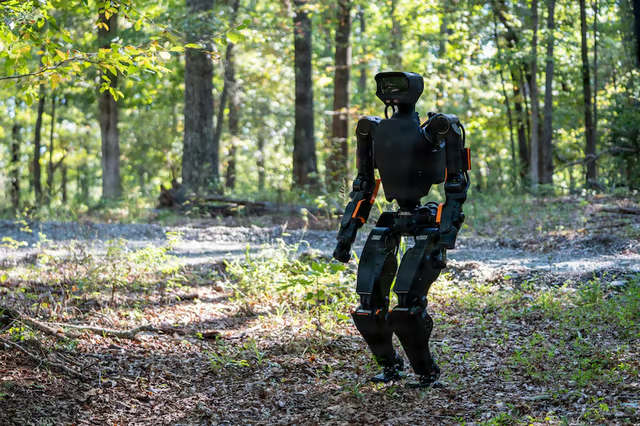
An armored humanoid robot named Alex took part in a US Army evaluation of technologies that could reduce soldiers’ exposure to dangerous work.
The US Army selected the Florida Institute for Human and Machine Cognition (IHMC), which developed Alex, as one of five winners of its xTechHumanoid competition.
The competition attracted 103 white-paper submissions, with 10 finalists selected and nine demonstrating their technologies at Marine Corps Base Quantico, Virginia, on Sept. 9-10. The Army announced the five winners Sept. 11, according to the US Department of War.
Alex stands out because it is a complete humanoid platform rather than a single supporting component. According to the Army, Alex features impact-resilient actuators, ballistic protection and hybrid autonomy combining artificial intelligence with human control for complex and dangerous missions.
“Humanoid robots are part of a broader autonomy push to increase the depth and breadth of robotic platforms, and [the] components industry can provide for a range of missions,” said Alex Miller, the Army’s chief technology officer.
Alex is only one piece of the puzzle
The other four winners show that the Army is not simply looking for a humanoid body. It also needs the supporting technology to make such machines useful in the field.
ACES Group won for an integrated power system, while Hydroplane Limited developed a compact mobile generator for longer-duration power in contested environments. RAS Labs brought tactile sensors capable of detecting force, object form and slip. Velocity Explorations developed software intended to translate trusted information and command intent into specific robotic actions.
That mix points to a practical problem: a robot can have advanced AI and armor and still be limited by its battery, ability to manipulate objects or ability to receive and execute commands.
More must-read AI coverage
- SS&C Intralinks DealCentre AI vs. Datasite: Which platform is built for the future of dealmaking?
- SS&C Intralinks FundCentre AI vs. Juniper Square: Which platform better supports modern private markets fund managers?
- Why Data, Not Models, Determines AI Success
- The Rise of the AI-Native Factory: How Physical AI Is Transforming Manufacturing
The bigger engineering problem
Power, manipulation and human control could ultimately determine whether armored humanoids move beyond demonstrations.
Armor can make a robot more resilient, but it also adds weight and increases the energy required to move. A robot that can enter a building is useful only if it can reliably negotiate doors, uneven surfaces and objects designed for human hands. The Army describes Alex as combining AI with human control, but its announcement does not explain which tasks are autonomous or when an operator must intervene.
The competition announcement does not describe a combat deployment for Alex or provide detailed protection, payload or battlefield-endurance figures. The xTechHumanoid competition is therefore an evaluation and development step, not a decision to field humanoid soldiers.
What Alex could mean for the battlefield
For soldiers and other personnel, the most immediate potential benefit is distance from dangerous work. The Army says it is exploring robotics to reduce exposure to hazardous and physically demanding tasks.
If Alex and related technologies mature, robots could eventually inspect risky interiors, handle dangerous objects or operate in environments where sending people first carries significant risk. For operators, however, that could also mean learning to supervise increasingly capable machines rather than simply controlling conventional remote vehicles.
For technology leaders evaluating humanoid robotics, the takeaway is to look beyond demonstrations and ask for measured runtime, task-completion rates, maintenance requirements and the frequency of human intervention. Those results provide a stronger basis for judging operational value than a competition win alone.
Read more: The gap between demonstrations and dependable work also shapes commercial adoption, where humanoid robot sales are growing but workplace pilots remain small.