
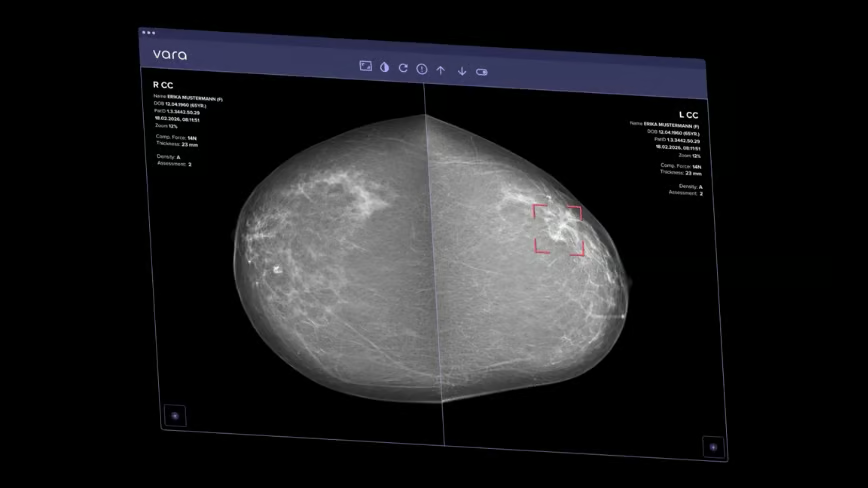


AI has taken a significant step beyond assisting radiologists: a breast-screening system has been cleared to report some mammograms as normal without a human reviewing every case.
Berlin-based Vara announced on Wednesday, Sep 2, that it had received Class IIb CE certification for its autonomous triage system. According to a Substack post by the company’s CEO, Jonas Muff, the clearance makes Vara the first breast-screening AI to be cleared to independently report examinations as clearly normal.
The move addresses a specific problem in organized breast-cancer screening: programs commonly rely on radiologists to read mammograms twice, even though most screening examinations are normal. Vara’s approach is to let AI handle the lowest-risk cases while directing the rest to human readers, potentially reducing the amount of routine image reading specialists have to perform.
Vara has also built a monitoring system to ensure that the AI always returns an accurate reading.
AI brings autonomy and some limits to breast cancer screening
Until now, Vara’s AI operated within workflows where a radiologist remained responsible for reviewing the mammogram. The company’s new certification allows the system to make the normal-case decision itself, but only for examinations it classifies as clearly normal.
Vara did not arrive at that point through a single validation test. The company has been using its AI in Germany’s national breast-screening program since 2019. That work included the PRAIM study, published in Nature Medicine in 2025, which followed 461,818 women across 12 screening sites.
PRAIM found that AI-supported screening detected 6.7 cancers per 1,000 women, compared with 5.7 per 1,000 with standard double reading, representing a 17.6% increase in cancer detection. The AI-supported workflow also produced a slightly lower recall rate, with 37.4 recalls per 1,000 women compared with 38.3 per 1,000 in the standard group.
The statistical difference matters because the new certification is not an unrestricted approval for AI to diagnose breast cancer independently. It allows the system to make a specific decision, while examinations outside that category are referred to a radiologist.
More must-read AI coverage
- SS&C Intralinks DealCentre AI vs. Datasite: Which platform is built for the future of dealmaking?
- SS&C Intralinks FundCentre AI vs. Juniper Square: Which platform better supports modern private markets fund managers?
- Why Data, Not Models, Determines AI Success
- The Rise of the AI-Native Factory: How Physical AI Is Transforming Manufacturing
How Vara plans to monitor autonomous AI in the real world
Using AI in high-risk activities like cancer detection is sure to raise concerns about the tool’s accuracy, particularly because human biology often varies and AI has, since its inception, shown an inclination to hallucinate.
To fix that problem, Vara also introduced what Muff calls a “patient safety” system. The Autonomous Triage Monitoring (ATMON) is designed to monitor the AI after deployment, rather than assuming its performance in a clinical study will remain unchanged in the real world.
The system tracks each screening site’s operating point, changes in mammography hardware, system health, and daily performance signals, as well as cancer detection and recall rates.
Vara says ATMON is designed to detect those changes and act on them. If the monitored safety measures move outside predefined limits, the system can automatically stop autonomous triage at that site and return the examinations to full radiologist reading.
The company says the monitoring system is built from more than seven years of real-world data, suggesting that its safeguards are based not only on controlled validation studies but also on how the system has performed across changing clinical environments.
What Vara’s clearance could mean for autonomous medical AI
Vara’s certification does not mean healthcare is ready to hand diagnosis over to AI. It does, however, show that regulators are beginning to accept a model in which an AI system can make a defined clinical decision without a doctor reviewing every case.
Robotic systems are already taking on increasingly complex surgical tasks. Newer AI systems are also being developed to reason across patient records, order tests, interpret results, and formulate treatment plans.
Vara’s breast-screening system also represents a more limited version of a future in which AI may move from merely detecting to providing solutions to some of healthcare’s biggest challenges to date.
However, even with regulators giving the nod, trust and reliability are central to how AI’s path into healthcare turns out. Patients may accept an algorithm that helps a doctor spot cancer more readily than one that makes the decision itself, while hospitals and clinicians will have to account for or compensate for errors, and the consequences of allowing AI to act without human review.
Vara’s clearance may therefore matter less for the number of mammograms the system can clear today than for the precedent it sets. If autonomous AI can prove reliable in narrowly defined clinical decisions, the next question will be how far regulators and healthcare providers are willing to expand that authority — and what safeguards they will require when human review is no longer automatic.
Let us teach you How to Talk to AI for free! Try our six-minute course at The Neuron Academy and learn a few simple ways to write better prompts and get more useful results from AI, or browse our other AI course for free for seven days. Check out all the lessons here →