

PayPal’s fast factsOur rating: 4.19 out of 5 Starting price: $0 per user per month Key features:
|

PayPal is THE pioneer in digital payment platforms that enable individuals and businesses to send, receive, and manage money online with ease. Originally founded in December 1998 under the name Confinity, PayPal was created to offer a secure method for transferring money via Palm Pilot devices, and it later pivoted to email-based payments.
Today, PayPal has over 400 million users with a brand proven to boost conversions for both in-person and online transactions. Learn about PayPal’s range of payment services for businesses of all sizes in this review.
PayPal pricing
One downside of PayPal supporting a wide range of methods is a complicated price matrix, and its confusing product names don’t help, especially for new merchants. In summary, PayPal’s primary pricing structure is a flat rate with zero monthly account fees, though qualified businesses can avail the cheaper “Interchange Plus, Plus” rates.
To help decipher PayPal’s pricing, below is a quick overview to help you get started (PayPal product names are in brackets):
- Monthly account fee: $0
- Transaction fees:
-
-
- Mobile and in-person transactions, including QR code: 2.29% + 9 cents to 3.49% + 9 cents
- Online transactions (PayPal Standard commercial rates):
- Credit and Debit Card Payments: 2.99% + 49 cents*
- PayPal Checkout: 3.49% + 49 cents*
- Pay with Venmo: 3.49% + 9 cents*
- PayPal Pay Later options: 4.99% + 49 cents*
- Local payment methods in other countries (PayPal Alternative Payment Method): 2.89% + 29 cents*
- Payment gateway transactions: 10 cents via standard or payment links/button
- Micropayments (under $10): 4.99% + 9 cents*
- Crossborder transactions: +1.5%
- Echecks: 3.49% + fixed fee* (capped at $300 per transaction)
- Manually entered/keyed-in transactions (PayPal Online Payment Service):
- Card Payments: 2.89% + 29 to 49 cents*
- Virtual terminal: 3.39% + 29 cents* + $30 per month
- ACH: 0.80% (capped at $5.00 per transaction)
-
- Standard online checkout services:
-
-
- Semi-hosted checkout (Payments Advanced): $5 per month
- Fully customized checkout (Payments Pro): $30 per month
- Payment gateway (Payflow Pro): $25 per month
-
- Optional services:
-
- Recurring billing: $10 per month
- Recurring billing tools: $30 per month
- Invoicing service: $14.99 per month (rates from 2.99% + 49 cents* to 4.99% + 49 cents*)
- Advanced Credit and Debit Card Payments (Interchange Plus, Plus): Interchange Pass-through Costs + 0.49% + 39 cents*
For qualified businesses, PayPal’s margin and fixed fee are directly added to the card network’s pass-through rates.
- Dispute fee (buyer’s PayPal account or a PayPal checkout transaction): $15 (for US merchants)
- Chargeback fee (guest checkout transactions): $20 (for US merchants)
*Please note that the fixed fees indicated are for US merchants. Visit PayPal for a complete breakdown of PayPal merchant fees.
PayPal’s hardware
In the news: PayPal is rebranding its POS products from Zettle to PayPal Point of Sale
PayPal offers two types of mobile card readers and a standalone terminal. The PayPal Reader connects with any smartphone or tablet installed with the PayPal POS app, ideal for small and micro businesses. PayPal Terminal is a standalone device with the PayPal POS software built in, making it a better choice for those looking for a more advanced solution.
PayPal Reader
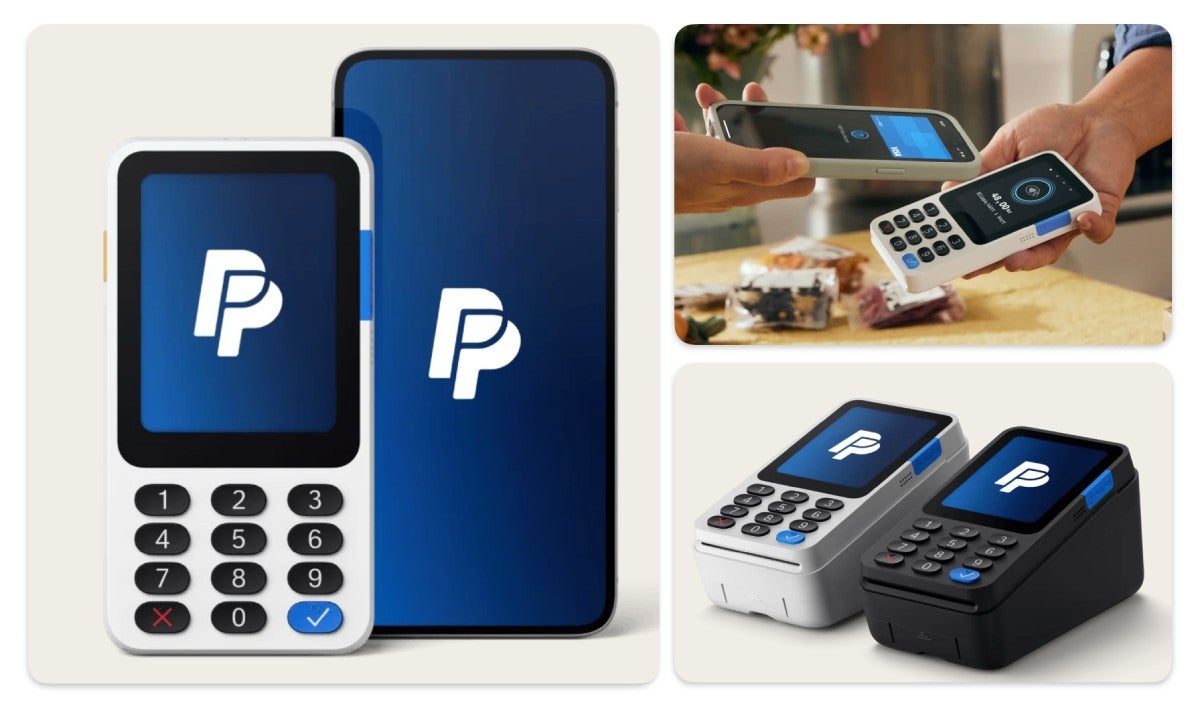
- Cost: $29 for the first card reader, $79 for succeeding; add $29 for optional Zettle dock
- Supported transactions: Swipe, EMV, contactless (3-in-1)
- POS software: On any iOS or Android smartphone/tablet
- Dimensions: 5.2 x 2.72 x 0.6 inches
- Weight: 0.32 lbs
- Battery life: Standby up to 48 hours; operational up to 12 hours
- Connectivity: Bluetooth Low Energy 5.1, Wireless, Serial pass-through dock connector
- Display: 3.2 inches, LCD, 262K colors LCD, 240 x 320 pixels, Capacitive & Backlight touchscreen
- Time to power up: ~2 seconds
- Contactless payments: ~5 seconds
- Card payments: ~10 seconds
- Warranty: 1 year
PayPal Reader 2
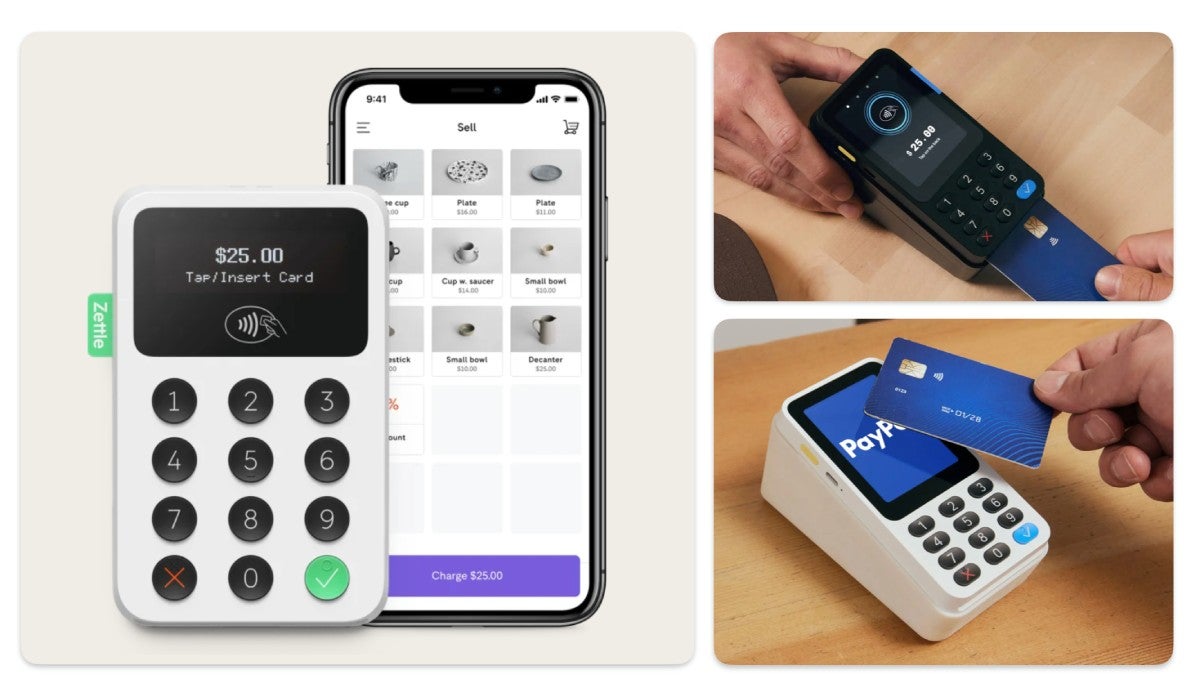
- Cost: $59 for the first card reader, add $19 for optional Zettle dock 2
- Supported transactions: Swipe, EMV, contactless (3-in-1)
- POS software: On any iOS or Android smartphone/tablet
- Dimensions: 5.4 x 3 x 0.59 inches
- Weight: 0.46 lbs
- Battery life: Standby up to 48 hours; operational up to 12 hours
- Connectivity: Bluetooth
- Time to power up: ~2 seconds
- Contactless payments: ~5 seconds
- Card payments: ~10 seconds
- Warranty: 1 year
PayPal Terminal
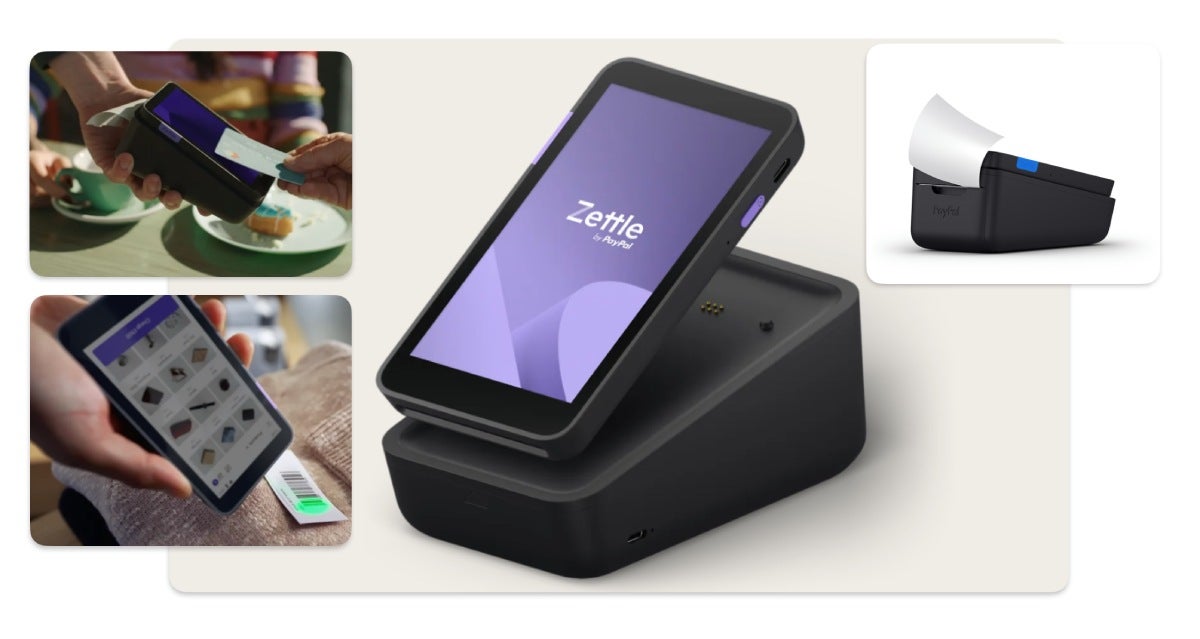
- Cost: $199 (basic); $239 (with barcode scanner); Add $70 for optional printer/dock
- Supported transactions: EMV, contactless
- POS software: Integrated
- UX/UI: Touchscreen
- Dimensions: 5.4 x 3 x 0.6 inches
- Weigh: 0.46 lbs
- Battery life: Standby up to 48 hours; operational up to 12 hours
- Connectivity: Wifi or 3G/4G with pre-loaded SIM card
- Time to power up: ~2 seconds
- Contactless payments: ~3 seconds
- Card payments: ~5 seconds
- Warranty: 1 year
PayPal Store Kits
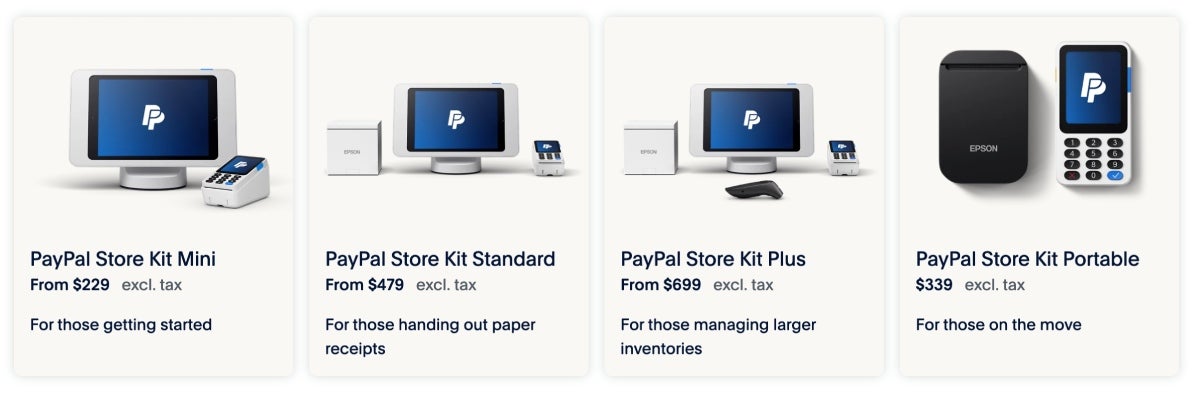
PayPal also offers a range of store kits for brick-and-mortar setups, which primarily include an iPad stand and a mobile card reader with a stand. Peripherals, such as barcode readers, cash registers, and countertop or portable thermal printers, are also available.
PayPal’s key features
With PayPal’s recent product upgrades, the system now provides better scalability, along with seamless transactions and quick access to funds. For small businesses, PayPal offers simple integration, easy invoicing, and minimal setup costs, while large businesses benefit from PayPal’s global payment capabilities, fraud protection tools, and developer-based customizations.
Here’s an overview of PayPal’s standout features:
PayPal online checkouts
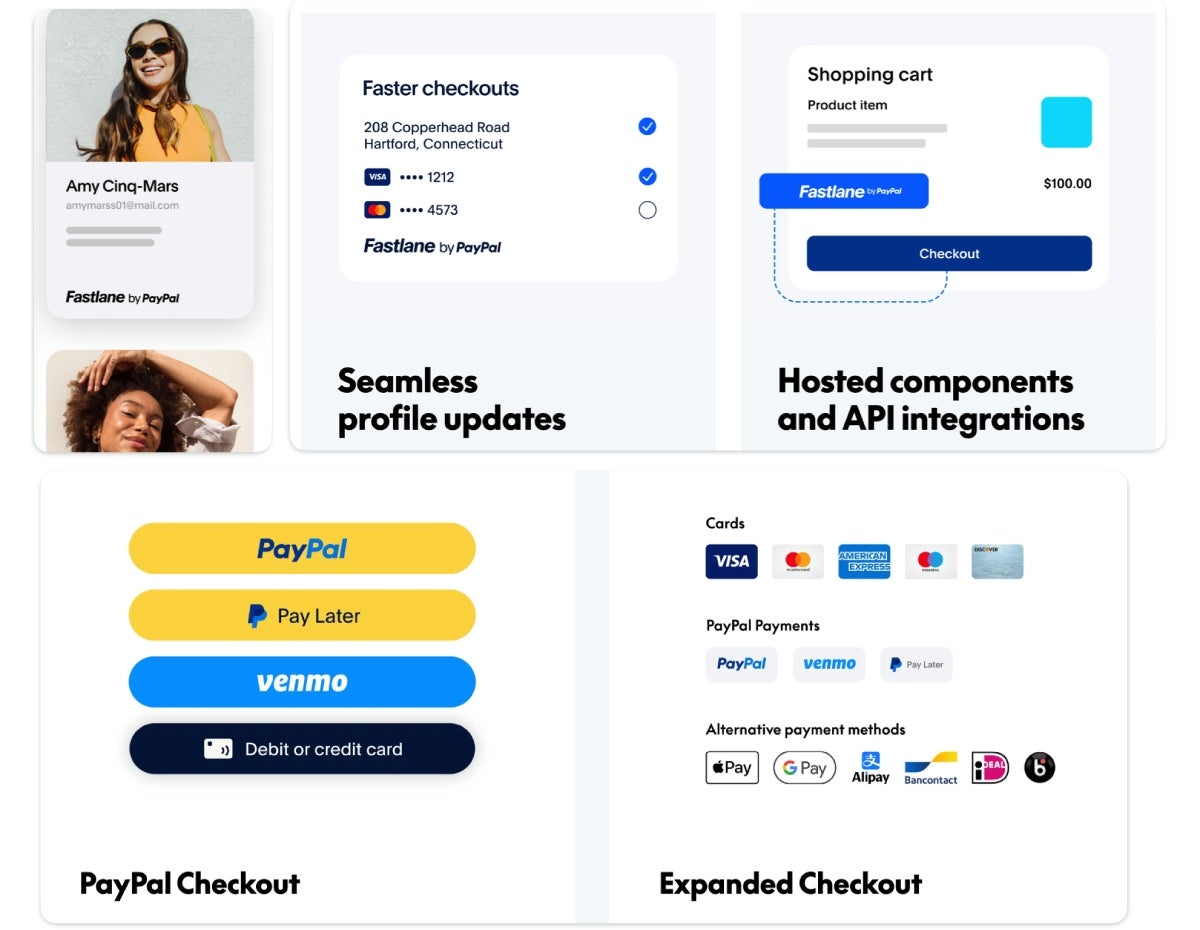
PayPal offers semi-hosted and fully customizable checkout options for your e-commerce website. Both allow you to accept various payment methods, including PayPal, Venmo, Pay Later options, credit/debit cards, Apple Pay, and Google Pay. Its latest feature, Fast Lane, supports one-click payments for “guests” who prefer not to log into their PayPal account.
International payments
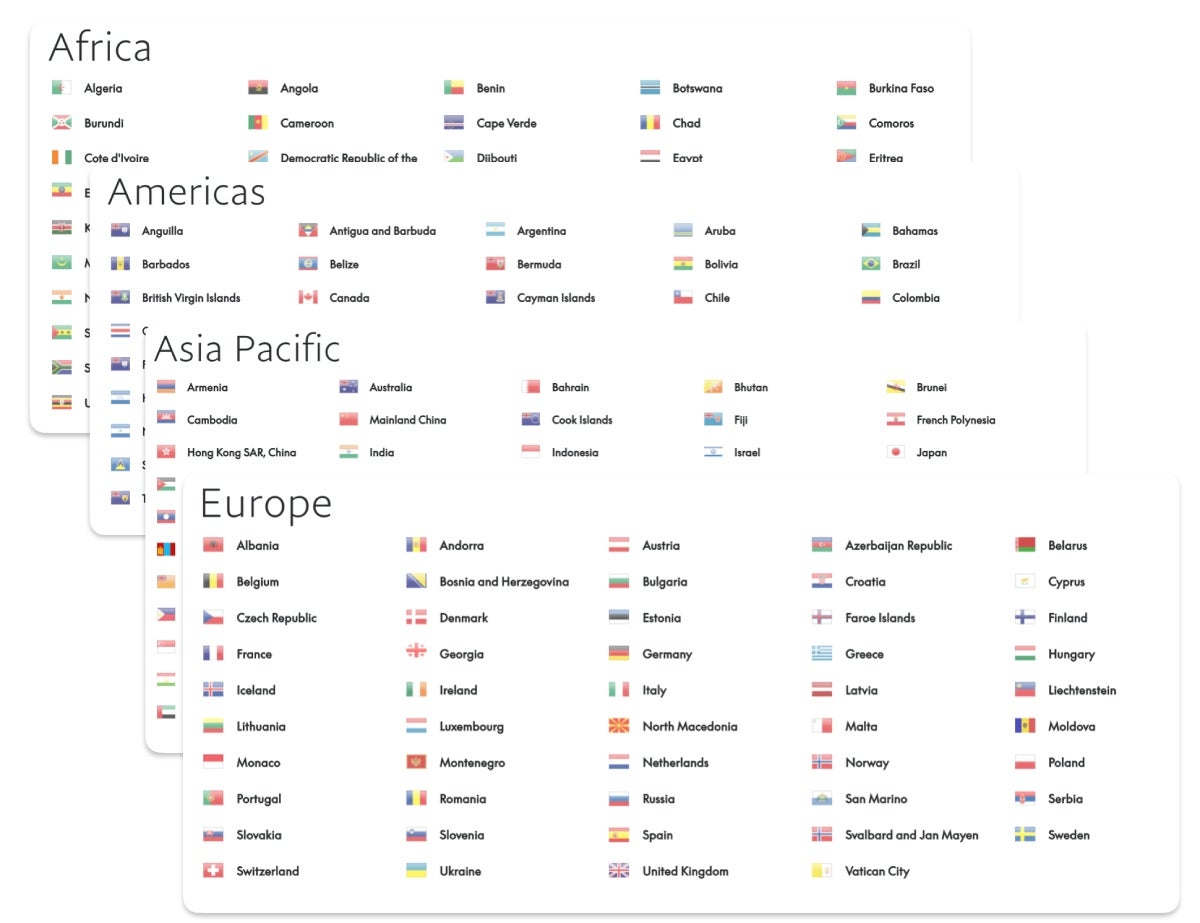
PayPal’s extensive global network and built-in currency conversion tools handle currency conversions automatically, simplifying cross-border transactions for merchants in over 100 currencies. While not as broad as Stripe’s list, PayPal also supports local payment methods, such as Alipay, GrabPay, and Apple Pay Web.
PayPal Pay Later
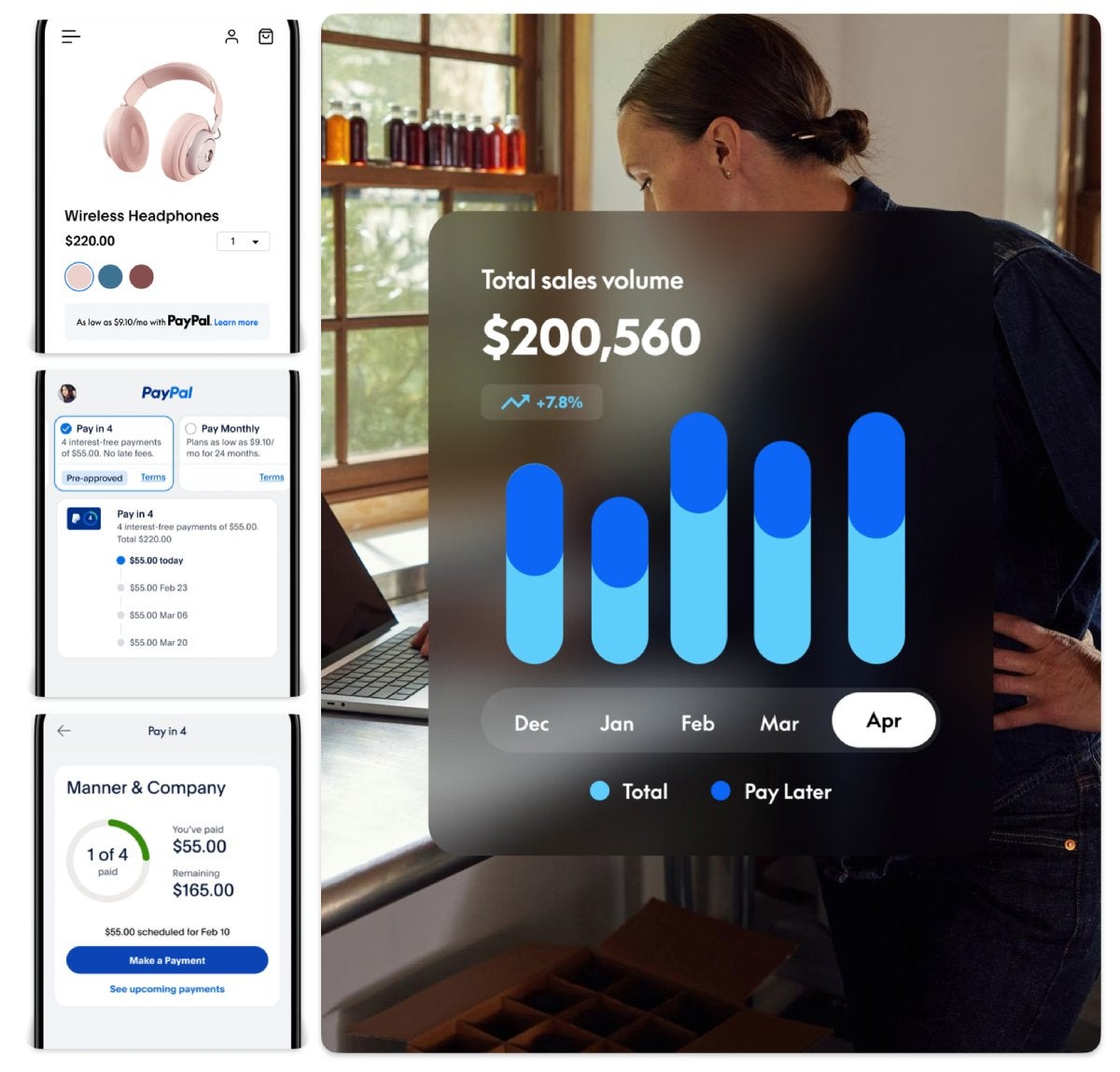
In true fashion of a pioneer digital payment innovator, PayPal launched its own short-term financing product, PayPal Pay Later, instead of integrating third-party platforms like Affirm. It works with e-commerce sites and digital payment apps hosted by popular brands, such as BigCommerce, WooCommerce, Salesforce, QuickBooks Online, GoDaddy, and Shopify.
Cryptocurrency transactions
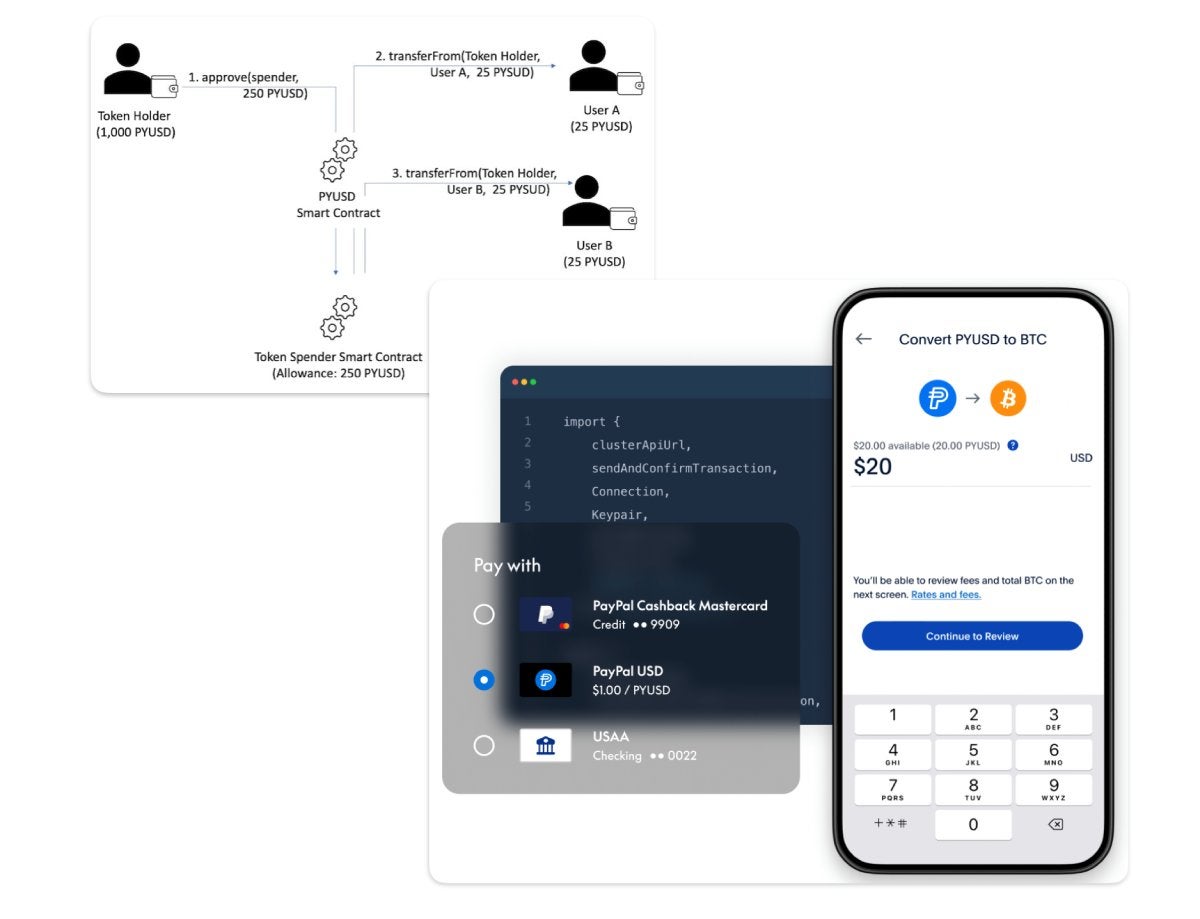
PayPal supports buying, selling, and holding cryptocurrencies, including Bitcoin, Ethereum, and its own stablecoin, PYUSD. The platform also allows users to use crypto holdings for purchases, with automatic conversion to local currency at checkout. Recent partnerships, such as with Coinbase, aim to expand the utility and adoption of PYUSD.
Chargeback and dispute management (for large businesses)
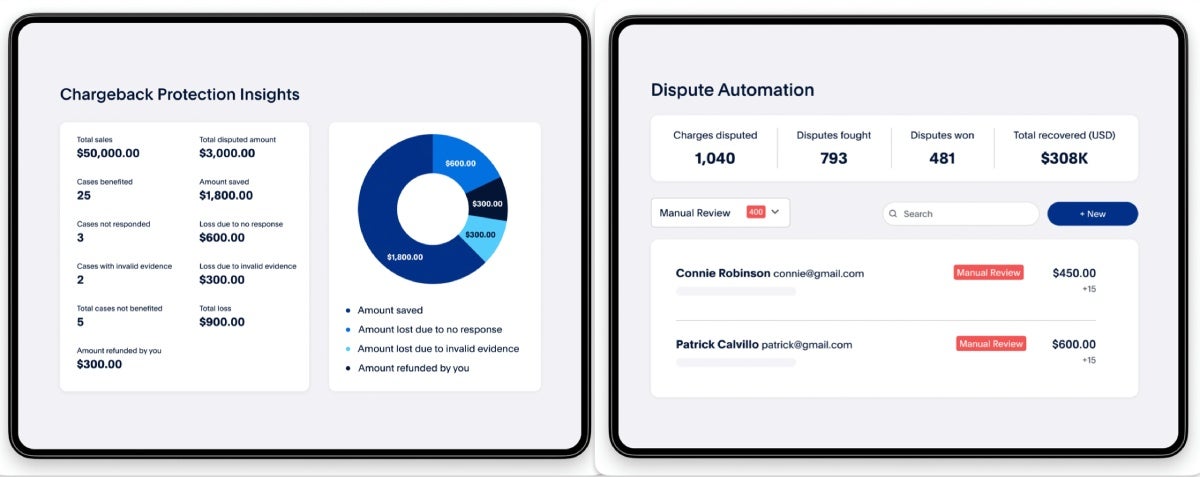
PayPal offers a structured dispute resolution process, assisting merchants in handling chargebacks, claims, and customer disputes. The platform provides tools for tracking case activity and communicating with customers to resolve issues efficiently. However, this feature is exclusive to enterprise-level businesses, unlike that of Square and Stripe, which offer basic dispute management tools at no extra cost.
Security and fraud monitoring tools
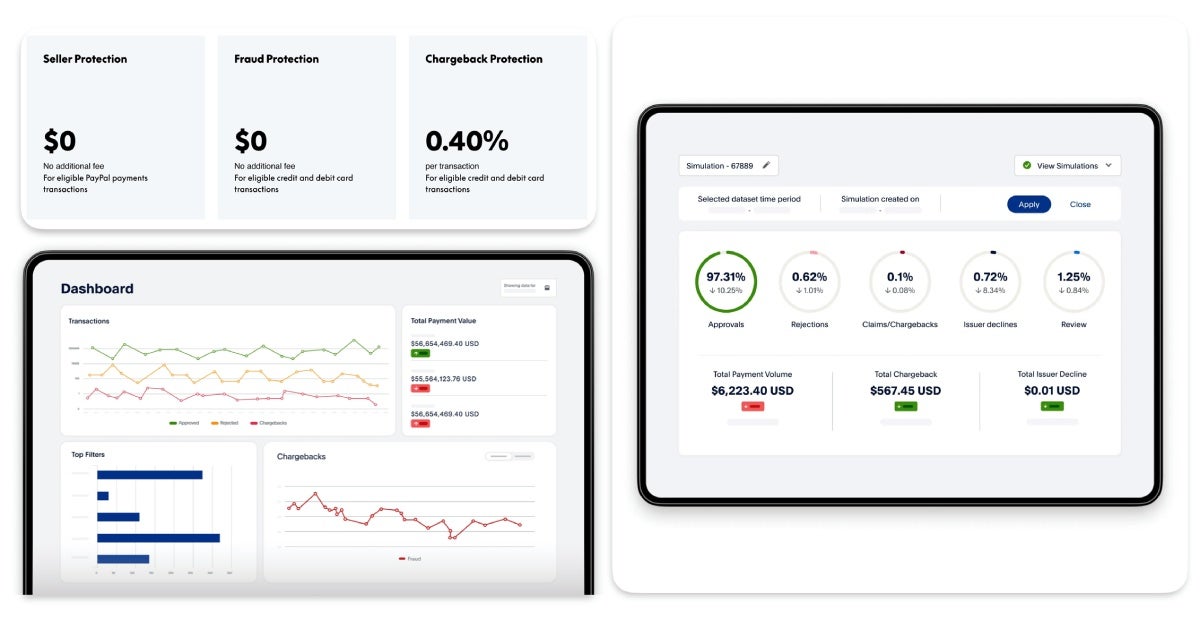
PayPal provides small businesses with automated seller protection, fraud protection, and chargeback protection (for a fee). The fraud monitoring dashboard, however, is reserved for enterprise accounts that employ advanced security measures, such as real-time monitoring, encryption, and two-factor authentication (2FA). PayPal’s Fraud Protection Advanced is equipped with customizable risk management tools, leveraging machine learning to identify suspicious transactions.
Integration and customization
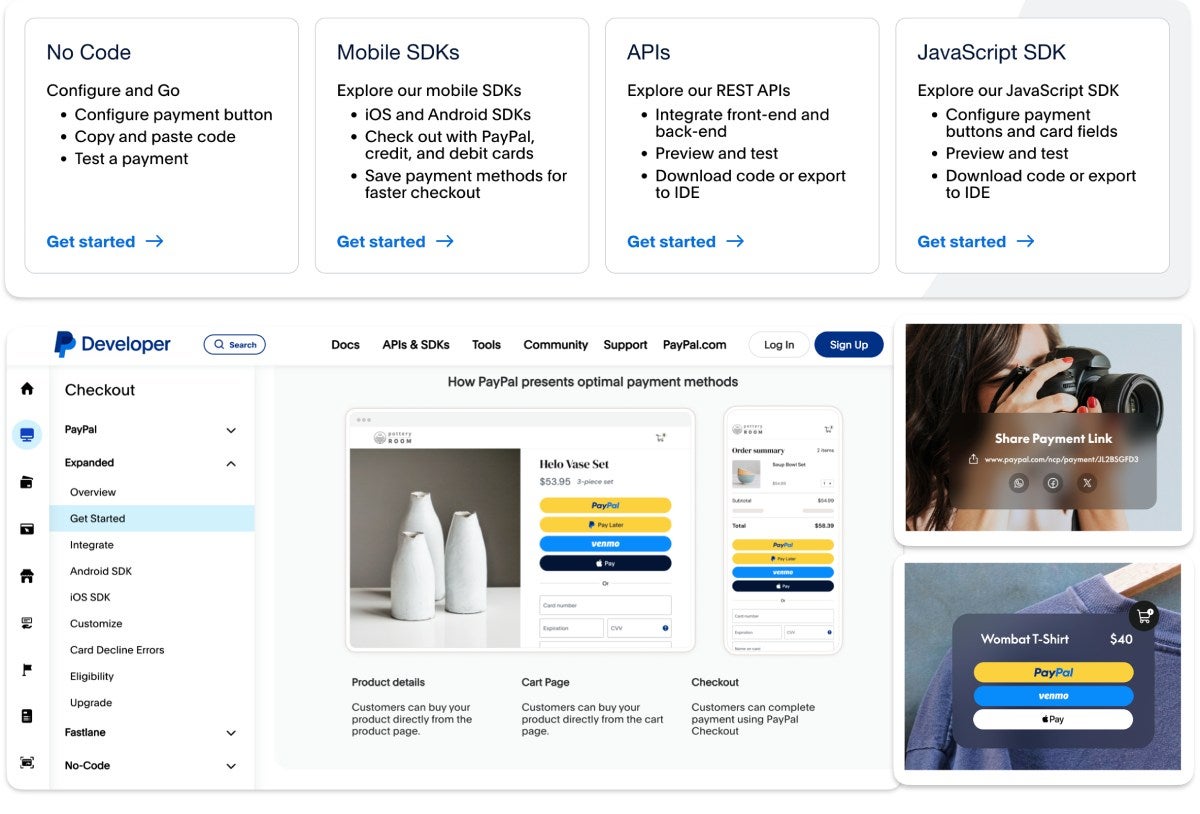
One of PayPal’s many standout features is its ability to integrate an additional online checkout service to work alongside other payment processors. This includes popular platforms such as BigCommerce, WooCommerce, Salesforce, GoDaddy, QuickBooks Online, and Shopify. For larger businesses, PayPal offers developer-based customization tools to tailor payment buttons, fields, and flows to match business branding.
The extensive documentation reminds me of Stripe, but with a more user-friendly sandbox environment. This makes PayPal ideal for businesses prioritizing quick deployment and multi-wallet acceptance with minimal development overhead.
Scalability
PayPal scales effectively for businesses of all sizes with flexible pricing, value-added services like Pay Later and Fastlane, and strong fraud protection. It supports seamless third-party integrations with major platforms like Salesforce and SAP, making it easy to fit into existing workflows. Developers can customize extensively using PayPal’s APIs and SDKs, including advanced features like third-party tokenization.
Reporting
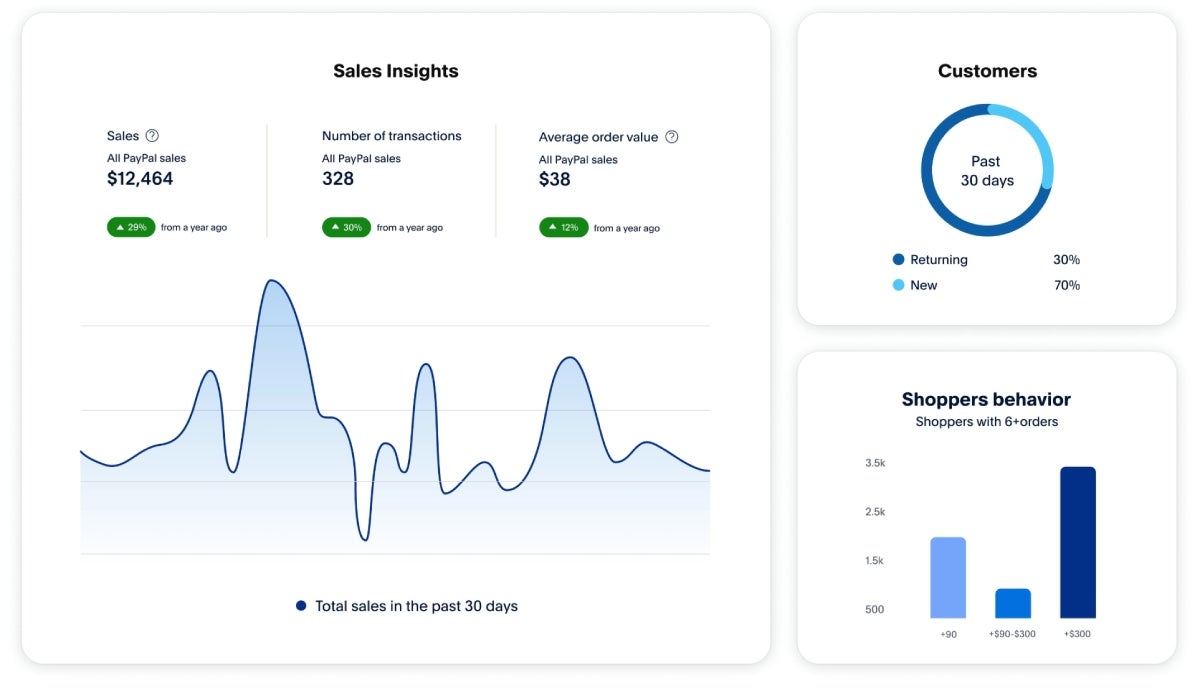
Small businesses using PayPal are provided with built-in reports to track sales, disputes, refunds, fees, and more. These reports are customizable with filters for time frames, transaction types, and customer data, and can be easily exported for accounting purposes. Enterprise-level businesses benefit from advanced reporting capabilities, including detailed transaction-level insights, settlement reports, and the ability to monitor checkout success rates and identify potential errors impacting performance.
Shipping
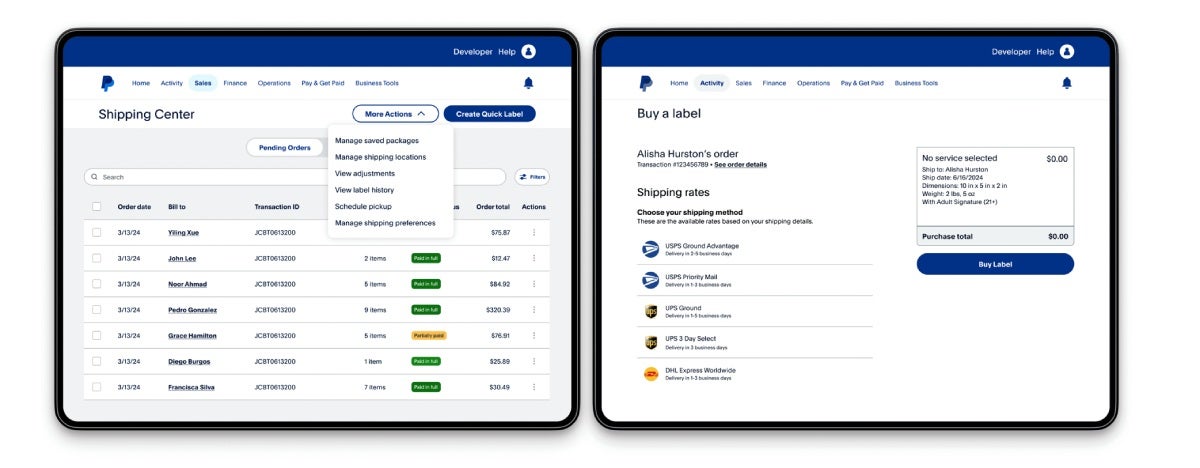
PayPal’s shipping tools let small businesses access major carrier discounts, print labels, track shipments, and sync tracking details directly to customer orders. Enterprise merchants can also set shipping presets and automate customs forms for international orders in addition to these tools. Though not as deeply integrated into the system as Shopify, PayPal’s shipping features are complete with the essential automation tools and are free to use.
PayPal pros
- Free POS software
- Fast sign-up and easy account set-up
- Instant access to funds
- Discounted hardware cost for new accounts
- Custom discounted processing rates for qualified businesses
- Range of no-code and developer-based customizations
- Option for primary or add-on online checkout
- Multiple product options for small to enterprise-level businesses
PayPal cons
- Complex pricing matrix
- Lacks industry-specific POS tools
- Chargeback management feature only for enterprise-level businesses
- Add-on monthly fees for payment gateway, invoicing, billing management, and semi-hosted checkouts
- Lacks level 2 and 3 data processing for B2Bs
- Reports of poor customer support quality
Alternatives to PayPal
| Our rating (out of 5) | ||||
| Starting price | ||||
| POS & e-commerce integration | ||||
| Access to developer-based customization | ||||
| Best for |
Helcim
Flat-rate pricing is primarily simple and ideal for new merchants; however, PayPal’s complex pricing matrix can be overwhelming. And while PayPal does offer custom interchange plus, plus rates, the add-on monthly fees for various payment services can quickly eat up your bottom line.
Helcim is an excellent alternative, particularly for fast-growing businesses that would like to get the most out of its payment processor. Unlike PayPal, there is no additional monthly cost to access Helcim’s range of payment services, such as invoicing and billing management, and transaction rates come with automated volume discounts, so businesses are always ensured of the lowest fees.
PaymentCloud
PayPal does not provide services to mid-to-high risk industries, and it’s no secret that there have also been reports of held accounts and frozen funds due to chargebacks. PaymentCloud is the best alternative for businesses that struggle with this issue. It offers hands-on merchant application and onboarding support with its team of industry experts. PaymentCloud also provides fully customized pricing and payment services tailored to efficiently manage chargebacks for any business type.
Square
PayPal acquired iZettle in 2018 and launched its very own mobile POS app, PayPal Zettle, in 2021. However, the software only offers standard POS features, which can limit a business’s ability to manage growing demands in a brick-and-mortar operation. This makes Square’s all-in-one POS, payments, e-commerce, and hardware system the better choice over PayPal. Square makes it possible to set up a small business at zero upfront cost with its feature-rich, free plan that includes industry-specific POS software, free magstripe reader, basic invoicing, and website builder tools.
Stripe
Both PayPal and Stripe stand out among other competitors in the industry for their ability to handle international payments (including cryptocurrency) and code-based online checkout customization. However, while both platforms offer PCI-compliant, low-friction integrations, large businesses that need a fully customized mobile platform will find that Stripe’s mobile SDK tools generally provide more granular control over the payment flow and deeper native platform optimization for complex apps.
Methodology
This PayPal review is based on a payment processor rubric with 19 data points that compares the top products in the industry on the following criteria:
- Pricing & Contract (30%): Measures how affordable and transparent the processor’s fees are and how fair and flexible the contract terms are (including cancellation policies). It focuses on making sure businesses aren’t trapped by hidden fees or unreasonable penalties.
- Features (25%): Evaluates the range and quality of every type of payment service. A strong showing here means a processor supports both day-to-day operations and future growth.
- Security and Stability (20%): Assesses how well a processor protects sensitive data, ensures uninterrupted service, and supports merchants with reliable hardware, PCI compliance, and dependable customer service.
- User Feedback (25%): Reflects real-world merchant experiences, focusing on ease of use, software and hardware quality, and the processor’s overall popularity and reputation. A high score here indicates trust, strong adoption, and overall satisfaction.
My assessment includes hours of hands-on testing and gathering real-life PayPal reviews from users of the PayPal Business app, mobile POS, and payment hardware.