


By Harris Kern
A traveler comes across
three bricklayers on a scaffold. The traveler asks the first one, “What
are you doing?”
The first responds,
“I am earning a wage.”
The traveler then asks
the second one, “What are you doing?”
The second responds,
“I am building a wall.”
They are doing the same
“work.” Which of the two is laying the better brick?
The traveler then asks
the third one, “What are you doing?”
The third responds,
“I am building a cathedral.”
The story illustrates the power that “big picture”
thinking has on the everyday work of laying bricks. But how does this story fit
with your job as CIO? If the IT department can understand its role in the
business’s big-picture goals, then it becomes a more indispensable part of the
team, and the IT staff, in turn, can see that their actions impact the overall
business. This enables them to act as partners in the business rather than just
worker bees, since seeing their place in the success of the business enables
them to make decisions and put forward innovative suggestions that go beyond
simply meeting the technical requirements requested by their client groups. Their
ability to add value, if they have a big picture-understanding and a big-picture
mindset, increases dramatically.
When IT is on board with the big picture, the rest of the
organization will be forced to view IT as a business partner and entrust them
for consulting work instead of merely looking at them as a support department.
The power of the Big Picture
The bottom line is that everyone needs to see the Big Picture.
This kind of thinking creates context and enables people to honor the values we
seek to live and work by. People, typically, are not motivated by values alone.
Instead, people are drawn to outcomes.
The more connected and integral you and your staff feel to the business, the
less likely you are to subscribe to the “us and them factor.” Avoiding
this attitude results in being less likely to disregard our values in dealing
with others, because we feel more of a connection to others with whom we share
the business.
Here are other reasons it’s important to grasp the big
picture:
- When it’s time to make a judgment call you are more
likely to make one in favor of the business. This lets you make decisions
on the battlefield in the midst of action with confidence. - The big picture is all about clarity: you know where
you are headed and your actions are aligned with the business goals. With
the big picture clearly in mind, every decision you make and every action
you take can be considered in light of how it supports or hinders the
business - Well-managed IT teams do their work in the context of
the big picture. They do not work on projects with the project itself
being the largest view they have of the business. Rather, they view their
projects within the scope of the larger business and where the business as
a whole is headed. - The more meaningful a business becomes to individuals, the more effort
people exert to bring about success. This is very different than a mission
or vision statement that is “owned” by the organization and not
the individuals.
Consequence-based thinking
We think of this awareness of the big picture as “living
above or below the line.” As you can see in Figure A, living above the line places emphasis on the situation. This means decisions become reactions justified by the situation not driven
toward a consequence. You’re less in control of the outcome.
|
Figure A |
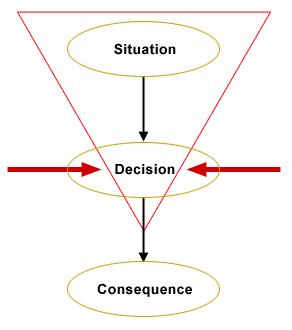 |
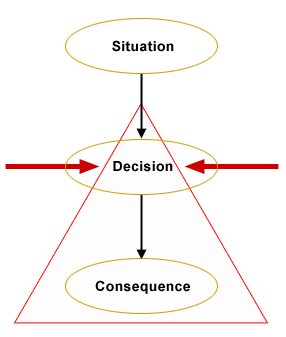
Figure B, on the other hand,
illustrates how living below the line places the highest priority on the
desired outcome. As a result, every decision can be weighed against its impact
on results rather than its “rightness,” given the situation.
|
Figure B |
 |
With the application of consequence-based thinking, people
recognize that ideas are not any one person’s responsibility or that efforts
alone will lead to the answers that will get to the desired consequences.
Whatever the problems, they can be resolved by changing the mindset of the
individuals. The focus must be to work as a team and implement consequence-based
thinking; the organization’s leader will discover that this isn’t just a
methodology. The practice will lead to solutions and this is why:
- It is important that individuals in any part of a
business understand how they connect to and serve the overall purposes of
the business. This is particularly relevant for those in IT positions. - Individuals should be organized into workgroups that
are aligned to serve the true purpose of the existence of the organization—the
“business.” - A commitment to serve the business is different than
a commitment to serve the workgroup or team. - It is equally important however, for individuals to
understand how they connect to and serve their own workgroups, department,
and the organization as a whole, and how that “system” supports
the business. - It is also important for individuals to understand
how they connect to and serve other workgroups and departments in order to
work synergistically within the organization for the success of the
business. - Individuals should measure their decisions and
actions in light of how individual decisions and actions serve the business
of the business, not merely by how well they serve the outcomes of a
project or the needs of a department. - It is important that members of IT teams see
themselves and their work as core to the business and not view the IT
function as an appendage of the business. IT is an integral thread that is
woven throughout all aspects of the business. The rest of the organization
is unlikely to see it as such if the IT team does not see itself this way
and does not approach each endeavor with just such a mindset.
As members of IT teams understand their place in the
organization and their role in serving the business of the organization (and not
merely the other departments in the organization), it’s likely that others will
view them as critical and necessary partners who can be trusted to provide
solutions that don’t merely serve process, but truly serve business outcomes.
As a result, they gain more opportunity to influence their internal clients
with appropriate solutions. This view of their role, combined with their
understanding and commitment to the business, will allow them to create
solutions that go well beyond the needs expressed by internal clients, to
ultimately benefit the overall business.
The Harris Kern
Enterprise Computing Institute (www.harriskern.com)
is a consortium of publications – books, reference guides, tools, and articles
– developed through a unique conglomerate of leading industry experts. Today, under the umbrella of the Institute,
IT professionals from many of the world’s leading companies come together to
take advantage of the institute’s leading edge disciplines and strategies for
improving the IT industry.