
Business intelligence tools are critical assets in the arsenal of enterprises. They go beyond mere data processing, as they are essential for converting vast amounts of data into actionable insights.
By aggregating data from various sources, both internal and external, these tools provide a thorough view of an organization’s operational landscape. This capability is key to guiding businesses toward informed decision-making and strategic planning.
SEE: What Is Predictive Analytics? (TechRepublic)
How do BI tools work?
BI tools operate through a multistep process whose key steps are data collection, cleaning and integration, analysis, and visualization. They gather data from a variety of sources, such as internal databases, cloud storage, customer relationship management systems, and external datasets.
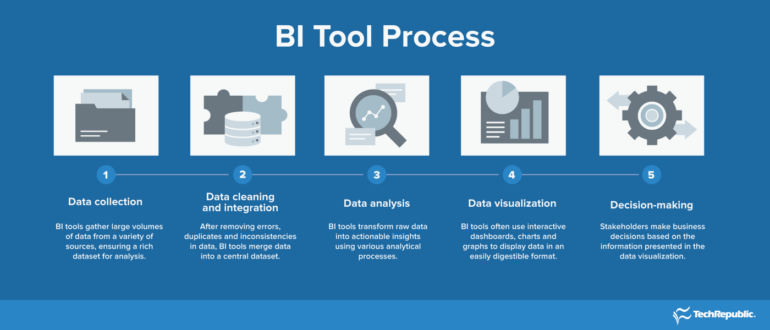
BI tools are then used to clean and integrate data to create a unified, coherent dataset. This allows the tools to properly analyze the data using various analytical processes, such as data mining, predictive analytics, and machine learning algorithms, to transform raw data into actionable insights based on patterns, trends, and relationships within the data.
From there, data analysts can take advantage of various visualization features offered by BI tools to create interactive dashboards, charts, and graphs to display data in a way that makes it easier to understand and derive meaningful conclusions.
SEE: 10 Best Practices for Optimizing Analytics Reports (TechRepublic)
Types of BI tools
From reporting to extracting, transferring and loading, here are some of the types of tools:
- Data visualization: Specialize in turning complex datasets into graphical representations for easier comprehension.
- Data mining: Use AI, machine learning, statistics, and database systems to find patterns in large datasets.
- Online analytical processing: Enable multidimensional analytical queries, which are useful for complex calculations, trend analysis, and data modeling.
- Reporting and query software: Focused on generating structured reports and queries to sort, filter, and display data.
- ETL: Extracts data from various sources, transforms it, and loads it into a database or data warehouse, thus helping to maintain consistency and usability.
- Self-service: Allows end users to conduct their own data queries and report generation, making analysis accessible to a broader range of users within an organization.
SEE: Benefits of Edge Computing (TechRepublic)
Key features of BI tools
Data integration
Data integration involves the merging of data from disparate sources into a single, cohesive dataset. This process ensures the analysis is comprehensive and accounts for all relevant data points, regardless of their origin.
Data quality management
Data quality management focuses on ensuring the accuracy, consistency, and reliability of the data being analyzed. It includes processes like cleaning, removing duplicates, and correcting errors.
Interactive dashboards
Interactive dashboards offer customizable and user-friendly interfaces that display real-time data and insights. These dashboards allow users to quickly access, analyze, and understand key business metrics.
Ad hoc reporting
Ad hoc reporting allows users to create specific, on-demand reports tailored to their requirements. This feature means users don’t need to rely on predefined report formats.
Predictive analytics
Predictive analytics use historical data to predict future trends and outcomes. This feature employs statistical algorithms and machine learning techniques, and helps businesses to anticipate market changes, customer behavior, and potential risks.
SEE: EU GDPR Compliance Checklist (TechRepublic Premium)
Benefits of BI tools
Enhanced decision-making
Through data-driven insights, BI tools enable businesses to make more informed and accurate decisions. This yields better strategic planning, improved resource allocation, and an increased likelihood of achieving business goals.
Increased efficiency
BI tools automate many aspects of data analysis and reporting, which saves time and reduces the workload on staff. Increased efficiency can lead to cost savings and allows employees to focus on more strategic tasks.
Competitive advantage
Businesses gain valuable insights into market and customer trends. With this information, companies can stay ahead of competitors, identify new market opportunities, and tailor products or services to better meet customer needs.
Risk management
By forecasting future trends and potential risks, businesses can take preemptive approaches to mitigate potential risks, ensuring more stable and secure operations.
SEE: Big Data Policy (TechRepublic Premium)
Challenges of BI tools
High initial and maintenance costs
The initial investment for purchasing and setting up these tools can be high and there are ongoing costs for maintenance, updates, and training. For small businesses, all this can be a substantial financial burden.
Complexity
BI tools often require specialized skills and training to use effectively, which can pose a challenge in terms of both the time and resources required for training employees or finding new personnel with the necessary skills.
Data security risks
Handling large volumes of sensitive data increases the risk of data breaches and security issues. Ensuring the security and compliance of data is a major concern for businesses, as these tools require robust security measures and constant vigilance.
Integration issues
Integrating BI tools with existing systems and workflows can be complex and time-consuming. Compatibility issues, synchronization, and maintaining data integrity during integration are common problems.
SEE: Hiring Kit: Data Engineer (TechRepublic Premium)
What are some top BI tools?
Some of the best BI tools include:
- Zoho Analytics: Self-service tool that enables users to create visually appealing visualizations and insightful dashboards in minutes.
- Tableau: Renowned for its advanced data visualization capabilities, Tableau enables users to create interactive and shareable dashboards. It’s easy to use and able to handle large datasets.
- Microsoft Power BI: Known for its seamless integration with other Microsoft products, Power BI offers comprehensive data analysis and visualization capabilities. It’s got a user-friendly interface and offers diverse data connectivity.
- Qlik: Its range of BI tools includes QlikView for guided analytics and Qlik Sense for self-service data discovery. Their associative engine stands out for its ability to insightfully connect data from multiple sources.
- Sisense: Featuring a user-friendly drag-and-drop interface and the ability to handle large datasets from multiple sources.
This article was originally published in November 2023. It was updated by Antony Peyton in July 2025.