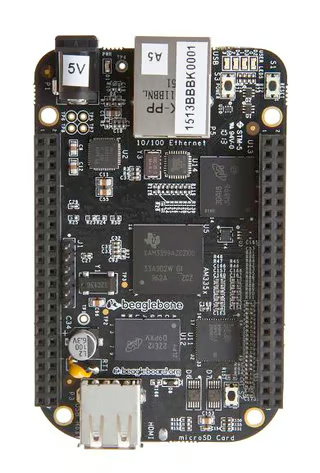
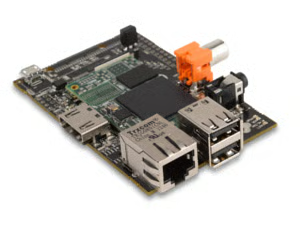
Aimed at broadly the same market as the Raspberry Pi, the BeagleBone Black has a lot to recommend it.
The BeagleBone is reportedly easier to set up out of the box than the Pi, a plus when the platform is designed for use by people learning to code or about electronics.
While the Pi’s integrated VideoCore GPU is more capable, able to decode 1080p and render 3D OpenGL graphics, the BeagleBone has the edge in CPU performance. The BeagleBone’s processor is both higher clocked and based on a more recent ARM instruction set in the Pi, giving it access to various optimisations. Tests indicate the BeagleBone’s CPU is capable of executing significantly more instructions per second.
The number of pin headers on the BeagleBone also make it a great choice for connecting to a wide range of sensor devices.
The BeagleBone is also an open platform, with the documentation for how to build a BeagleBone Black – layout files, schematics, and reference documents – available on the BeagleBone Black wiki page.
The BeagleBone costs $55, although it is currently out of stock at many suppliers.
Specs
If you’re interested in hacking together an electronic gizmo then Arduino boards can often be the better choice than the Raspberry Pi.
While the Raspberry Pi is a small form factor computer that runs a Linux OS, Arduino are energy sipping boards that house microcontrollers designed to manipulate hardware like sensors and motors.
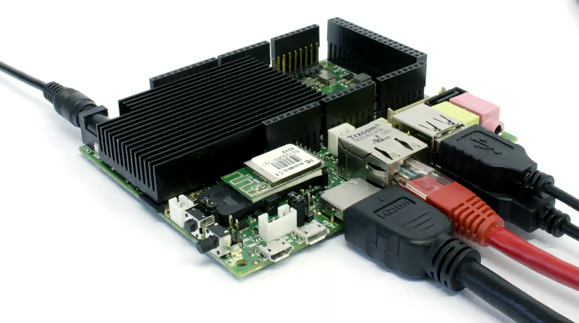
Both platforms have their advantages, which is why the UDOO attempts to combine them into a single product.
UDOO is an open hardware, low-cost computer equipped with an ARM i.MX6 Freescale processor to run Android and various Linux OSes, and the ARM SAM3X CPU found on the Arduino DUE.
The board is aimed at people wanting to learn about electronics and build their first simple projects, as well as experienced makers wanting to prototype products. The boards are installed with Linaro 11.1 and a number of programming languages and tools aimed at beginners, such as Scratch4Arduino.
The board is designed to run both Android and a variety of Linux OS, and to be a development platform for ArduinoTM and Google ADK.
Compared to the Pi the UDOO has double the RAM and four faster cores, as well as the integrated Arduino. But the additional hardware comes at a cost – with dual core boards selling for $99 or $115, depending on the configuration, and quad-core for $135.
Specs
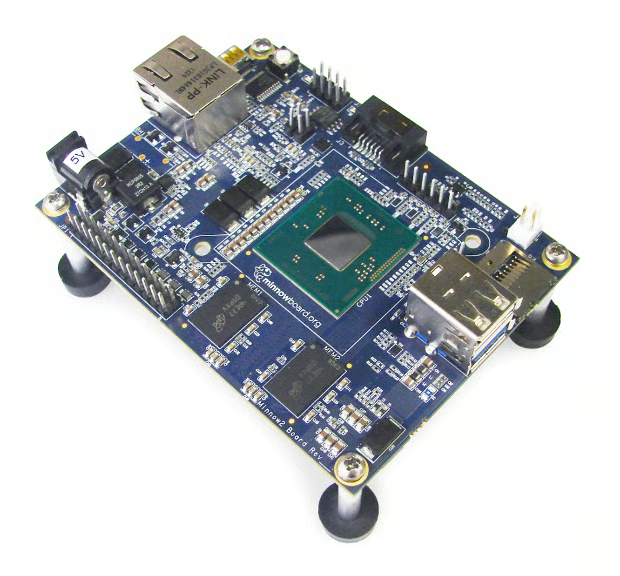
If the Raspberry’s Pi’s slightly long-in-the-tooth, ARM-based processor doesn’t have the necessary grunt then perhaps the more powerful x86-based CPU on the Intel MinnowBoard Max will meet your needs.
The MinnowBoard Max outspecs the Pi in many areas, with a 64-bit CPU running at about double the clock speed and with twice the RAM.
The extra grunt comes at an additional cost, with the board selling for $99 or $129 for a slightly higher-specced version. The first boards are projected to be sent out from the end of June this year.
Specs
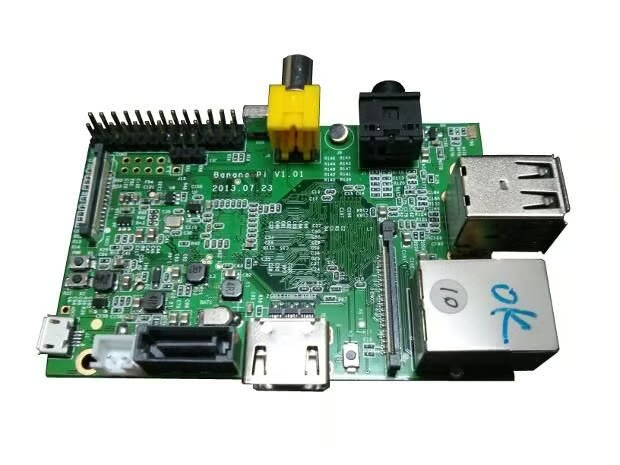
No relation to the Raspberry Pi, in spite of the name, this small board computer aims to take on the Pi with its higher specs.
If imitation really is as flattering as is claimed then the Raspberry Pi should be blushing, as the Banana Pi is identical to the Raspberry Pi down to the layout and footprint of the board.
Compared to its namesake the Banana Pi has double the RAM, a higher-clocked CPU and can support faster data transfer with attached devices via its SATA port.
The makers claim the board is compatible with a range of Pi-targeted operating systems. However, the software listed as working on the board is sparse, with the official page only mentioning the drag and drop programming language Scratch.
There are also reports of the Banana Pi struggling to play 1080p video in XBMC due to a lack of support for hardware accelerated video decoding.
And as pointed out on the Raspberry Pi forums this board doesn’t have the community that can help new users get up to speed and get the system performing as they want.
The Banana Pi is available for $74 with shipping.
Specs
The makers of the HummingBoard claim it can walk and talk like a Pi – just a good deal faster.
The HummingBoard offers a higher clocked, better optimised CPU and four times the memory of the Pi, along with integrated wifi and Bluetooth connectivity. Gigabit Ethernet, an on-board real-time clock module and an infra-red receiver are available as optional extras.
As a board that reproduces the layout and much of the configuration of the Pi its makers say it should also work with much of the hardware made to extend the Pi’s capabilities.
Pricing and availability for the HummingBoard is not yet available.
Specs