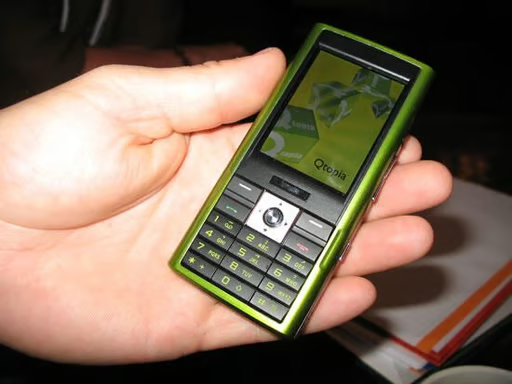
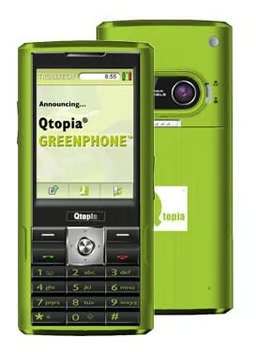
Trolltech is the company that brought developers the Linux-based mobile application platform Qtopia. In August it also used the LinuxWorld conference to announce the Greenphone, which is thought to be the first fully reprogrammable Linux phone. Trolltech hopes that the Greenphone could help grow the mobile Linux market, by encouraging developers to
\r\nDespite being created purely for developers, the Greenphone is a more attractive device than one might imagine. “We wanted developers to use it as their everyday phone,” said Haavard Nord, co-CEO of Trolltech.\r\nZDNet UK met with Nord in central London to see the device, which will go on sale to developers at the end of September.\r\n
\r\n”It’s kind of mind-boggling for developers,” he added. “Everybody usually wants to protect the software in their phone, but we want to let the developers experiment and innovate.”\r\n
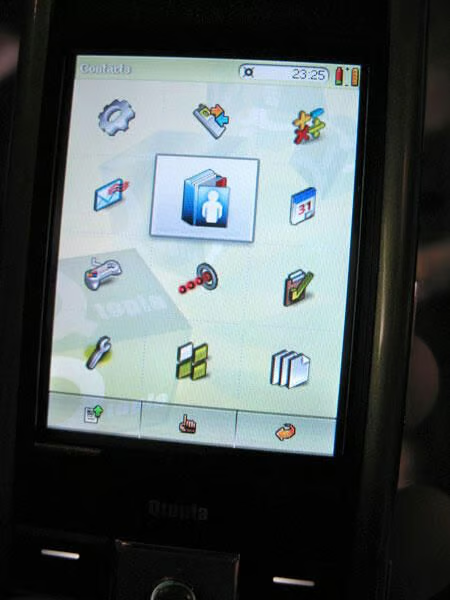
Trolltech’s out-of-the-box user interface is fairly standard, with familiar contacts, calendar, messaging and other icons. It has a touch screen and stylus, which Nord says will help developers create paint applications. He acknowledged, however, that it still has a “few flaws” and would not ship with a browser or media player. “We have partners doing this,” he explained.\r\n
\r\nNord told ZDNet UK that he thought the last five years had seen an unimpressive level of development in terms of mobile applications, but suggested this was changing. “Most of the phones sold today are so-called feature phones,” he said, “but the makers are not inherently software companies. The focus has now shifted more into software, which is a difficult transition for the industry. We believe Linux can help resolve some of these problems–it’s a very solid technology, but more impressive is how the community works in a large ecosystem together, so development happens faster.”\r\n
\r\nFeature phones, rather than top-end smart phones (where Linux already has some presence) will prove to be the biggest growth market for open source, as they present the greatest challenge to developers, he said. “They use home-grown operating systems, and with lots of features the software has turned very messy. It gets harder to drive development.”\r\n
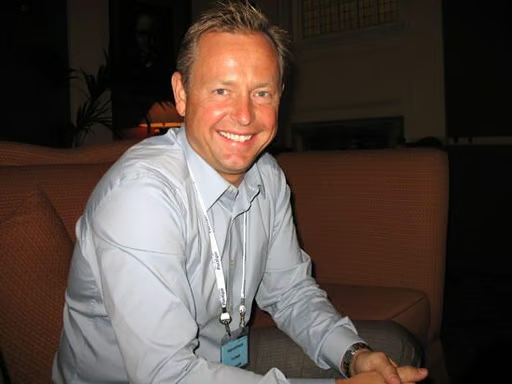
“Our final goal,” said Nord (pictured here), “is to see phones that work better for the end user.”\r\n
\r\nManufactured by Yuhua Teltech in Shanghai, the Greenphone runs on a 312MHz Intel XScale processor, has a mini-USB port and a 1.3-megapixel camera, and takes standard mini-SD cards.\r\n
\r\nIt also has SIP (Session Initiation Protocol) stack capabilities, which Nord said made it “easy” to produce VoIP capabilities and add multimedia functionality. “We’ll see tons of applications but I’m also interested in seeing new ways that people can interact with their phones,” he said. Future iterations of the device are likely to include built-in Wi-Fi capabilities, but there are no plans at present to include GPS.
Bill Detwiler is the Editor for Technical Content and Ecosystem at Celonis. He is the former Editor in Chief of TechRepublic and previous host of TechRepublic's Dynamic Developer podcast and Cracking Open, CNET and TechRepublic's popular online show. Previously, Bill was an IT manager in the social research and energy industries. He has bachelor's and master's degrees from the University of Louisville, where he has also lectured on computer crime and crime prevention.


