


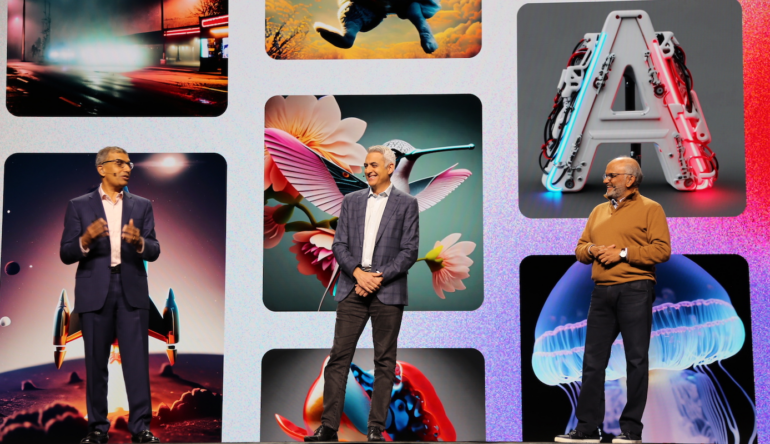
Adobe held a full-court press event in Las Vegas at its annual Summit. In a hall the length of two football fields with five massive video screens ranging lengthwise across the space, the company’s event featured a panoply of digital images, all created with its new generative artificial intelligence tool, Firefly (Figure A).
Figure A
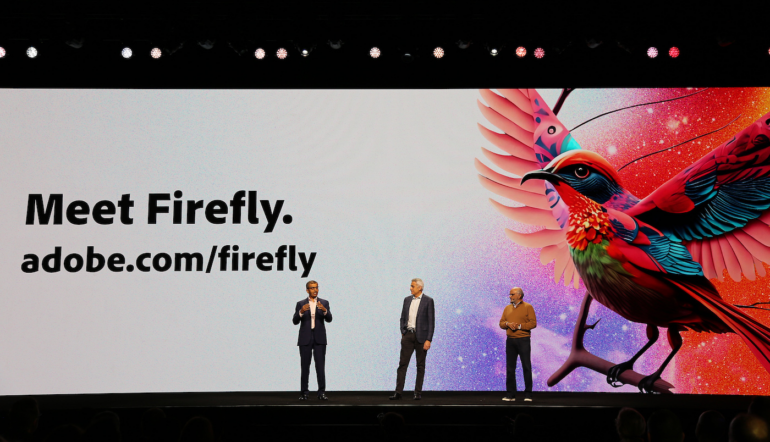
At the event, Adobe executives, including CEO Shantanu Narayen, laid out the company’s vision and range of ambitions for product innovations. As part of this initiative, Adobe is going all in on generative AI, introducing a raft of new products to a global audience of industry participants, analysts, customers and the press.
Anil Chakravarthy, president, digital experience, at Adobe spoke about digital-first, end-to-end customer experience as now central to marketing communications, and that AI and machine learning will be key to Adobe products serving these enterprises. He added that generative AI for creativity and customer experience will “Require a really thoughtful approach so we can amplify and not replace the power of human ingenuity. Our belief is that generative AI will be a ‘copilot.'”
Jump to:
- What is Adobe Firefly?
- Creator-centric approach to generative AI
- Adobe launches raft of new products
What is Adobe Firefly?
Adobe Firefly comprises a set of creative generative AI models, the first of which the company said would be trained on Adobe Stock images with openly licensed content and public domain content where copyright has expired. It will focus on image generation and text effects for commercial use for Creative Cloud, Document Cloud, Experience Cloud and Adobe Express workflows. Adobe Firefly is offered as a public beta (Figure B).
Figure B
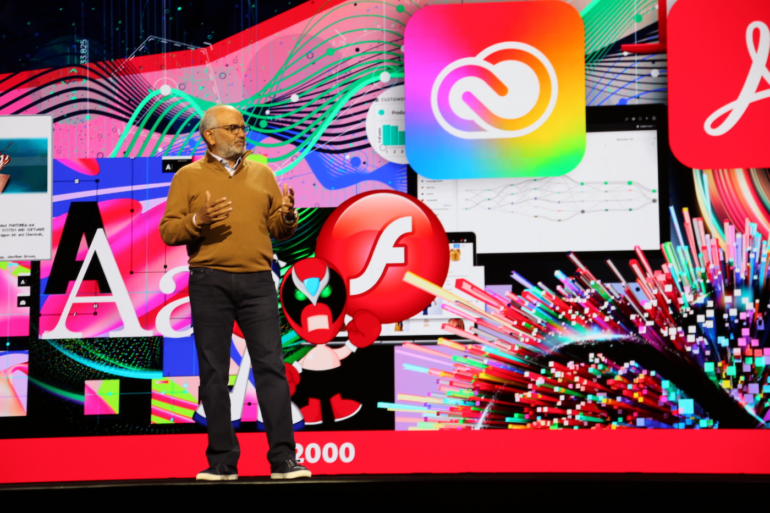
Shantanu Narayen, CEO, Adobe
The company said Adobe Express, Adobe Experience Manager, Adobe Photoshop and Adobe Illustrator are to be the first Adobe applications integrated with Adobe Firefly.
David Wadhwani, president, digital media, at Adobe, said the company trained the models on hundreds of millions of stock and open license images, and that the framework was built to freely integrate with apps and content. He said in the coming weeks that video, audio, vectors and 3D content will be in the pipeline, and that Adobe-trained content and models will be safe for commercial use, “So we can go from leveraging AI for personal projects to commercial application.”
SEE: Google, also launching generative AI, releases large language models to developers. (TechRepublic)
Creator-centric approach to generative AI
Wadhwani said Firefly will be creator centric and an extension of the Content Authenticity Initiative Adobe co-launched in 2021, which now includes 900 organizations.
More about Innovation
- Sovereign AI Explained
- The Rise of the AI-Native Factory
- Why Data Determines AI Success
- SS&C Intralinks DealCentre AI vs. Datasite: Which platform is built for the future of dealmaking?
“We will put content credentials at the forefront of everything we do” he said. “We want to give credit for what people create.” He said, for example, all Firefly-generated content created will be marked as being AI generated.
Additionally, he said the image library will include availability of “do not train” tabs giving creators control of the fate of content they create.
“We recognize that all training content is provided to us from stock contributors, so we will announce how we plan to share success with them so contributors get compensated for their efforts,” Wadhwani said to audience applause, adding that the Firefly API will be available to third-party developers.
Adobe launches raft of new products
At the Adobe Summit, other AI plans and deep integrations were rolled out that Chakravarthy said would be key to much of what the company is doing.
Adobe Sensei GenAI
Adobe Sensei GenAI is what the company calls a generative AI copilot in Adobe Experience Cloud to “help increase marketers and other customer experience teams’ productivity without having to increase their workload,” according to a statement. Adobe said the framework allows users to shift between services and existing features within their workflows for planning, asset creation, personalization, customer journey management and more.
Adobe is integrating Sensei GenAI with innovations for its Real-Time Customer Data Platform, including the ability to deliver over 600 billion predictive insights each year. The company said the changes will let brands reach customers with increased personalization.
New toolsets for supply chain, analytics, creative and web development
Adobe announced new applications for enterprise creative and website development including:
- Upgrades to Adobe Experience Manager, comprising tools for updating enterprise websites and mobile apps using any word processing or spreadsheet tools, integrated with Adobe Sensei AI to analyze content performance.
- Adobe Express for Enterprise, which is a set of creative tools for images and videos and other content.
- Adobe is launching what it calls the world’s first comprehensive content supply chain solution, including a collaboration with Accenture.
- New product analytics in Adobe Experience Cloud.