



Cisco is introducing a suite of generative artificial intelligence-driven features in its Webex video conferencing platform, from meeting summaries to visual enhancements. These features are aimed at both customer communications and hybrid working end users.
The company joins enterprises like Microsoft, Salesforce, Adobe and Google in adding generative AI capabilities to its service. The new upgrades to Webex include AI-powered audio, video, natural language understanding and analytics enhancements.
Jump to:
- Webex looks to grab market share from Zoom, others
- Cisco on multi-year path to incorporate machine learning
- AI enhancements in Webex
- Webex’s tools for customer-facing communications
Webex looks to grab market share from Zoom, others
According to customer relationship management data company Datanyze, Zoom is the market leader in video conferencing, with 72.61% market share and more than 176,757 companies using it. It reports that Cisco Webex is a distant second with 8.6% with more than 20,935 companies using Webex.
After Webex, according to Datanyze, are GoToWebinar with 7% of the global market share, On24, Adobe Connect, Livestorm, GoToMeeting and Google Hangouts.
Cisco on multi-year path to incorporate machine learning
Javed Khan, senior vice president and general manager of collaboration at Cisco, said the company has been advancing its use of machine learning systems for at least three years.
More must-read AI coverage
- SS&C Intralinks DealCentre AI vs. Datasite: Which platform is built for the future of dealmaking?
- SS&C Intralinks FundCentre AI vs. Juniper Square: Which platform better supports modern private markets fund managers?
- Why Data, Not Models, Determines AI Success
- The Rise of the AI-Native Factory: How Physical AI Is Transforming Manufacturing
“Cisco has been investing in this for 10 or 15 [years], starting with basic things like noise cancellation and with some of our video conferencing technologies that have the ability to detect faces and zoom in and out,” Khan said. “So, we have been working on this for a while.
“What’s happened in the last couple of years is that the underlying technologies reached a point where the level of processing in real time and the amount of training data available has just grown exponentially. So these technologies, I think, have gotten 100 times better, which is allowing for things that weren’t possible before.”
Khan said that in the last three years Cisco spent about $1.5 billion acquiring several companies including Voicea and BabbleLabs for voice enhancing technologies as well as MindMeld, a natural language-processing company.
AI enhancements in Webex
Cisco said the integration of AI has allowed the company to make several text and image enhancements that include image optimizing, 3D effects and natural-language queries.
Cinematics for Webex devices
The upgrades to Webex add a cinematic quality to user video using its RoomOS conference video system, which optimizes video by automatically switching between cameras, for example, if a user is employing more than one.
The company said the feature also allows IT administrators to create virtual spaces, or meeting zones, that automatically exclude distracting objects or people.
The cinematic feature includes the ability to capture the speaker at their best angle by automatically switching views.
Webex’s portrait effect
The AI baked into Webex also lets users choose to do complex visual optimizing effects, such as adding depth and sharpness to one’s appearance and making low-resolution video high definition (Figure A).
Figure A
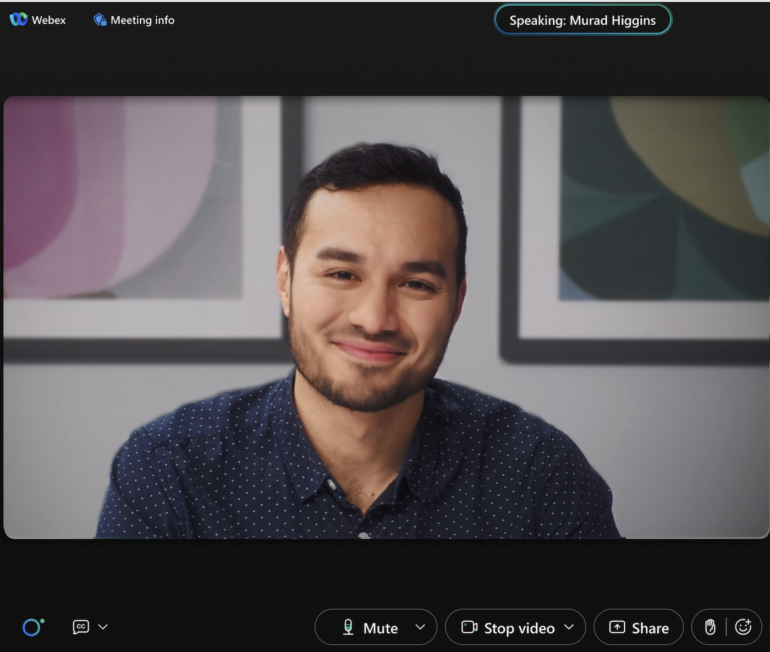
Further, the AI recognizes human gestures and can add on-screen emojis corresponding to them, including gestures like hands raised for celebration, pressed together for thanks and request, and a heart for affection. It also adds animated features like confetti, fireflies and universe effects (Figure B).
Figure B

And if a speaker leaves the camera view zone without departing the meeting, the AI can recognize this and display a “be right back” icon (Figure C).
Figure C

Message recommendations
The message recommendations feature uses AI to prioritize chat and space messages based on interactions with team members and other people users engage with most. Space recommendations suggest relevant Webex spaces to join based on similar people and engagements.
Webex’s tools for customer-facing communications
Cisco said its use of large language models in Webex customer experience made it possible to deploy in its Webex Contact Center automated, AI-fueled features like:
- Virtual Agents: A self-service chatbot.
- Agent Answers: A feature that provides real-time recommendations to an agent based on their inquiry.
- Contextual Chat Summary: A new feature, which will be available on the Webex Connect platform to automatically summarize any long-form text across digital channels. It can be used with Webex Contact Center or any other third-party contact center solution.
The company said it is also adding generative AI capabilities to Webex Campaign, part of Webex’s communications platform-as-a-service solutions portfolio. These functions include:
- A subject line generator for email subject lines for marketers and content creators.
- Evaluate Node for developers and IT professionals, designed to simplify building new flows and applications.
Khan said Webex AI capabilities will roll out over the course of 2023, with some available now.