


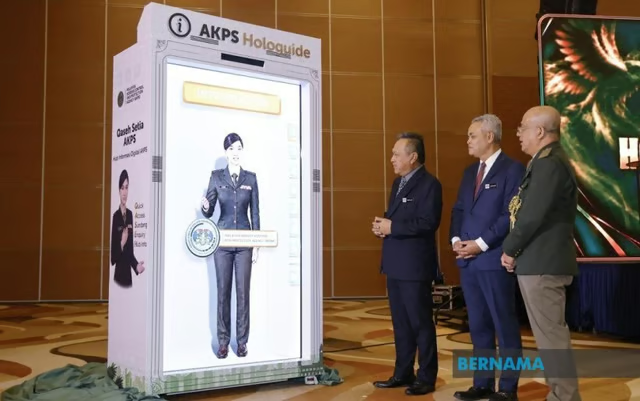
Malaysia has unveiled a holographic border officer that answers travelers’ questions in English and Mandarin. The interactive assistant is intended for Kuala Lumpur International Airport (KLIA), although passengers cannot yet count on finding it there.
The Malaysia Border Control and Protection Agency (AKPS) introduced the assistant on Oct. 26, 2026, for planned deployment at KLIA Terminal 1’s satellite building. During a live demonstration, a digital officer answered questions in real time, offering a preview of how the technology could help international passengers navigate Malaysia’s entry requirements.
The system is designed to explain arrival procedures and required documentation, particularly for travelers unfamiliar with the country’s immigration rules. AKPS has not announced when it will become available to passengers.
How the hologram answers arrival questions
Named AKPS Hologuide, the system was unveiled during the agency’s second-anniversary celebration in Sepang. A live demonstration reported by The Star showed a digital avatar of an AKPS officer responding to questions in English and Mandarin.
AKPS deputy director-general for management Ismail Mokhtar said the hologram would help passengers understand Malaysia’s entry requirements. In Bernama’s report on the announcement, he described the initiative as part of the agency’s effort to improve access to arrival information.
The assistant is designed to explain entry procedures and necessary documentation, according to Malaysia’s public broadcaster RTM. Passengers might ask which documents to prepare or what steps to follow upon arrival, although AKPS has not published a verified list of supported questions.
The agency has not disclosed the assistant’s complete language support or confirmed whether it provides individualized visa guidance or information about the Malaysia Digital Arrival Card (MDAC). It has also not announced passport-scanning, identity-verification or automated immigration-clearance functions.
Malaysia’s project follows other digital government initiatives in Southeast Asia. The Philippines recently introduced Google Gemini-powered public services through its eGovPH platform, including government information and document-related assistance.
KLIA deployment date remains unconfirmed
AKPS plans to place Hologuide in Terminal 1’s satellite building, which serves international passenger movements. The agency has not confirmed an operational start date, the number of units planned or their precise placement.
Malaysia’s entry requirements vary according to nationality and immigration status. Accurate, regularly updated guidance will be essential if the hologram is to help passengers understand which documents and procedures apply to them.
Elsewhere in Southeast Asia, a Singapore-Vietnam digital credentials pilot is testing electronic document authentication for cross-border trade, while Singapore’s shift toward passkey authentication focuses on digital identity security. Hologuide serves a different purpose: explaining entry requirements rather than verifying identities.
Several operational questions remain unanswered, including how immigration information will be updated, whether unresolved queries can be referred to human officers and how traveler interactions will be handled. AKPS has not identified the underlying software or confirmed whether the assistant uses generative AI.
Until Hologuide enters public service, travelers should consult the Malaysian Immigration Department for entry requirements. Travelers required to submit the Malaysia Digital Arrival Card (MDAC) can register through the official portal within three days of arrival, including the submission date. Requirements and exemptions depend on the traveler’s status.
AKPS has not announced when Hologuide will begin assisting passengers at KLIA. Until then, existing immigration information channels remain the reliable starting point for preparing travel documents.
Read more: Malaysia is also developing AI governance legislation that could shape oversight of future public-sector AI deployments, although AKPS has not confirmed whether Hologuide uses generative AI.