


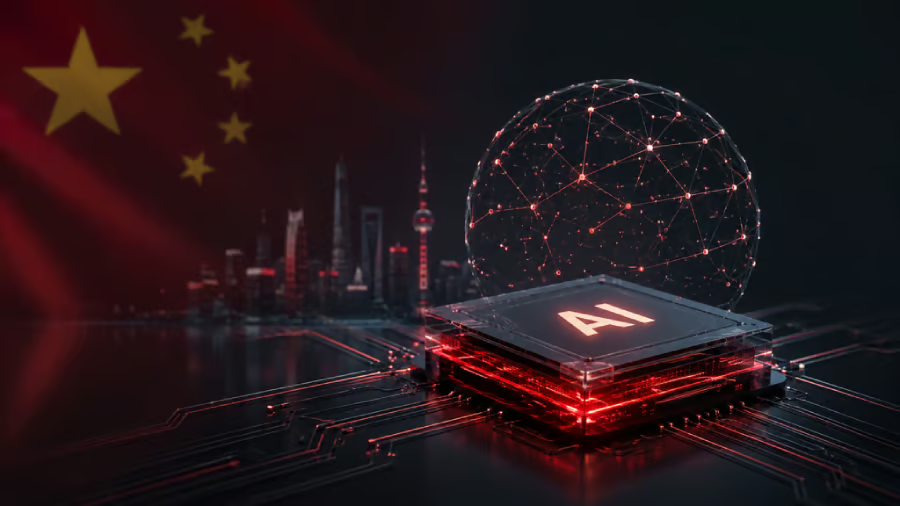
China is weighing tougher export controls on advanced AI models and semiconductor technologies, a move that could reshape how its leading AI companies share technology with the rest of the world as competition with the United States intensifies.
According to a Financial Times report, China’s Ministry of Commerce has been consulting major domestic AI and semiconductor companies on proposals designed to keep strategically important technologies from moving overseas or falling under Western ownership.
The discussions reportedly include companies such as Alibaba, ByteDance, and Zhipu. Officials are considering limits on transferring AI training data abroad and restricting foreign users from downloading the model weights behind China’s most advanced AI systems.
Overseas customers would still be able to access those models through online services, according to the report.
Reuters separately reported earlier this month that Chinese officials had already met with major AI companies to discuss restricting overseas access to the country’s most advanced AI models, including systems that have not yet been released.
The proposals remain under review, and regulators are gathering feedback from industry before deciding whether to move forward, the Financial Times reported.
Chips and acquisitions also under review
The reported discussions extend beyond AI software.
Officials are also seeking industry feedback on whether overseas manufacturers such as Qualcomm and Taiwan Semiconductor Manufacturing Co. (TSMC) should be barred from producing advanced chips based on designs created by Chinese companies including Huawei, Alibaba and ByteDance.
Another proposal would tighten oversight of foreign acquisitions involving Chinese companies developing strategic technologies, particularly in emerging areas such as agentic AI.
If adopted, the measures could become part of the next revision of China’s catalogue of technologies prohibited or restricted from export, one of Beijing’s primary export control frameworks.
More must-read AI coverage
- SS&C Intralinks DealCentre AI vs. Datasite: Which platform is built for the future of dealmaking?
- SS&C Intralinks FundCentre AI vs. Juniper Square: Which platform better supports modern private markets fund managers?
- Why Data, Not Models, Determines AI Success
- The Rise of the AI-Native Factory: How Physical AI Is Transforming Manufacturing
A balancing act for China’s AI ambitions
The reported talks come as Chinese AI developers gain global attention with increasingly capable models.
Last week, Moonshot AI introduced its Kimi K3 model, adding to growing evidence that Chinese developers are narrowing the performance gap with leading US AI companies. Unlike many American frontier models, several Chinese systems allow developers to download and customize model weights, helping drive adoption outside China.
However, industry participants have reportedly warned regulators that tighter controls could slow innovation and make it harder for Chinese AI companies to compete globally by limiting international adoption of their technologies.
What this could mean
If China ultimately restricts exports of AI models, model weights and chip designs, it would signal a notable shift in strategy. Beijing has spent years promoting open AI development to expand its influence abroad, but the country’s most advanced technologies are increasingly being viewed through a national security lens.
For businesses and developers outside China, any new licensing or export rules could reduce access to some of the country’s fastest-growing AI technologies while increasing uncertainty around future partnerships, chip manufacturing arrangements and open-weight AI releases.
The proposals also illustrate how AI is becoming subject to the same geopolitical controls that have already reshaped the global semiconductor industry.
Rather than competing only on innovation, governments are increasingly treating advanced AI as a strategic asset, meaning future breakthroughs may depend as much on policy decisions as on technical progress.
Also read: Moonshot AI is reportedly preparing for a Hong Kong listing after Kimi K3 demand helped push its annual recurring revenue to $300 million.