


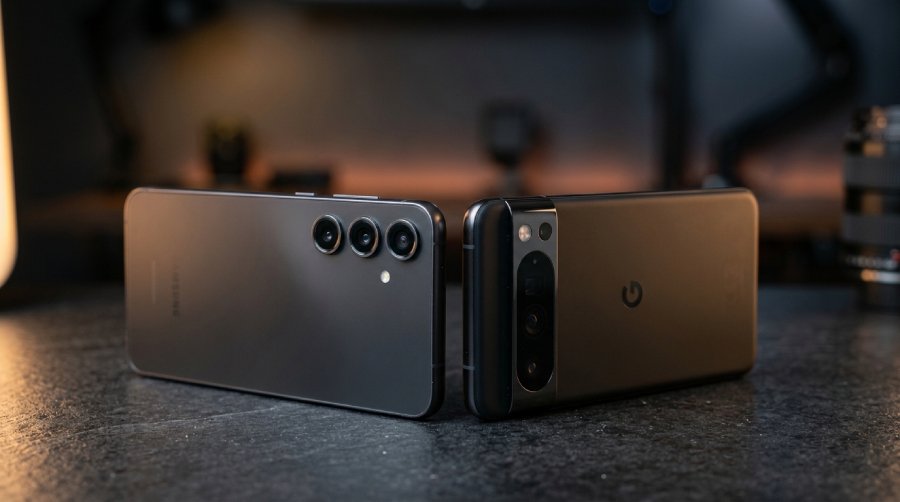
A $500 phone looks like the easy choice until you check how much storage you’re already using.
Best Buy’s US Black Friday listings put the unlocked Samsung Galaxy S26 FE with 128GB of storage at $499.99 and the unlocked Google Pixel 11 Pro with 256GB at $749. That’s a $249.01 difference. These are the advertised prices for the Graphite Galaxy and Obsidian Pixel, before tax. The comparison doesn’t count trade-in credits or carrier bill credits.
I’d take the Galaxy if 128GB is enough and you like a bigger screen. I’d pay more for the Pixel if the extra space would solve a problem you already have, or if you regularly take photos of things you can’t get close to.
Editor’s note: Prices were correct at the time of publication. Retailers may change prices and availability.
What each Black Friday deal gets you
The two listings aren’t for equivalent storage. The Galaxy costs less and gives you a larger display. The Pixel offers twice the storage in these configurations and a longer optical reach with its telephoto lens. Here’s what Samsung’s specs and Google’s specs show.
| Feature | Galaxy S26 FE | Pixel 11 Pro |
|---|---|---|
| Best Buy US price | $499.99 | $749 |
| Storage at that price | 128GB | 256GB |
| Display | 6.7 inches, up to 120Hz | 6.3 inches, 1–120Hz |
| Optical telephoto zoom | 3x | 5x |
| Update commitment | Seven generations of OS upgrades and seven years of security updates from global launch | Seven years of OS and security updates from first Google Store availability in the US |
Our standalone Pixel deal coverage looks at the $749 offer on its own. With the Galaxy in the picture, there’s a different question: would the Pixel’s upgrades change what you do with your phone, or would you just be paying for features you rarely use?
Where the Pixel earns its premium
Open your current phone’s storage settings before opening either listing.
If you already spend time deleting videos, clearing downloads, or choosing which apps to keep, going back to 128GB could put you right back where you started. If most of your files already live in the cloud and your storage has plenty of room, the extra space may not be worth the money.
The Pixel’s 5x optical telephoto is the other reason to pay more. Think of filming a school performance from the back of the room or getting a shot across a field. The Galaxy has a dedicated 3x telephoto, an advantage we noted in our Galaxy S26 FE vs. Pixel 10a comparison. The Pixel 11 Pro offers more optical zoom, though that spec alone doesn’t tell you which phone takes the better picture in every situation.
More Google coverage
- New Google Search AI Mode is ‘Total Reimagining,’ Says CEO Sundar Pichai
- In Major Ruling, Judge Finds Google ‘Willfully Acquired and Maintained Monopoly Power’ Over Digital Ad Market
- Google’s Big Bet on Nuclear Energy: ‘The Race to Power AI-Driven Data Centers is Accelerating’
- Computer History Museum Releases Original AlexNet Code: Why It Matters
When to keep the $249
The Galaxy’s larger screen can be useful if you spend the day reading documents or making small edits on your phone.
The Pixel’s smaller display may suit you better if one-handed use matters. If you’re already leaning Samsung but want a smaller phone, our Galaxy S26 FE vs. Galaxy S26 comparison explains what you give up by choosing the FE.
Before you buy either phone, check the things a spec sheet can’t tell you:
- Try the size in your hand. Open a long email, type a reply, and reach the top of the screen. The Galaxy’s extra space can help when reading, but it doesn’t help if you’re constantly shifting your grip.
- Check the carrier and your work setup. Use your carrier’s compatibility checker for the exact unlocked model. If this is a work phone, confirm your employer allows the model and that you can move your authenticator before wiping the old one.
- Compare the price you’d actually pay. At checkout, confirm the storage, condition, and any activation or trade-in terms. If you need a new case or charger, count that cost too.
I wouldn’t pay the Pixel premium for software support alone. Both manufacturers promise seven years of security updates, and neither clock starts when you buy the phone. If both models pass your checks and you can’t name a problem the extra storage or zoom would solve, I’d buy the Galaxy and keep the $249.
Related reading: See how two Motorola Razr models compare at the same Black Friday price.