


Google’s attempt to get Android users to look up from their phones may be nearing the end.
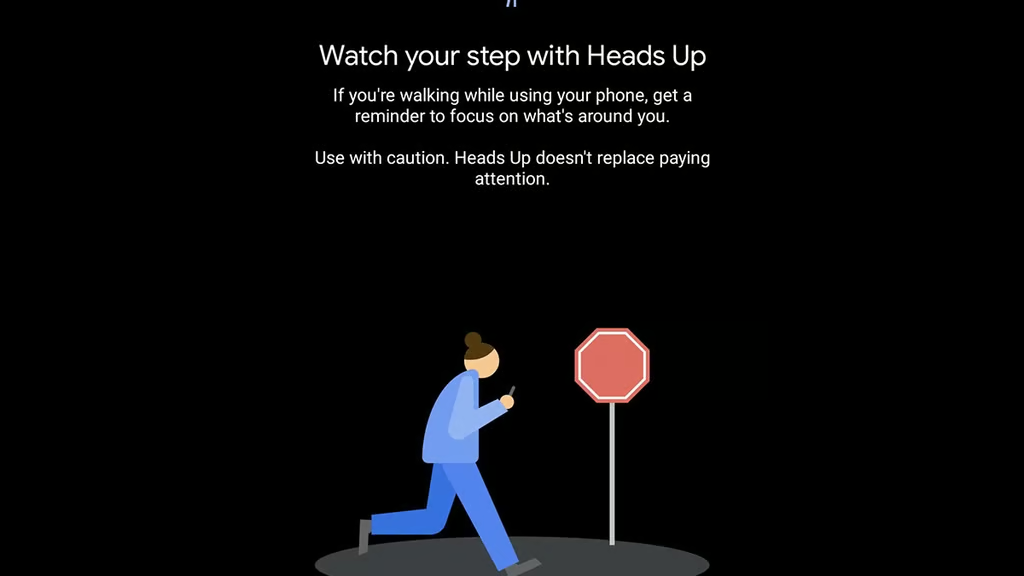
The company appears to be preparing to discontinue Heads Up, a Digital Wellbeing feature that warns users when they are walking while staring at their phones — a habit many phone users have.
Heads Up is part of Google’s broader Digital Wellbeing effort, but it works differently from familiar tools such as screen-time reports and app timers. Rather than simply measuring phone use, it tries to infer when a person is walking and using their phone, then intervenes with a safety reminder.
Google has not confirmed an explanation for the planned removal, nor has it announced a shutdown date. The change therefore says less about Android’s immediate fate than it does about one of Google’s smaller experiments in making a phone respond to a user’s behavior beyond the screen.
What is Heads Up?
Google’s Digital Wellbeing is a collection of Android tools designed to help users understand and manage how they use their phones. It includes features such as screen-time tracking, app usage reports, notification counts, app timers, Focus mode, and Bedtime mode.
Heads Up is one of those helpful features in Digital Wellbeing. Introduced in 2021, it warns people when they are walking while using their phones, displaying reminders such as “Look ahead” and “Watch your step” to encourage them to pay attention to their surroundings.
Technically, Heads Up uses the phone’s motion sensors to detect walking-related activity. It can also use location information, when permitted, to help the feature determine whether the user is walking outdoors rather than simply moving around indoors.
The apparent change is narrower than the removal of Digital Wellbeing itself. Android Authority found strings in an APK teardown suggesting Google is preparing to deprecate Heads Up while leaving the broader Digital Wellbeing system intact.
That means tools such as screen-time tracking, app timers, Focus mode and Bedtime mode are not implicated by the teardown. Heads Up also remains documented by Google, so for now the feature is still available on supported devices.
Why the timing is interesting
Heads Up has never been perfect. In my own use, it has occasionally warned me to look up when I was not doing anything that seemed to justify the alert, although there have also been times when the reminder worked exactly as intended.
That makes its apparent retirement interesting because Android phones are now better equipped with sensors and contextual features than they were when Heads Up launched in 2021.
One possibility is simply that the feature never attracted enough use to justify continued development. Android Authority described Heads Up as underused, although Google has not said whether usage played any role in the apparent deprecation.
That leaves Heads Up in an interesting position. It may have been a useful idea that arrived before the surrounding technology had matured, only to face retirement at a point when Android phones are arguably better equipped to make it work.
The feature may be going away, but the idea is not
There is a bit of irony in Google retiring Heads Up now. The feature may not have been popular enough to keep, but the problem it was trying to solve hasn’t disappeared, and phones are now far better at sensing movement, location, and context than they were when Heads Up launched.
So the bigger question isn’t whether one Digital Wellbeing feature survives, but how much our phones should understand about what we are doing outside the screen.
Heads Up was an early attempt at answering that question. Its apparent retirement may show that sensing context is only half the job; the intervention also has to be accurate, useful, and unobtrusive enough for people to keep it enabled.
Other news: Google is developing persistent AI memory that keeps decryption keys on users’ devices, aiming to let Gemini retain personal context while preventing Google employees from accessing stored information.