


Microsoft has revealed its latest ambitions to set the AI world ablaze with excitement.
At its annual Ignite conference this week, the tech titan previewed a sweeping set of AI advances that it says will reshape how organizations ideate, build, deploy, and govern AI systems.
The announcements reflect Microsoft’s increasingly assertive push to position itself not only as a platform provider, but as the architect of a full-stack AI environment spanning data, developer tools, enterprise productivity, and governance.
The remarks came in a blog post authored by Frank X. Shaw, Microsoft’s Chief Communications Officer, who argued that AI must be treated as a foundational layer of modern work rather than an afterthought. As Shaw put it, “AI is not something that you can just plop on the end of a finished product, like a cherry on top of a sundae.” Instead, he emphasized that responsible adoption requires “thinking through how it can be used most effectively at every layer.”
The message underscores a growing trend across the tech sector: enterprises increasingly want consistent, integrated AI tooling that avoids the fragmentation created by dozens of disconnected apps, agents, and analytics platforms.
Push toward frontier firms
A key narrative at Ignite 2025 is Microsoft’s belief that a new class of organizations — referred to as frontier firms — will gain a competitive edge by embedding AI across every function. According to Microsoft, these firms do not just adopt AI, they redesign operational models around it.
The company’s goal is to help customers reach this state by aligning AI across infrastructure, data, workflows, and everyday productivity tools. Shaw framed it as enabling organizations “to drive the next generation of digital transformation for every organization and at every level of the work they do.”
AI in the flow of human ambition
A major theme was the deepening of Microsoft 365 Copilot’s capabilities through Work IQ, described as the contextual intelligence that informs the assistant’s understanding of how individuals and teams operate. Shaw said, “Work IQ amplifies your IQ. It’s the intelligence layer that enables Microsoft 365 Copilot and agents to know how you work, with whom you work and the content you collaborate on.”
The introduction of APIs for Work IQ marks a significant shift. Developers and enterprises will now be able to build agents tuned to internal workflows, using real operational signals such as work habits, communication patterns, and organizational knowledge. This move could intensify competition in the enterprise AI market, where contextual relevance is increasingly seen as essential for real productivity gains.
Equipping every employee to build
Another major set of updates aims to help non-technical employees to create and deploy AI agents. Microsoft argues that workers closest to frontline problems are often the best positioned to solve them — if given the right tools.
Fabric IQ is designed to unify analytical, time-series, location, and operational data under one shared semantic model. This step could significantly reduce friction for businesses that historically had to stitch together disparate datasets before applying AI. Organizations already using Power BI will immediately benefit, since their existing data modeling becomes fuel for agent reasoning.
Foundry IQ extends this coherence by providing a single managed knowledge system across Microsoft 365, Fabric, custom apps, and the web. This is a notable attempt by Microsoft to become the central nervous system for enterprise AI, reducing reliance on ad hoc integrations and third-party connectors.
The new Microsoft Agent Factory program then ties these layers together, giving customers a metered, scalable way to build and deploy agents across Microsoft 365 and beyond. With hands-on support from AI Forward Deployed Engineers, Microsoft is signaling that it wants enterprises to treat agent development as a core operational competency.
Explosion of AI agents
One of the most consequential announcements centers on governance. Citing IDC research, Microsoft warns that by 2028 organizations may deploy 1.3 billion AI agents. Such agents could automate critical workflows — yet most companies currently lack tools to track their behavior or secure their access to data.
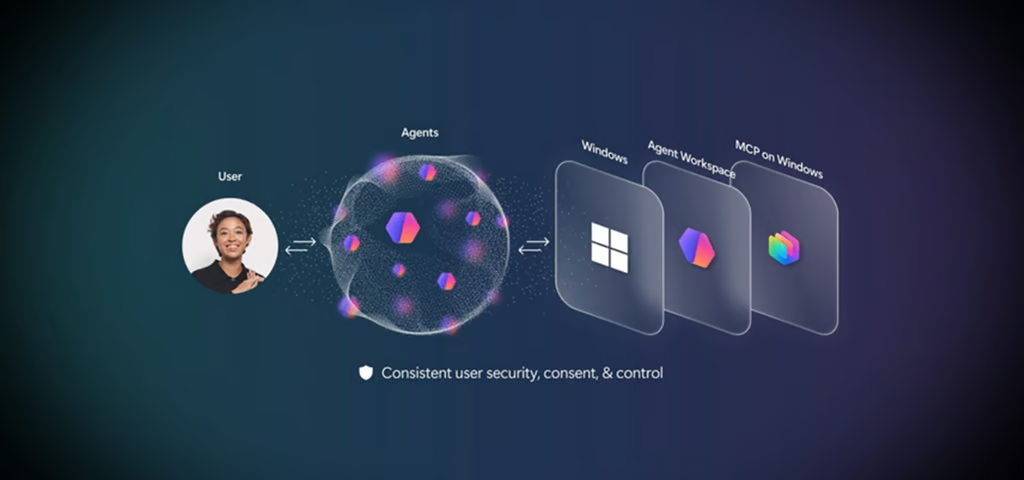
To address this, the company introduced Microsoft Agent 365, a platform for observing, managing, and securing agents regardless of where they were built. The system equips agents with protections familiar from human accounts, including Defender, Entra, Purview, and the Foundry Control Plane. By extending enterprise-grade identity, compliance, and cybersecurity controls to non-human actors, Microsoft is attempting to prevent a future where “AI agents are the new shadow IT.”
The capability could become a differentiator in the enterprise AI market, where regulatory and security concerns increasingly shape buying decisions.
The bigger picture
From productivity to data management to security, Microsoft’s Ignite 2025 announcements signal a cohesive strategy: to centralize the entire AI lifecycle under one ecosystem. If successful, this could accelerate AI adoption across industries by lowering complexity while raising trust and governance standards.
For developers, the unified architecture means fewer silos and more direct integration between agents, data systems, and operational tools. For IT leaders, it offers clearer oversight of a rapidly growing landscape of AI workflows. For frontline employees, it opens the door to building AI helpers without needing deep technical expertise.
The broader implication is that AI is becoming less about isolated models or applications and more about orchestrated systems that operate continuously across an organization’s digital fabric.
Microsoft confirmed that Azure blocked a denial-of-service attack that involved more than 500,000 IP addresses spread across multiple regions.