
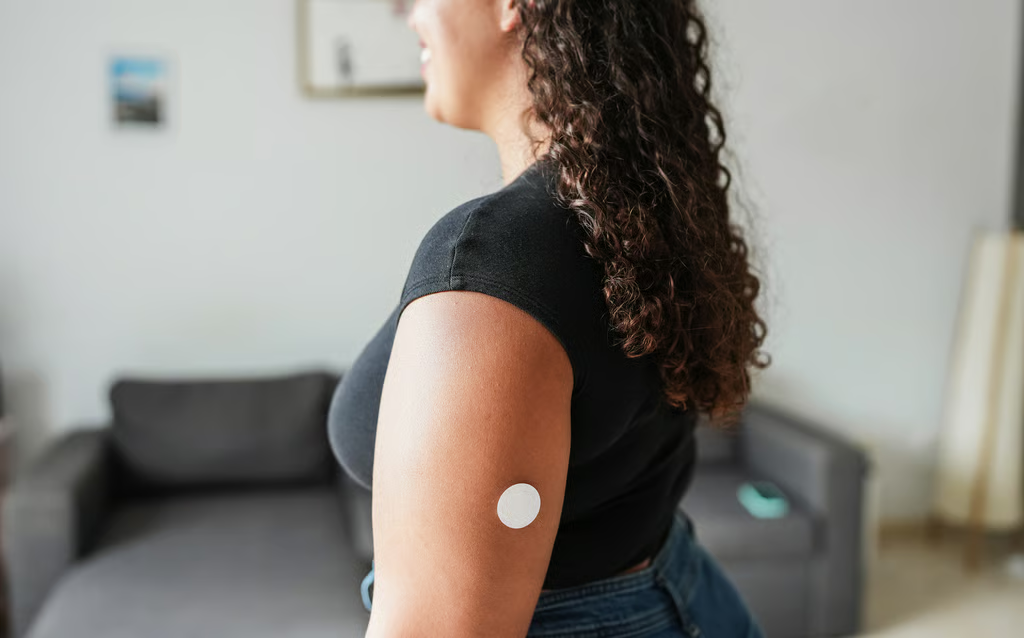


A continuous glucose monitor (CGM) on your arm can now act more like a wearable: app-connected, data-rich, and marketed as a way to understand your body in real time.
But more personal data does not always mean more useful health guidance. Over-the-counter CGMs have the clearest role in diabetes management and prediabetes support; for healthy users, the clinical payoff is less certain, and the privacy trade-offs are real.
The users most likely to benefit
The FDA cleared Dexcom’s Stelo glucose biosensor in March 2024, making it the first OTC CGM in the US. Stelo is for people 18 and older who do not use insulin, including some people with diabetes and people without diabetes who want diet and exercise feedback. It is not for people with problematic hypoglycemia.
Abbott received FDA clearance in 2024 for Lingo, an OTC integrated CGM for adults who do not use insulin. These devices differ from diabetes-management CGMs that may provide alerts, support treatment decisions, or connect with insulin-delivery systems.
FDA-cleared OTC CGMs are feedback tools, not substitutes for clinical diabetes care. Stelo users should not make medical decisions based on device output without consulting a health care provider.
A CGM uses a small sensor to measure glucose in interstitial fluid beneath the skin and track patterns across the day. The appeal is immediacy: users can see how meals, workouts, or poor sleep affect glucose patterns instead of relying only on occasional fingerstick readings or lab results. New platforms are already packaging no-prescription glucose tracking with subscriptions and wellness scores.
Unlike smartwatches or rings that claim noninvasive glucose readings, CGMs use a sensor under the skin; the FDA has warned consumers not to use those devices for blood glucose measurement.
The CDC’s 2026 National Diabetes Statistics Report estimates that 115.2 million US adults have prediabetes, and 40.1 million people in the US have diagnosed or undiagnosed diabetes.
A 2026 systematic review and meta-analysis found that CGM use was associated with lower mean glucose in non-diabetic users, with the benefit concentrated among people with prediabetes. The same review found no significant BMI effect.
For healthy users, that feedback can be interesting. It does not make every spike medically meaningful or turn a month of app data into a proven long-term health gain. That does not make every spike medically meaningful or turn a month of app feedback into a proven long-term health gain.
The app layer behind the sensor
A CGM is not just a sensor. It also comes with an app, a cloud account, data-sharing terms, and sometimes coaching features that turn glucose readings into recommendations.
HIPAA protects health information handled by covered entities and their business associates, but it does not automatically cover every consumer health app or wearable-device company. CGM data may be treated differently if it stays in an app, enters a provider record, or flows through a wellness service.
The FTC’s Health Breach Notification Rule may apply to some health apps and connected devices outside HIPAA. Users still need to know what the app collects, where it sends data, and whether it uses information for research, advertising, analytics, or third-party integrations.
Security also belongs in the decision. FDA guidance for cyber devices emphasizes security planning, vulnerability management, and software documentation in certain premarket submissions.
For TechRepublic readers, the practical filter is straightforward: check whether the sensor is FDA cleared, understand what the app does with glucose data, and treat the numbers as feedback rather than medical advice.
Read more: Apple and Samsung are exploring how glucose data could shape AI health advice as wearable companies look beyond simple tracking.