


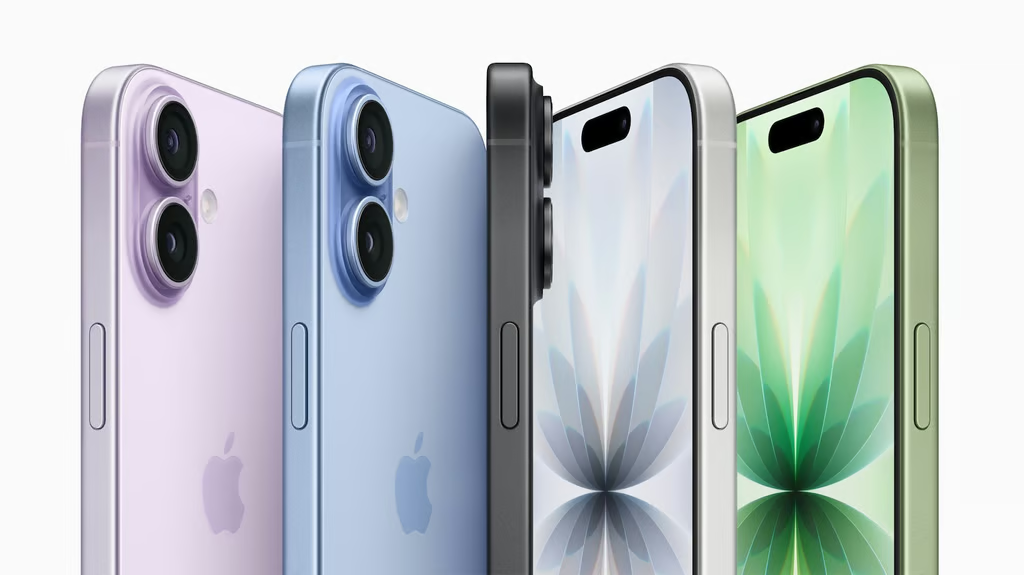
Apple continues to define the cutting edge of smartphones, bringing artificial intelligence and new camera capabilities to its latest lineup.
Apple introduced the iPhone 17, as well as the slim iPhone Air, on Sept. 9 during the keynote presentation titled “Awe dropping.” Three models were released: the iPhone 17, iPhone 17 Pro, and iPhone 17 Pro Max. We’ll show the differences between the Apple devices to help you decide the best fit for home or work.
- What are the key features of the iPhone 17, iPhone 17 Pro, and iPhone 17 Pro Max?
- Chip upgrades
- Camera features
- Apple Intelligence and iOS 26
- Sustainability
- More features of the iPhone 17 and iPhone 17 Pro
- What are the differences between the iPhone 17 models/newly announced models?
- What’s the target market for the iPhone 17 line?
- How much does the iPhone 17 cost, and when will it be available?
What are the key features of the iPhone 17, iPhone 17 Pro, and iPhone 17 Pro Max?
The iPhone 17, iPhone 17 Pro, and iPhone 17 Pro Max all offer similar features, with expanded video editing and more storage in the higher-end phones.
The base model iPhone 17 is the consumer version, with advanced features. However, it lacks the professional focus of the Pro and Pro Max. The Pro features a more powerful chip, enabling advanced camera systems and enhanced mobile gaming. The Pro Max offers storage up to 2TB.
Design
The front cover of the iPhone 17, and both front and back covers of the Pro models, are protected by Ceramic Shield 2, Apple’s proprietary ceramic-glass mix that improves scratch resistance. The 6.3-inch Super Retina XDR display offers up to a 120Hz refresh rate, which adjusts based on the content.
Unlike some other iPhone models, the iPhone 17 is only available in one size.
Inside the iPhone 17 Pro and Pro Max is the new brushed-aluminum unibody design. To fit some components around the battery, which takes up much of the phone’s space, a raised “plateau” houses the camera across the top of the device.
For extra durability and wireless charging, Apple suggests the iPhone 17 Pro Clear Case with MagSafe.
Color options and ports
The iPhone 17 comes in five colors: black, lavender, mist blue, sage, and white. The iPhone 17 Pro comes in deep blue, cosmic orange, or silver.
As is standard for iPhones today, the iPhone 17 line has a single port, a USB-C.
Chip upgrades
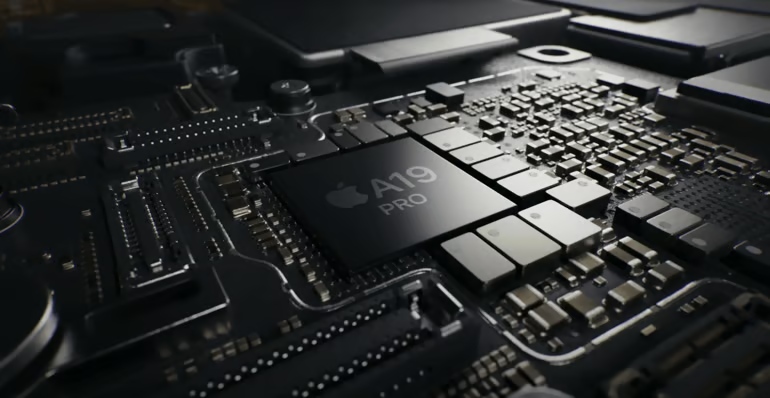
Inside the iPhone 17, you’ll find either the A19 or A19 Pro chip, which are Apple’s newest processors. Both are built on the 3-nanometer fabrication process.
These chips bring a 6-core CPU, 5-core GPU, and a Neural Engine for AI features, such as Apple Intelligence and the latest-generation Photographic Styles. Apple states that the current-generation CPU is 1.5 times faster than the A15 Bionic chip in the iPhone 13, and the current-generation GPU is more than twice as fast as the A15 Bionic. Modern smartphone games will run faster on the iPhone 17 thanks to those chips, Apple said.
A19 Pro includes a 6-core CPU and 6-core GPU, plus the same Neural Accelerator architecture as the A19 inside each GPU core. It makes it easy to run video games, edit videos, and work with large local language models on the device.
Camera features
Like its predecessor, the iPhone 17 has a dedicated Camera Control button. New this year is the Center Stage front camera, which uses a square front sensor to widen the field of view horizontally, even if the user holds the phone vertically.
Apple emphasized that not having to rotate the phone to reorient the camera could give the user more stability and control. When multiple people enter a group shot, the camera can automatically extend the field of view to include everyone.

The Center Stage camera enables:
- 4K HDR video.
- Dual Capture mode, which uses the front and rear cameras at the same time.
The iPhone 17 Pro and Pro Max increase the optical zoom to 8x.
Apple Intelligence and iOS 26
iOS 26 is the successor to iOS 18, which might be confusing to some users. Apple recently changed its naming scheme for its new operating systems to reflect their release year, which is why iOS 26 is the successor to iOS 18.
Apple Intelligence, its generative AI and machine learning features suite. Apple Intelligence can now translate between languages in Messages, FaceTime, and Phone.
Visual intelligence lets users launch internet searches right from images on their screens. Developers can leverage the on-device foundation model, enabling certain AI app features to operate offline.
iOS 26 also brings the Liquid Glass design language. Users will notice a small but meaningful change in how games are organized with the addition of the Apple Games app.
Sustainability
Apple said the design of the iPhone 17 aligns with its commitment to carbon neutrality by the end of the decade. The device includes:
- 30% recycled content.
- 85% recycled aluminum in the enclosure.
- 100% recycled cobalt in the battery.
In addition, it is manufactured with 35% renewable electricity, the company said.
The iPhone 17 Pro and iPhone 17 Pro Max are manufactured with 40% renewable energy and 100% recycled gold plating in the circuit boards, as well as 30% recycled content overall. The cobalt in the battery is 100% recycled, Apple said.
More features of the iPhone 17 and iPhone 17 Pro
New accessories include:
- Clear Case with MagSafe charging.
- Silicone Case with MagSafe charging.
- Crossbody Strap.
- TechWoven Case with woven fabric (for iPhone 17 Pro and Pro Max).
Apple said the iPhone 17 provides “all-day battery life.” Power management built into iOS 26 helps optimize battery use with Adaptive Power Mode, which draws on contextual information about the user’s interaction patterns.
The iPhone 17 Pro Max has the best battery life yet in an iPhone, lasting up to 39 hours of video playback.
What are the differences between the iPhone 17 models/newly announced models?
| iPhone 17 | iPhone 17 Pro | iPhone 17 Pro Max | |
|---|---|---|---|
| Capacity | 256 GB 512 GB | 256 GB 512 GB 1 TB | 256 GB 512 GB 1 TB 2 TB |
| Size | Height 5.89 inches (149.6 mm) Width 2.81 inches (71.5 mm) Depth 0.31 inch (7.95 mm) | Height 5.91 inches (150.0 mm) Width 2.83 inches (71.9 mm) Depth 0.34 inch (8.75 mm) | Height 6.43 inches (163.4 mm) Width 3.07 inches (78.0 mm) Depth 0.34 inch (8.75 mm) |
| Weight | Weight 6.24 ounces (177 grams) | Weight 7.27 ounces (206 grams) | Weight 8.22 ounces (233 grams) |
| Display | Super Retina XDR display 6.3-inch (diagonal) all-screen OLED display 2622-by-1206-pixel resolution at 460 ppi 1000 nits max brightness (typical) 3000 nits peak brightness (outdoor) | Super Retina XDR display 6.3-inch (diagonal) all-screen OLED display 2622-by-1206-pixel resolution at 460 ppi 1000 nits max brightness (typical) 3000 nits peak brightness (outdoor) | Super Retina XDR display 6.9-inch (diagonal) all-screen OLED display1 2868-by-1320-pixel resolution at 460 ppi 1000 nits max brightness (typical) 3000 nits peak brightness (outdoor) |
| Always-on Display? | Yes | Yes | Yes |
| Chip | A19 6-core CPU 5-Core GPU with Neural Accelerators | A19 Pro 6-core CPU 6-Core GPU with Neural Accelerators | A19 Pro 6-core CPU 6-Core GPU with Neural Accelerators |
| Camera | 48MP Fusion Main 48MP Fusion Ultra Wide 48MP Dual Fusion camera system with optical Zoom up to 2x 18MP Center Stage front camera Center Stage for photos Ultra-stabilized video Dual Capture video Spatial photos | 48MP Fusion Main 48MP Fusion Ultra Wide 48MP Fusion Telephoto 48MP Pro Fusion camera system with optical Zoom up to 8x 18MP Center Stage front camera Center Stage for photos Ultra-stabilized video Dual Capture video Macro photography Spatial photos ProRAW | 48MP Fusion Main 48MP Fusion Ultra Wide 48MP Fusion Telephoto 48MP Pro Fusion camera system with optical Zoom up to 8x Macro photography Spatial photos ProRAW |
| Battery | Up to 30 hours of video playback Up to 50% charge in 20 minutes | Up to 33 hours of video playback Up to 50% charge in 20 minutes | Up to 39 hours of video playback Up to 50% charge in 20 minutes |
What’s the target market for the iPhone 17 line?
The target market for iPhones is typically users with smartphones that are a few years old. A two-year refresh cycle is typical for iPhones. The longer the wait to upgrade, the more dramatic the improvements appear, and Apple provides comparison data going back to the iPhone 13 to show how much more power the current generation contains.
However, iPhone 16 series or iPhone 15 Pro/15 Pro Max — the first models to feature Apple Intelligence — may not see a significant difference and may find limited value in upgrading.
How much does the iPhone 17 cost, and when will it be available?
The iPhone 17 is available starting at:
- $799 for the 256GB model.
- $999 for the 512GB model.
The iPhone 17 Pro is available starting at:
- $1,099 for the 256GB model.
- $1,299 for the 512GB model.
- $1,499 for the 1TB model.
The iPhone 17 Pro Max is available starting at:
- $1,199 for the 256GB model.
- $1,399 for the 512GB model.
- $1,599 for the 1TB model.
- $1,999 for the 2TB model.
The iPhone 17, iPhone 17 Pro, and iPhone 17 Pro Max will be available for preorder on Friday, Sept. 12.
Users in more than 63 countries and regions — including Australia, Canada, China, Colombia, France, Germany, India, Japan, Malaysia, Mexico, Singapore, South Korea, Thailand, Türkiye, the UAE, the UK, the U.S., and Vietnam — will be able to place orders.
All three models will be available on store shelves on Friday, Sept. 19. At that time, the smartphones will be purchasable in 22 additional countries and regions that were not eligible for preorders.